Saturday, March 8, 2014

The Cramped Canals of Xitang


Xitang is sort of the epitome of a tourist town in China.  It is the place that all the people in the larger cities in Zhejiang Province (and surrounding provinces on the east coast) go to visit.  It's sort of like the Renaissance Fair of China, and like Renaissance Fairs, it is a mix of the authentic, the unauthentic,and the trying to recapture the authentic.   But I'll spare you my rant on Renaissance Fairs and skip right to Xitang.

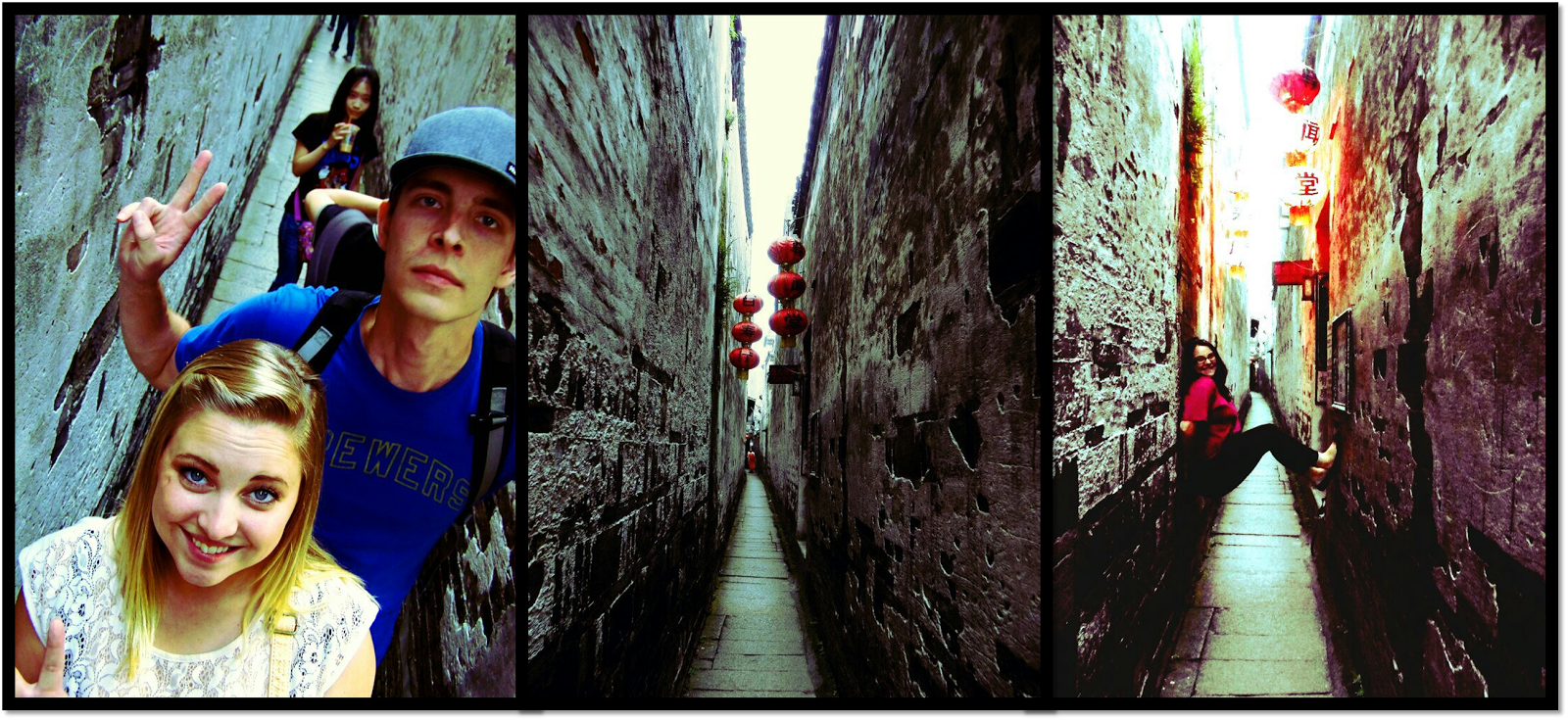
Like Fenghuang, Xitang is a canal town with old-style architecture.  Unlike Fenghuang, Xitang is much smaller, lacks those cool stilts, and has sort of a different attitude.  While the native population of Fenghuang seemed to enjoy working and living in this tourist area, the people of Xitang were quite obviously over it.  Xitang is also quite small; it's streets compacted into a very tiny area, meaning you can see pretty much all there is to see of Xitang in a day.  These narrow streets are actually what Xitang is most famous for; some of them are barely wide enough to fit down; your shoulders occasionally brushing the edges of the most narrow pathways.   However cool these tiny pathways are, when you try to cram the multitude that swarms to Xitang during peak tourist season into these tiny pathways....well, you get over Xitang really quickly.  It's a lot of being crammed uncomfortably close to hordes of strangers trying to push their way through in both directions along a path that is just a little wider than your average side walk.  Add in summer heat, and its a tad uncomfortable.

Check out those narrow streets!

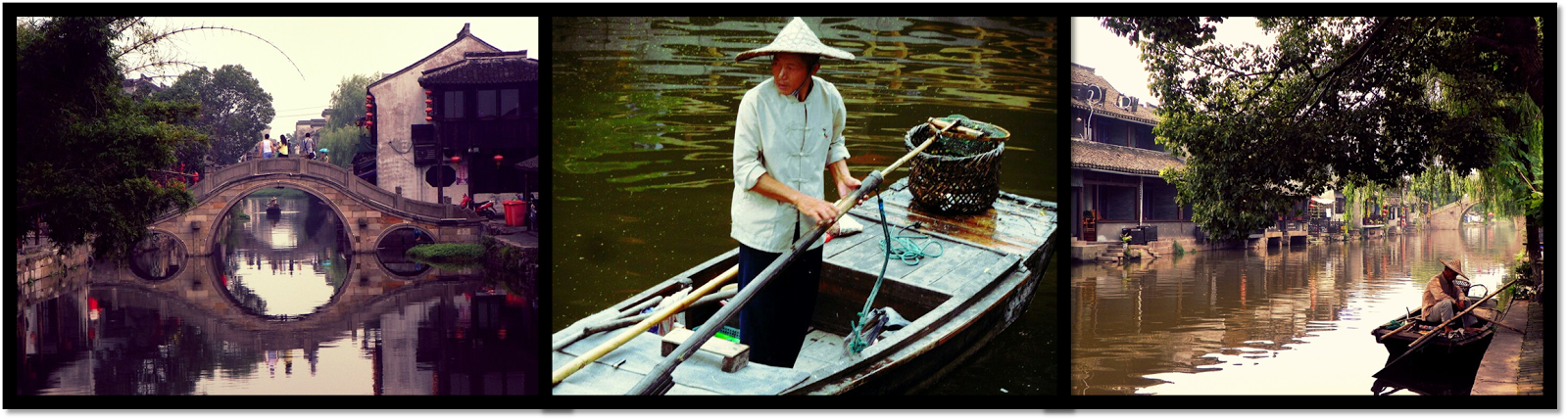
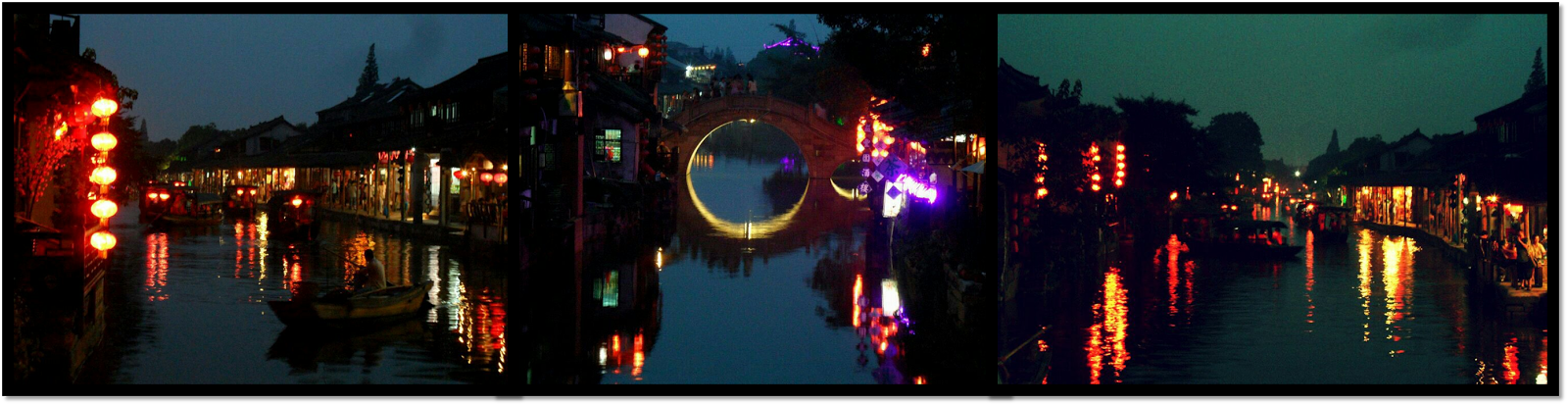
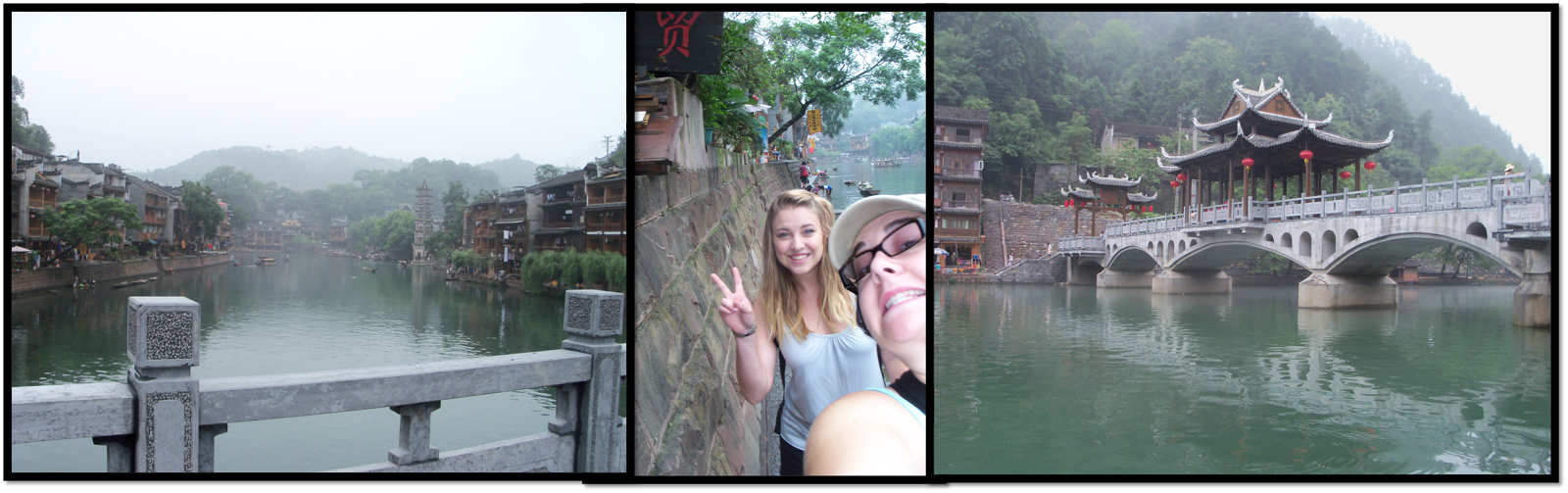
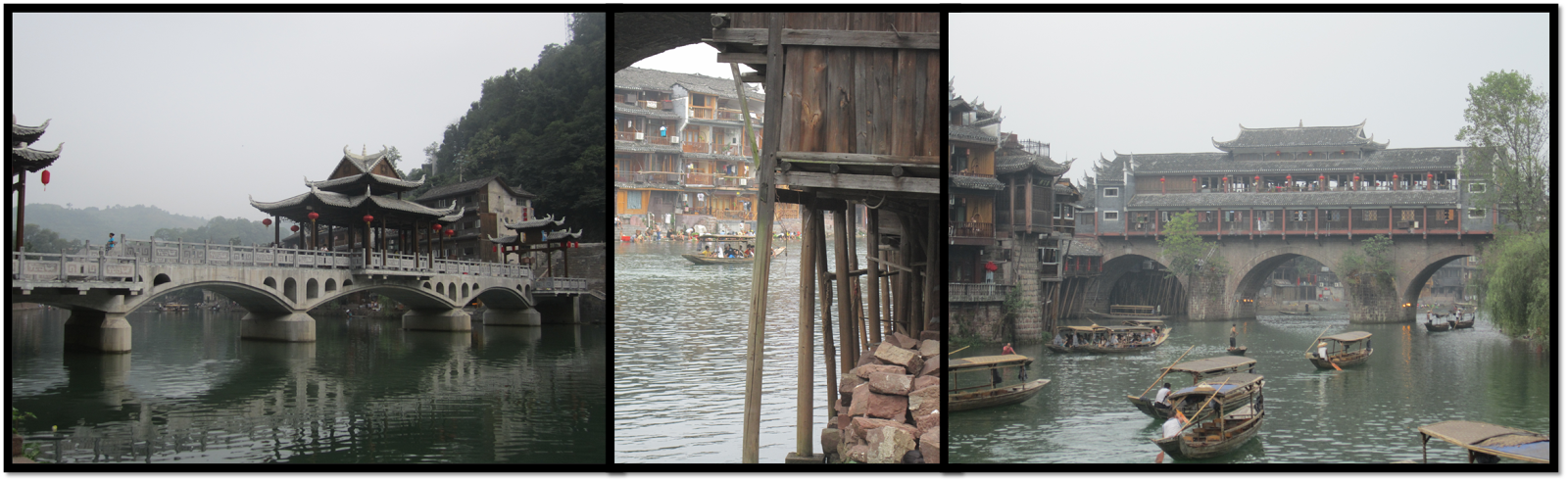
That being said, if you are in Zhejiang province, I would still go and see it.  They have some really beautiful stone bridges along the canal--those beautiful curved ones, and when the water is still (which it typically is, being a canal) you can see the bridge reflected in the water.  They also have these guys rowing down the canal.  I have no idea if they are actually working on cleaning up the canal, as you can occasionally see them fishing stuff out of it, or if they are there solely to enhance that old-time feel of the place.  There are also larger boats if you are feeling like cruising down the canal, you can take a boat ride.  At night the tourists buy and then light hand made paper-boats and float them down the canal and lanterns are strung up across buildings. The pictures of the canal and the architecture, and the bridges are totally worth a trip to Xitang...I just wouldn't stay for more than a day or two....and I wouldn't go back.

Boat and such. 
Night shots!
Another neat thing to do in Xitang is the shopping.  Almost all of the buildings along the streets are stores or restaurants of some kind, and Xitang does provide some neat shopping opportunities that you don't typically find in the big cities.  So if you are looking for some quirky folksy stuff  (though many places here do not barter), shopping here can be fun.

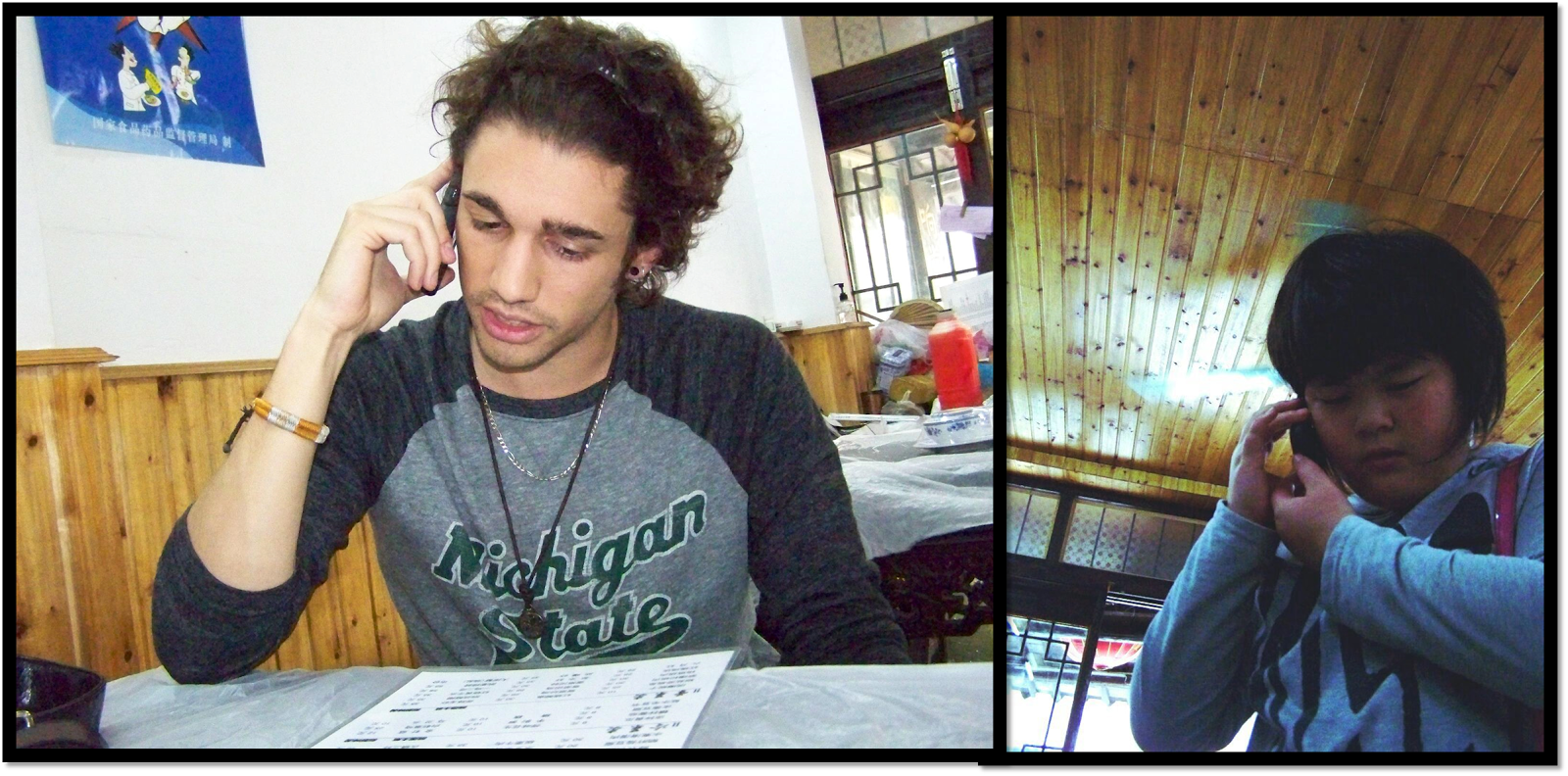
Restaurants here are also an adventure.  Since you are in a smaller city (but still large by American standards) many of the menus have a limited (if any) picture menu.  So if you are not feeling any of the dishes on the picture menu, and you only have a few dishes memorized, you might need to take some risks.  That is what I did; I assumed the cheapest items on the menu were the vegetables, because in my experience that is typically true.  So I pointed at dish entirely in Chinese characters, but only six yuan...it turned out to be snails.  Which we ate and were quite good, but if snails are not your thing, I would stick to the picture menus...or go into a crowded restaurant and just point to dishes other patrons are eating and say "I want that.". Like I said, Xitang is a pretty small historic district located in a fairly large city...so if you can't find something to eat here (and they have hostels and American-style bars that sell familiar food in the historic district as well) you can venture outside of the historic section and go find a KFC.  But be careful, they sometimes will make you pay (50 yuan) to get back into the historic section if you leave, particularly during peak tourist times, and if you cannot find your ticket stub.   You can actually avoid the ticket price all together if you stay at one of the hotels or hostels in the district; many of them have a front door that it outside of the historic zone and a back door that opens into it; if you stay there, you do not need a ticket as long as you exit and enter through you hotel/hostel.

This is Justin on the phone with his girlfriend, who is Chinese....and then our waitress on the phone with Justin's girlfriend.  We are trying to figure out our menu. 
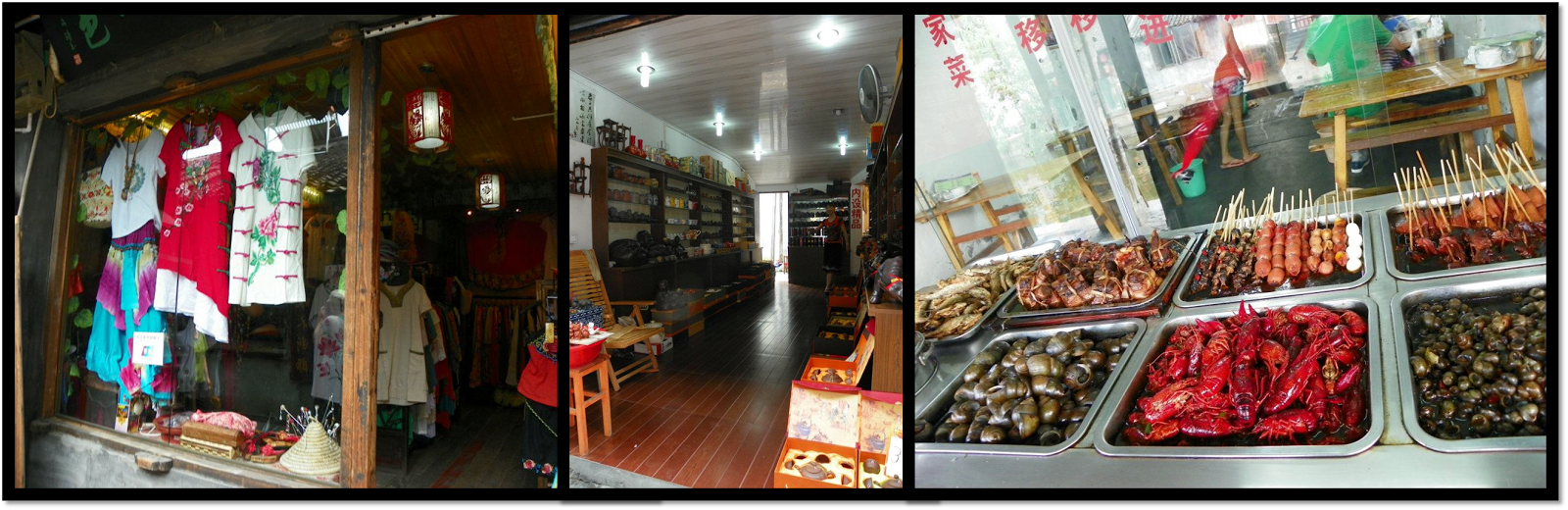
To the left and center are a clothing store and a tea shop, to the right is some street food. 
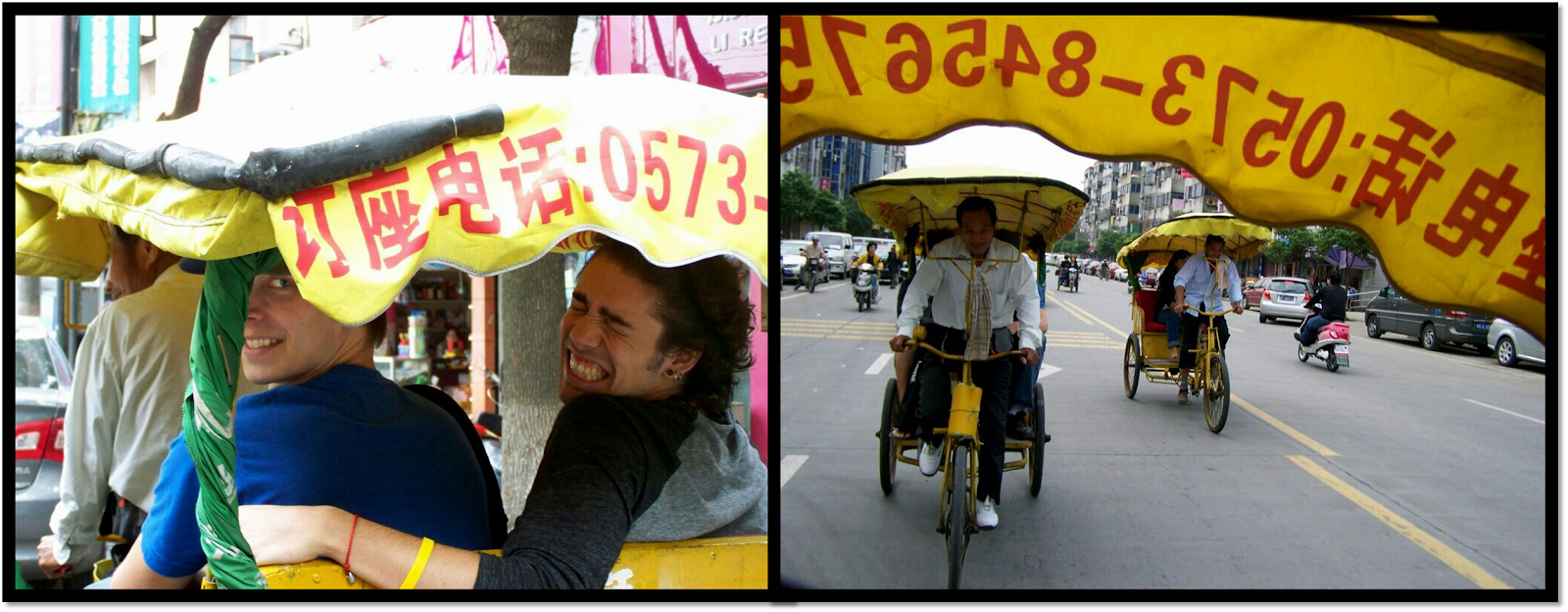
Xitang has the honor of being the first place that I traveled to after arriving in China.  During National Holiday Week Justin, Liv, Zach, and I made the quick three hour bus ride from Hangzhou to Xitang.  From the bus you take a rickshaw a short distance to the historic center.  We stayed in a room above the bar--and were really glad that it was still warm and dry weather, because that place was not what I would consider insulated.  We spent about 36 hours in the town exploring, shopping, eating, and taking ridiculous pictures.  It was a really nice, short trip--a good first foray into travel. Of course, being my first adventure, everything was new and shiny and awesome.  I took a friend who visited me to Xitang a little over a half year later, and while she enjoyed the novelty of the place (though not the crowds and the heat) I found myself less impressed with Xitang than I was the first time.  So while I recommend visiting the place, I don't recommend going back for a second visit.

Rickshaw Rides!
I come down kinda hard on Xitang here, but it really is a great place to visit...just not necessarily to revisit.

Many of these very pretty pictures are courtesy of Dr B, who I dragged through these crowded streets in the height of sweltering summer weather.

Thursday, March 6, 2014

Critical Thinking and Speaking--Debates


So, as I have mentioned in some of my other posts about teaching in China, my second year I was given a couple of new courses.  Cross Cultural Reading, which I discussed earlier in the this blog, and the other course was called Critical Thinking and Speaking.

This was not really explained to me in great depth, but I was told that it was supposed to focus on improving critical thinking and both offer more opportunity for oral speaking and also improve their oral speaking skills.  So it was kind of like Oral Speaking through Critical Thinking.  Or vice-versa.

As I have also mentioned, the teachers were not given a great deal of direction (or limitations) in how to go about teaching these courses, and since this was my second year, I was sort of excited (rather than terrified) to be designing these courses with only minimal direction.

I decided to focus the course around argumentative speaking and writing.  I cut the course in half, with the first half of the year focusing on debates (which is what I am going to expand upon in this post) and the second half of the year focusing on argumentative speeches (both writing them and delivering them).   Having never really taught or participated in a formal debate, I spent my summer doing some research into how best to approach teaching debate.

During my first class, after we went over the syllabus and my expectations, we brainstormed some controversial topics, both in China and in the rest of the world.  We came up with a list that included the one child policy, drunk driving, mandatory morning exercise for college students, cell phone usage in schools, mandatory dorm inspections, having English majors take every class in English, dating in college, school uniforms, working while in school, online shopping, and the use of social networking to name only a few.

I received a less than enthusiastic response to the idea of debates, but in class I didn't really think anything of it--my students do not particularly like projects that single them out in front of other students and ask them to speak (I think very few people actually enjoy this).  However, later that night I received a phone call from my professor (who got me this teaching job) telling me that she had received several emails from the students, each of them very nervous about doing debates.  We talked for a while to see if we could figure out the root of this problem.  It turns out they had another class in the previous year that featured debates and they were very frustrated by this class.  They did not succeed in this class, and they were afraid of failing at debates again, especially if debates made up half their grade for the course.  However,  I assured her (and my students during our next class) that I would be very explicit in explaining how our debates would be carried out, what my students would need to do to succeed, and how I would be grading them.   This seemed to calm my students down, however I could tell they were still a little apprehensive.

I used this website in my research on how to construct a debate.  I separated the class into groups of three.  Each week, two groups would debate against each other over one of our pre-approved topics (and a couple I threw in there to mix things up bit).  The groups debating and the topic given to them would be assigned by me the week earlier--both groups would have a full week to research, prepare, and practice for their debate.  The class would determine the winner by determining which group provided the best and most compelling argument--well presented, logical, back by fact/examples, and persuasive.

Of course, I didn't just throw them into this.  We spent a whole class doing "practice:"debates.  We began by looking at the different kinds of information in each argument--the claims, the examples, and the persuasive language.  Claims being your argument.  For example:  "The one child policy is bad because it leaves all the financial burdens for caring for ones parents on the shoulders of one individual."   This is a good claim because it clearly tells the positive or negative (in this case, negative) and lists a concrete reason why one-child is bad.  The examples to support this claim would be specific data from credible sources that support the financial burden of the one child policy on only children.  A possible example of a specific, fact-based example could be

" In China, the percentage of the population over the age of 65 years was 5 percent in 1982 and now stands at 7.5 percent but is expected to rise to more than 15 percent by 2025.28 Although these figures are lower than those in most industrialized countries (especially Japan, where the proportion of people over the age of 65 years is 20 percent), a lack of adequate pension coverage in China means that financial dependence on offspring is still necessary for approximately 70 percent of elderly people" (Zhu, Wei Xing,, M.P.H, Lu Li, M.D., and Therese Hesketh, Ph.D. "The New England Journal of Medicine." The Effect of China's One-Child Family Policy after 25 Years — NEJM. New England Journal of Medicine, 15 Sept. 2005. Web. 03 Mar. 2014.)

The student would then back it up with a few more similar examples relating to financial burden on children and the One Child Policy.  It is also important to remind them to only make one claim at a time.  So if they are talking about the financial burden, do not also talk about female infanticide, and do not provide any examples that do not specifically relate to the financial burden of the one-child policy.  One claim (or argumentative point) per person, backed up with examples.   The final part of the debate is using persuasive language.  This is a mix of how you present the data in the claim and examples as well as providing personal or anecdotal examples.  For example, after the hard (factual) evidence, you can encourage your students to say something like this: "Imagine being barely 30 years old, starting your family, still working your way up in your career, paying of debt from school, and trying to make ends meet while also finding yourself caring for your retired parents.  How will you manage?!"

Our practice debates were on fairly common topics, and I provided short readings so they could give concrete examples during their practicing without having to waste too  much of our limited class time on research.  We  made claims together, searched out facts, and practiced using persuasive language in whole group and small group.

When the debates began, the first person of the group launches their opening argument.   I usually began with the affirmative side, the side that was in favor, or defending, whatever our particular argument for that day was. So, for example, if the topic for that day was the One Child Policy, the people in favor of the policy would list their first claim backed up by fact-based examples and anecdotal evidence.  Next, the group who disagrees with the argument , or the negative team, lists their first claim and supportive evidence. So the person speaking would only mention one claim (or point in their argument) per turn, with evidence.  When one team is speaking, the other team is taking notes.  When two people from each team have spoken (both groups have introduced their two most compelling claims with evidence), I give them 5-7 minutes to compare notes and formulate their rebuttal.  Each group is then allowed a rebuttal, where they defend their position by providing counterarguments to the claims the opposite team had introduced.  When both groups have moved through all three parts of this debate, the teams leave the classroom, and the rest of the class then determines the winner, with the teacher as tie breaker.

So this is a visual I provided for my students on how the debates were going to look each time.  I have found with any student, but especially EFL students, it is good to provide visuals when possible.  This also helped me keep myself organized. 
I also created a rubric for assessing each group as they debated.  This would help our class determine the winner of the debate, especially if the debate was close.  These were collected and used as a participation grade.  Students were graded on individual contributions /performances in their in-class debates, as well as how they worked as a group--did each member's argument flow from on member to another?   Did it feel as if they worked together or just did their parts individually and wing it? Did each team's rebuttal address the points made by the opposing team and provide compelling (and fact-based) counterarguments?  On an individual basis: were their debates logical and fluid (claim, examples, persuasive language) and focused?  Each team debated once during the first half of the semester and their midterms were debates.  Throughout the semester, we worked on body language during a performance, persuasive language, and how to make our argument stronger.  In retrospect, I could probably have spent an entire semester on this, perfecting their debate skills.

While some of my students retained a steadfast dislike of debates, most of them grew to understand and tolerate them, with a handful of them actually enjoying it.  All of them improved the ability to craft an argument in a formal debate, and improved their critical thinking skills.   Debates take a long time to set up if you want to maximize student learning and really learn debates.  We didn't start actually doing the official debates until the fourth class--the first three classes were all "how to" classes, and throughout the remainder of the semester we learned ways to improve our debates for our midterms.  I think modeling exactly what I expected of them, and being very clear about my expectations eased some of their anxieties about debate.  I actually had a lot of fun teaching debates, and what we learned in terms of formulating an argument for a debate segued nicely into the second half of the semester: argumentative speeches.  We also began turning debates into argumentative speeches in the first half of the semester, after each debate.  We would learn about the purpose, how to craft introductions, theses, body paragraphs, and a conclusion.

Not only do debates improve critical thinking, but it also improves authentic oral language--students cannot fully memorize responses to a debate; the other team might throw out an unexpected response, and they will have to craft a spontaneous response, using their knowledge of English rather than relying on memorization. During the rebuttal, they have to synthesize what they have learned from the opposite team in order to create a logical rebuttal that addresses the opposite teams initial claims (arguments).  They should, having researched the topic, have some knowledge of the counterargument, they cannot fully prepare for what the other team is going to discuss,and they must craft this language in the 5 minutes they are given to prepare the rebuttal.  I have found that many times Chinese students seem to rely heavily on memorization, and this forced them to rely on it somewhat less.  I found it a good way to begin a class on argumentative speeches, but admit that the whole course probably could have centered around debate.  In a later post I will talk about the speeches we wrote and delivered.

Monday, March 3, 2014

Fenghuang: Phoenix Town


So I realize that I have actually posted about our Summer 2012 Epic in reverse chronological order. We went from Hangzhou to Fenghuang to Zhangjiajie to Xi'an and then back to Hangzhou; my blog posts, however, actually take you in reverse order.  So I figured I would make this reverse journey complete and finally post about our first destination, a lovely little canal town called Fenghuang, which translates to Phoenix (which is apparently what they call peacocks--which in my opinion makes peacocks sound even more awesome then they already are).

So, before I get to Fenghuang, let me talk a little about the planning of Budget Tour.  Liv and I decided that we wanted to see more of China, and that we wanted to do it without spending a lot of money (Chinese income + American debt = not so much disposable income).  Thankfully, China can provide just that kind of travel experience for those who are willing to be a bit more adventurous and spend a few hours in less than ideal travel conditions.  However, neither of us had any concrete idea of what we wanted to see in China...Liv was more interested in seeing some natural wonders, and I was interested in seeing the Terra Cotta Warriors--and other historic kinds of architecture.   So we decided to do a trip that was half man-made, half natural wonders.  The planning of this trip was largely placed on Liv's very capable shoulders.

After a couple of weeks of flipping through the Lonely Planet: China Guide, plotting out different potential sites along a very general path (starts in Hangzhou, ends in Xi'an), we came up with a game plan.  (And by 'we', I pretty much mean Liv--she contacted most of the hostels, figured out all the trains and buses, and wrote down all our information in English and Chinese).  Our plan was to go from Hangzhou to Fenghuang, from there onto Zhangjiajie, and then finally end up in Xi'an before heading back home to Hangzhou.  We would do this by taking the cheapest, or next to cheapest, trains available, and we would be staying in hostels.

Before I get into the lovely Fenghuang, let me tell you a little bit about China's train system.  China has fantastic public transportation.  We opted for one of cheaper trains which took us from Hangzhou to Fenghuang in about 21 hours.  This was not a sleeper car, although we tried our hardest to get sleeper cars on as much of this trip as possible--they get booked up pretty fast, so we actually only managed a sleeper for one leg of our journey.  Our trip included a lot of sitting upright and being smooshed together for long periods of time--our trains rides were all between 21 and 27 hours long. It was often uncomfortable.  But this trip was 1,000% worth it.  Liv spent a lot of time sleeping, I read Game of Thrones, and we both honed our card game skills.

Pretty stoked for the first leg of our journey!  And yes, those trains are just as crowded as they look.
Our glamorous travel.  The pic on the far left is a man selling legs of chicken out at the train window while we were stopped at  station. We were very confused. 
It should also be noted that this trip was our first big solo adventure.  What I mean by that is that we did not have anyone with us who had been in China for many years and who spoke Chinese fluently.  We also did not just fly into the city with the only travel concern being our taxi from the airport to the hostel and back.  This was pretty hardcore, and we were pretty much all on our own--for two full weeks.  And we planned this trip without too much advice from our China-expert friends.  So there were a few moments during this trip (mostly during transitions between locations) that were a little bit scary.

But hey, what's an adventure without a little nerves, am I right?

Maybe you can see why we were a tad nervous at times...
We arrived in Fenghuang in the middle of the afternoon. The touristy part of this town--the sections along the river, with the notable stilt homes, is not very large, and it did not take us more than about 10 minutes of wandering through this touristy section to locate our hostel. (Although it did take a few minutes to locate the touristy part of Fenghuang--this was one of those slightly scary moments).  It probably took us longer than it should of to find our hostel, because we were (despite a considerable lack of sleep) distracted by what we were seeing...but I'll get to that in a minute.

We found our hostel (cute and kind of off-beat--following the pattern of hostels in China) and checked in.  Our hostel was fine, although since the whole town is wedged along this river, our hostel was a tad on the damp side.  And our whole bathroom was the shower, with the toilet (a squat toilet--which is unusual for hostels) that served as both a toilet and a drain for our shower. The bathroom was unpleasant.  But the rest was clean and comfortable, and so we were pretty happy.  We dropped off all our stuff, and headed out the door to explore a bit and find food.   We walked a few doors down from our hostel and ordered a really early dinner (it was probably about 3:00 pm).  We then walked around a bit, but we both sort of decided to wait to really sink our teeth into sightseeing until the next day, as we'd pretty much been awake for a full day.  Thus, we walked back to our hostel and passed out around 6:00pm.  We slept for a good 14 hours. Sadly, I have no pictures of this hostel.

The food of Fenghuang. Sooooooooooo Good. The pics at the end are these wonderful egg pockets they make. Like the world's greatest egg McMuffin.
Having turned in so early the day before, we were wide awake by about 8:00 in the morning.  We ate breakfast at our hostel (an indulgence that I engaged in at almost every hostel I've ever stayed at--they offer good old fashioned American breakfasts), bought a tourist map of Fenghuang, and then hit the town.

Our first morning in Fenghuang.
This town is cute, and different from other canal towns I have been in.  First, it's larger than some of the other canal towns, which means you are not just walking around the same four streets. It also means that you are not fighting against streams of thousands of people through this itty bitt touristy town.  Additionally, the stilt architecture was new (not something I had seen in similar towns) and made for some really cool views of the river, with this hodgepodge of buildings jutting out over the water.  Many of these homes, hotels, and restaurants had balcony seating looking out over these rivers. Finally, since Fenghuang is somewhat further off the beaten track, being all the way in Hunan Province, it doesn't have that sad, overused, over-hyped quality to it.  And the people who lived there didn't look miserable because they were not constantly being packed with tourists.  I mean, there were a lot of people there, but it wasn't so packed you were fighting to get through some of the narrower streets.  And is just had an altogether different vibe.

Some  scenic shots of Fenghuang.
Some More!
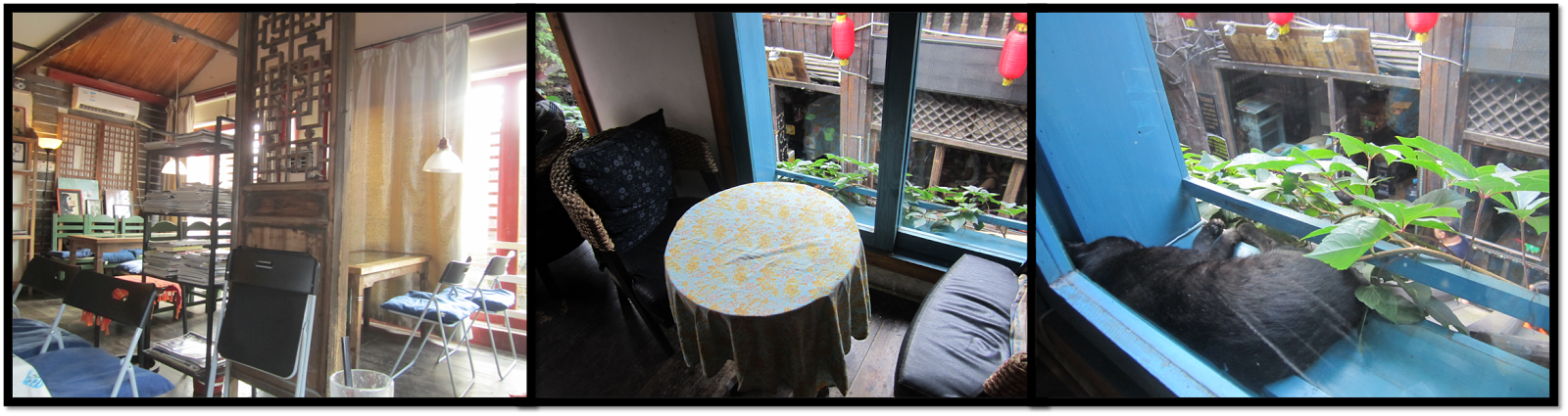
As a tourist to the town, you could walk along the river, take pictures, wade into the stream, or take a boat ride up and down the river.  On the streets that did not run directly next to the river, you could find little shops selling every possible kind of souvenir and trinket.  There were also several other restaurants, hotels/hostels, and even a few nightclubs.  We stumbled upon a really great little cafe whose name had something to do with birds--Sparrow Cafe? Swallow Cafe? We indulged in properly made coffee and pizza (both were sort of hit or miss the further away from big cities you got).  We visited this place a couple of times...until the police came in right when we were about to leave and shut it down because the boss didn't pay their rent that month.  Whoops.  Liv also got locked in the bathroom for like a solid 15 minutes; the lock was screwy and would not unlock, despite banging, wiggling, and yelling.  But they had this really cute friendly cat! And pizza!!

Swallow Cafe...or something. It was wonderful.
So what is it exactly that is so appealing about Fenghuang?  It's one of those towns that has preserved an older form of architecture (preserved, and rehabbed), and it is located in the middle of an otherwise modern city.  The stilt architecture means that the structures along the river jut out in a hodgepodge, yet still appealing way, creating a really interesting harmony between man and nature.  There are no cars or mopeds through this older section of the city, which is a nice change from the rest of China. You can get some common, and not so common, trinkets from the many vendors around the town, and as someone who had never been to Hunan province before, you can try some new kinds of food.  I highly recommend being adventurous with the food in this province--it was really good.  Even the street food--we had these fried egg pockets for breakfast one morning that were amazing. 

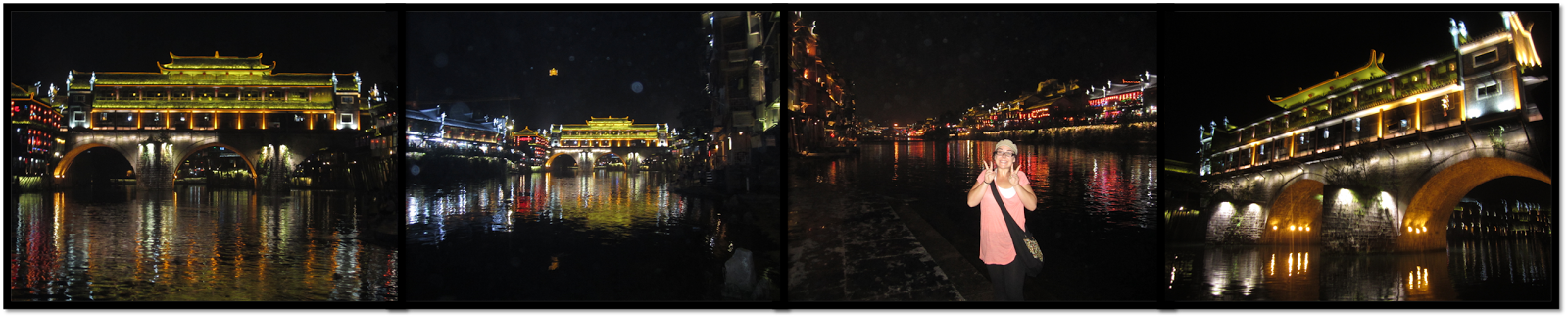
Fenghuang at night.
We stayed in Fenghuang for about a solid two days before catching a bus and heading to Zhangjiajie.  During that time, we spent a lot of time walking, snapping pictures of those cool stilts (and being asked to be in other people's pics, of course), eating local food, and in general just relaxing.   Both of us had just had friends and family visit us from home, and while that time is precious, it can also be exhausting.   So just chilling next to a river, reading a bit, and drinking coffee was an excellent and relaxing way to begin Budget Tour--one of the most epic trips of my life.


For other stops on this epic trip, check out here, here, and here

Monday, February 17, 2014

Ba-What Now?


So, if you have been following this blog, you know I was offered a job to teach in the Kingdom of Bahrain when I attended a job fair in January, and that I accepted said job.  Now, being Americans (coupled with the fact that Bahrain is like, this itty bitty country), not many people know about this country, or where in the world it is located.  So you might be thinking, as many do...Ba-what?

Naturally, when I tell people I am going to Bahrain, their first question is, "oh, and where is that?"  To which I get to respond with, "Oh, you know, in the Persian Gulf...right between Saudi Arabia and Iran."   To which there is usually a nice, looooong, pause.   This pause is usually filled with warring emotions; excitement for me (I have great friends) that I am going to be teaching full time in another country, and concern for my safety.  Because the region is not generally considered safe (thank you CNN).

The purpose of this particular blog post is to tell you a bit about the Kingdom of Bahrain, both in my own words, and by providing a whole bunch of helpful links.

Bahrain is its own country and is governed by a constitutional monarchy.  So there is a king, just like England has a queen.  However, I believe that in Bahrain (unlike England) the king is more than just a figurehead; he is an active and vital part of the governance of this country.  I also think the constitutionality of said monarchy is somewhat more fluid, depending on the political climate.

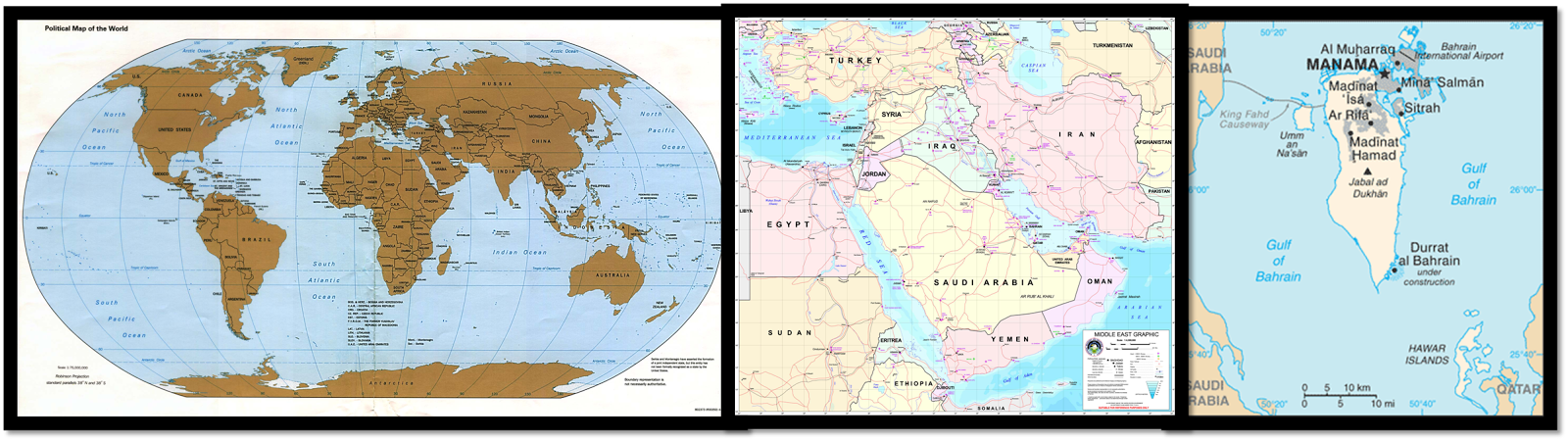
Bahrain is, as I mentioned, a tiny country, consisting of one large main island, and several smaller islands.  I believe you could drive around the whole of the main island in about an hour; it is 34 miles long and 11 miles wide.  It is so small, in fact, when I was trying to show my students at one of my schools where it was on the map, the island itself is not shown; rather, a triangle where the island should be is situated in the Persian Gulf.  The weather in Bahrain is what I am both excited and nervous about.  I currently live in a very cold region of New York State--as I type this it is -9 degrees Fahrenheit.  This is, in my opinion, colder than the Earth has any reason to be.  One of my requirements for my next teaching position was that it simply does not snow.  Well, Bahrain fits the bill perfectly, with temps only reaching a low of about 60 degrees Fahrenheit in January, the coldest month of year.  However, New York is quite lovely in the summer, with temps averaging in the low 80's, with only a few weeks of moderately uncomfortable humidity.  Bahrain can get to be over 100 °F in the middle of the night during its warmest months (July) with 100% humidity.  China was hot, but not that hot.  Nonetheless, I am so tired of cold, I think my desire to get out of the cold far outweighs my trepidation of the heat and humidity.

Where in the World is Bahrain?  Left, world map; center, map of Middle East; right, map of Bahrain.

But what about safety is what many people are thinking, as even the most CNN-critical people still ask.  I mean, the news has got to be getting that alarming data about the Middle East from some where, right?  I am not trying to make light of my safety, but Bahrain is about as safe as I would be anywhere else in the world.  It is no more or less safe that it would be for a lone woman in New York City or Madrid or London, and you would use the same precautions you would use in any large city around the world.   There have been protests in certain districts in the capital, and I will be living in the capital, but you avoid the protests, on the off chance they become violent, and you will not be anywhere near them if there is an issue.  Bahrain's economy is not only stable, but it is thriving, and it enjoys peaceful relations with it's neighbors.  Bahrain also has a working relationship with the United States and hosts a U.S. Navel base on the main island.   Yes, it is in a region of the world that Americans generally view as hostile, but we are not talking about Baghdad. 

Since Bahrain has very strong international political and economic ties with the United States and the European Union, an expat living in that country is able to find many familiar products.  Since they are imported goods, you'd pay more for them then you would in America, but they are still readily available (and this price hike is something I am used to--sour cream and onion Pringles were about 5$ a can in China).  There is a host of familiar grocery stores, banks, restaurants, and products available in Bahrain.  In addition to having these international markets, Bahrain also has its own markets, where I am told bartering is welcome--and it's something I am looking forward to doing again.  These markets offer a wealth of goods at very reasonable prices.  So it looks like someone will be going shoooooooooooping.

Bahrain is not (like some of its neighbors) a dry country, although alcohol is not to be consumed in public (on the streets) but only in licensed establishments, such as bars, nightclubs, and restaurants. It is also an Islamic country, and while it is by no means as conservative as some of it's neighbors, I will likely be making a few adjustments to my personal wardrobe.  Bahrain does not require it's women to be covered from head to toe, but if you want to minimize cat calls from the locals, you are going to want to dress conservatively.  I am told this means shirts with sleeves of some kind, shirts that are not low cut, and dresses that make it to your knees--this is also what is recommended for professional attire in Bahrain.  However, there is no law that says I cannot skip about town, during my non-professional time, in a tank top and hot shorts.  It's simply not advised.  As my recruiter put it, "it is wise to be conservative when you arrive, and as people get to know you, you can make adjustments that are more in keeping with your preferences."  Kind of like making new friends--you are not 100% you; instead you are a politer, blander version of you until everyone gets to know each other better.  I am not going to lie though, my biggest area concern about this move is how it affects my wardrobe (I know, it seems sort of silly--but so is my love of leggings).  I am told pretty much anything goes when on a beach in Bahrain, as long as you are wearing something, and your attire hear depends entirely on personal or cultural preferences.

Of course, I have been reading quite a lot about the country over the past few weeks, and above is simply a summary of what I have been learning. If you want to know more about Bahrain, there are some links below.  Or you can Google it.

http://en.wikipedia.org/wiki/Bahrain
http://www.bahrain.com/en/Pages/default.aspx#.UwIlW_ldU1I
https://www.cia.gov/library/publications/the-world-factbook/geos/ba.html
http://bahrainguide.org/content/view/38/83/
http://www.expatwomen.com/expat-women-countries/expat-women-living-in-bahrain.php
http://www.expatwoman.com/bahrain/

Saturday, February 15, 2014

Nightlife in China: Clubs


Going out for a night on the town in China is a unique experience, and it was one of my favorite parts about living in Hangzhou.   A night out on the town usually meant either KTV or clubbing (or sometimes both). Now, I was not one for clubbing back in America, for several reasons.  One, I spent the majority of my formative years as an introvert, so getting dressed up, and being displayed on a dance floor (because clubs in America are basically just places to be seen) seemed like a really bad idea.  Two, I went to college in a really small town, and their idea of 'nightlife' are sketchy bars where you just sit around, listen to loud music, get drunk, and try to make conversation by screaming over the music.  Not that there is anything wrong with the bar scene, but it is a far cry from the nightlife in China.

Clubs in China, or at least Hangzhou, are considerably less pretentious.  They are even less pretentious if you are foreign, as in my experience foreigners tend to garner a lot of positive attention.  We have literally gone to clubs dressed as hipsters, rock stars, members of the Jersey Shore, and unicorns and have never felt awkward or insecure in our reception by management or the other clubbers.  If anything, we were welcomed with open arms.

So I don't have too many pics of clubs in China.  Photodocumenting was never on the top of my to-do list when I went out, but I did capture this night, as it was our hipster night out (we don't normally dress quite like this). 

Your average club in China is going to have a few key characteristics.  There will be a lot of tables, because most of the Chinese clubbers go to sit around, look pretty, and get drunk (kind of like the bar experience in America, but classier). Except unlike bars in my small college town, these places will also have a DJ, not just an iPod plugged into a sound system or a Goo Goo Dolls cover band. They will also have a dance floor, which can range from really small to decent.  However, it is okay if the dance floor is not huge, because like I said, the majority of the Chinese will be at tables, drinking, and kind of swaying the music around their table.  If you are at a foreign club (a club either owned or frequented by foreigners) then there is considerably more action on the dance floor. The majority of clubs in Hangzhou are also also really nice.  I am not talking about a sketchy little hole in the wall here people (for those of you familiar with SUNY Oswego, this is  not Toucans or Club Crystal).  The clubs--many of them, anyway--are really nice! Like, stepping into a music video kinda nice.  Like watching a clubbing scene from a movie kind of nice.

And if I haven't sold you on these clubs yet, here's another thing.  Many of the bars around the clubs have nights like "lady's night" (sorry gents) and ladies drink cocktails from 8 to midnight...FOR FREE.  So you go to a bar, get however drunk or tipsy you want, and then you hit those clubs.  It's like a system invented by geniuses...or college students.

So let  me set the scene a little for you.  You walk into the club (there is no cover charge) you walk up to a service desk where you can check your coat and bag if you wish--for free.  You slip the coat check ID tag around your neck or wrist. You can hear the distant pulse of the music from the other room, and the beat starts to thrum through your entire body.  You then walk into the club proper, where the music pretty much takes up residence inside your body; seriously, it's like the music becomes your heartbeat and  your bone marrow.  You make your way over to the bar, maybe order a drink, and wait until the DJ played a song you know.  As soon as that familiar beat starts playing, you push your way onto the dance floor (depending on the club your were in, it is either empty or packed) and dance until you need to sit down because your feet are killing you and you can't breathe.


A really nice thing about clubbing (and almost everything) in China is that is very safe.  You can go with just you and a friend or just a group of girls and you will be totally fine.  The only club I have ever felt a little threatened in was in a club that was owned, operated, and frequented by foreigners.  Chinese men tend to be wary of women, in a respectful sort of way.  I am not saying they are never inappropriate, but it was rare for one of us to feel threatened by a Chinese man at a club.  It was typically another foreigner who would make us feel uncomfortable, and I think this is largely due to the different cultures and cultural norms represented in these clubs.  People from all over the world come to China to work or study; throw these different cultures into a nightclub, add a little alcohol, and sometimes it got uncomfortable.  Whenever it did, we would leave, and either go to another club (a Chinese owned and operated club) or head to KTV or home. If you are going to visit China (especially in one of the bigger cities on the east coast) and you are having any reservations about it's night life--don't.  I mean, use your head, but don't be over anxious about it.
 
So hipster it hurts. 
Many of the clubs are located in various clubbing districts, so if one club is not playing the music you feel like listening to (or some of the other foreigners are getting handsy in a way you are just not feeling), there are three to five clubs in the immediate vicinity you can walk to and check out.  You can take a taxi to one of the other clubbing areas to check those out as well.  I recommend a taxi for a distance of more than a few blocks; China is safe, especially eastern China and especially if you are foreign, but if it is just you and a couple of girlfriends, why take chances?  Going out to clubs in China was one of my favorite weekend activities; it was a good way to cut loose, relieve some stress though dance, and have a good, safe time.  If you get tired of dancing, you can go sing KTV--they're everywhere.


I live in a small town in New York and I miss Hangzhou's nightlife.


Friday, February 14, 2014

The Foreign Phenomenon


Being a foreigner in China is a unique experience, and one that will vary depending on your country of origin, what you look like, where in China you settle, and what it is that has brought you to China.

The fact that you probably don't look very Chinese, makes for a very interesting experience being a foreigner in China.  In some ways, being foreign in China is a lot like being Lady Gaga in the middle of Iowa; you are a celebrity.  However, while my overall experience as a foreigner in China was positive, there were also some frustrating things about being foreign in China.

Let me reiterate; while occasionally my life was frustrating (um, as life tends to be pretty much anywhere) I had a fantastic experience being a foreigner in China.

Daily Life: Foreign Phenomenon

A lot of times, walking down a street in China (especially if you happened to be in a smaller town or city, was a lot like being a celebrity in America.  You would constantly be pointed at to whispered choruses of "Laowai!"  This phrase means "foreigner" and it was the first Chinese phrase I learned upon arriving in Hangzhou; I heard it so frequently that I asked someone what it meant shortly after my arrival.

Another disconcerting aspect of being obviously foreign in China was being photographed.  Now, we weren't being photographed every day as we walked down the streets in Hangzhou, because Hangzhou is a relatively big city, and foreigners abound.  However, when we were in tourist spots in or near the city (as people from more remote parts of China visited these areas) or if we were in a smaller part of China, we would be photographed.  Some times we would be asked if we could be in pictures or if they could take our picture, to which we largely said yes.  The only time we refused was if we were in sort of a hurry or if we'd said yes, and then a whole line of people started, waiting for a photo with us.  I know, it's crazy--never in my life have I had people lining up to be in pictures with me.  But it was generally good practice to be accommodating with the pictures, because if you were traveling with only one other person, and wanted a photo of just the two of you, you now have a whole bunch of people who are willing to snap that photo for you.

Not exactly a hardship to be asked to be in photos. 

We don't know any of these people.  They just asked to us to be in a picture with them. 

However, what happened even more frequently than being asked to be in photos was the "sneaky photo."  This is the person who sees you, maybe they point and whisper and giggle to their friends, and sit down somewhere near you, but have not yet approached you.  Eventually, one or more of them will take out their phones.  Whispering ensues as they get the phone onto the camera setting, and then one of them holds the phone up and begins taking pictures of us as we are walking, sitting, eating, talking etc.  Now, some of them try to be sneakier than others.  Some try and pretend they are texting or something as they photograph us, but that is not always the case.  And since you begin to recognize the signs, and they are not always particularly quiet or subtle about it (plus, once you learn some Chinese, you can literally hear them talking about taking your picture--they just assume you don't understand)--you know when your pictures is about to be taken.   This is actually my favorite.  Because the amateur paparazzi is so focused on getting the picture before we leave, they are not actually paying attention to the picture they are taking.  We would wait until it looked like they were ready to snap the picture and then we would whip around and pose.  On one occasion, we did this, the woman then looked at the picture to make sure she caught us, and noticed we'd both posed; she jumped a little and looked up at us with a sheepish/embarrassed smile and waved.

The woman on the left is my favorite.  Stealth!

Below is a video from a town called Xitang--we found ourselves the subject of some photographic study--the guy with camera is not being subtle...the guy next to him is sneaking in a shot with his cell phone.


I have read some other articles and blogs on travel since I have begun my own, and what I am hearing from almost everyone is this surprise that everyone they met was so friendly.  We must be a very distrustful people, as a whole, to be continually surprised by the kindness of strangers when we travel to other countries.  This is certainly true for China; everyone I met was exceptionally friendly and willing to help me when I needed it.  When I was lost or looking for something, I would stop and ask someone.  Now, there was frequently a language issue because my Chinese was limited, and often times, so was their English.  But we would find someone--usually a teenager still in school--whose English was proficient and we would figure it out.  I never had anyone wave me off because they were too busy or didn't want to help.

Assumptions: Beating Gossip Girls

I don't know how many of you are avid Gossip Girls or Vampire Diaries watchers, but I can tell you right now, these two shows (among many others) are very popular in China.  Now, you might not think too much of these characters sexual proclivities--you may not share in them, but to each their own, am I right? We also understand that this is television, and that the lives of our teenagers are not all filled with promiscuity (just like we know that they are not filled with vampires).

However, our entertainment media seems to idealize a highly sexualized society.  And this is reflected in the assumptions that many Chinese had of Americans.   My students would say that Americans were very open.  At first, I thought this meant friendly; I learned later it meant slutty.  They really do believe that many American women view sex quite casually (which anyone whose been to Wisconsin knows is just not true).   As someone who is not particularly promiscuous, I found this assumption to be somewhat offensive. I do, however, have to admit a certain truth behind this stereotype; I would say on average, American women begin having sex a lot earlier than Chinese women.

Another thing idolized by American television is the desire to sit on a couch all day and do nothing.  It seems like many of our sitcom characters work towards being able to lounge around and do nothing, and they seem to place a high value on the time that they devote to doing nothing and are quite (comically so) upset when that time is interrupted.  Well, this (among other things) has led to the stereotype that Americans are on a whole lazy, and maybe a bit stupid (again, think of our sitcoms). If the stupid thing offends you, try also to remember some of the gems that have been said by our politicians and our media, not just our television shows.

Yet another thing idolized by Americans is violence.  I just watched the Expendables 2 the other day, and every time they shot someone, they pretty much exploded into a bloody gross mess.  Our movies are violent.  And to be fair, a lot of the gun violence in schools is hitting our media, and is certainly hitting media abroad.  There are Chinese parents who are afraid to send their kids to study in the U.S. because they are afraid they are going to get shot at school or at a shopping mall.  When I think of my country, I largely view it as safe, so the idea that someone was afraid to come to America was initially surprising.

So if you are keeping track, the Chinese seem to think of Americans as lazy, gun-toting, moronic, nymphomaniacs who are probably going to kill you.  I cannot tell you how many times sentences started with, "American's are..." and ended in something wildly exaggerated or outright untrue.  Having that ignorance thrown in your face often was frustrating, however, I did try to remember that America has just as many untrue and offensive stereotypes about the Chinese.

Language: Ting bu Dong

Chinese is hard.  While grammatically it is fairly simple, and seems to follow more rules than English, the correct pronunciation is very difficult.  Do not even get me started on reading the characters--I am terrible at it! This would be one area of life in China where being a native English speaker gives you absolutely no advantage whatsoever.   Thankfully in most large cities, most street signs are either also in English, or at least in pinyin (Chinese using the English alphabet), which is much easier to decipher.  It is possible to navigate most of the large cities (Shanghai, Beijing, Hong Kong) without knowing more than a minimal amount of Chinese.

That being said, I highly recommend you learn at least some "Survival Chinese."  Learn how to give/receive directions, order food, buy things, explain who you are, etc.  Your life will be much easier and you will have a better degree of independence--you won't have to rely on the availability of your more language apt friends, your students, or the presence of English to get around everyday. It also seems polite, to learn at least the basics of the language of the country giving you a job.  And hey, when are you going to have a better opportunity to learn a very valuable language then while you are living there?!

You know, muddling through with my basic Chinese.  Thankfully everyone was almost always very patient. 

However, even with some basic Chinese skills, you may not always be understood.  This is in part because many Chinese simply do not realize you are speaking Chinese when you begin talking to them.  They see you, in all your foreign-glory, and assume that the words coming out of your mouth are English.  This is due to two reasons.  The first, Chinese is hard, and you are probably not getting the tones and pronunciation right.  You might be saying the "right" words, but with the wrong tone, it totally changes the meaning.  This means that once the Chinese citizen realizes you are mangling his language, he or she then needs to think about the sounds you are making, consider the context in which you are making these sounds, to come up with the most likely intended meaning of the several possible phrases you are communicating.  You can understand why most of them just wave their hand and say "ting bu dong" (don't understand) or "no English" when you start speaking.  And I have had Chinese shopkeepers tell me they don't understand English when I am asking them a question in Chinese. Well I realize the fault is likely mine, because my Chinese is not wonderful, this is extremely frustrating, because it often feels as if the people who do this are not really giving me a chance to try to speak Chinese.

The second reason for this is that because Chinese is so hard, many Chinese simply do not believe that non-native Chinese speakers can learn Chinese.   And to be fair, it takes a long time to really perfect the language.  So, when they see you, and you do not look Chinese, they are going to assume that you just don't know the language.  This is particularly frustrating for people who have been there many years--one of my friends who had been in China for many many years prefers to conduct conversations in Chinese via phone--when they can't see him while he is speaking, they think he is a Chinese citizen.

Teaching: Getting Over the Fear of Limited Direction

I have talked briefly before about how I was given a relatively huge amount of freedom when designing my courses and my curriculum.  As in in many other aspects of my life in China, teaching was sort of carte blanche.   I was not formally observed very frequently by the school (although I was often observed by the other foreign teacher's I was working with), I did not have to provide lesson plans, I was not given any curriculum for the majority of my courses.  Basically I was asked to fill out a very general course outline at the beginning of each semester, with how I was assessing students and the topics I would be covering and about what week I would be covering those topics.  But I was never really asked to account for these plans--no one really checked in on week seven to make sure I was, in fact, teaching exactly what I'd written I would be teaching at that time.  The fact that I spoke English fluently and had a minimum of a bachelor's degree was pretty much all the curriculum I needed, or at least that what it seemed like.

Now, if you are reading this and thinking, "oh hey, this sounds like a cake job I can take while also getting to live in and see another country" I want you to stop reading.  As teachers, we have a responsibility to our students, and while the school may not hold you accountable, at least not initially, you owe your students the best opportunity to learn that you can give them.  Imagine someone blowing off your education as simply a chance to see the world and get paid while doing it?  I am pretty sure that would piss you off--you'd feel cheated of an educational opportunity.  As you can imagine, not too many native English speakers find their way to China in order to teach, and you owe your students your best.  And while a university may not fire you for being a shitty teacher your first year, they are not likely to hire you back for a second year.

Now, if you are reading this and thinking that this sounds like a great opportunity to explore and expand your teaching interests or skills, by all means, read on, and I apologize for the soap box in the paragraph above. Since native English speakers are highly valued, you will not have trouble finding a position at a University or high school in China (although, like anywhere, there are different requirements for different schools--some are quite rigorous).  While having no curriculum is at first somewhat alarming (especially if you are trained as a teacher, you will be thinking: "But what do I teach?!?!"), you get used to the idea that if no one is telling you what to do, then no one is also telling you what you can't do.  This gives you a huge degree of creative freedom when it comes to curriculum design and implementation. The kind of freedom you are not likely to have in the States. For more in depth information on the kind of courses I taught, see previous posts here, here, here, here, and here.

Also, many of your students will adore you.  First, because you are a foreign teacher and this is a novelty.  You will actually find yourself being whispered about, and speculated about (is so and so dating this other foreign teacher?)  You will find yourself being ranked among other foreign teachers on levels such as cuteness, likability, strictness, and attractiveness--which is weird and somewhat unsettling at first.   However, like I said, if you are not a good teacher, this adoration will not last long.  So the second part of this adoration comes from doing your job well, and challenging your students to be better, while keeping in mind that they are learning English as a foreign language.  Also, the Chinese just seem to value their education, and therefore their educators, to higher degree than is average for Americans.

As a native English speaker, your are considered a valuable commodity.  Sometimes it will feel like the school you are working for is pointing at you and saying, "look here, we have him/her! He/she is from *insert English Speaking Country Here*"  It feels strange to be so highly valued simply because English is your first language.  As a such a commodity, you will often find yourself being traded to other schools.  Of course, this is done in a professional way; someone will ask you--repeatedly--if you'd like to do a guest lecture at another university or a primary school.  The school you are working with is typically offering to rent the services of their foreign teachers as a way to build or maintain relationships with other schools. While it is not expected you say yes each and every time they ask you, it is expected that you, and the other foreign teachers working there, will take turns agreeing to participate in this extracurricular teaching.  The school will often times pay you, and will usually provide transportation from your home to the other school. I had some really fun and rewarding experiences teaching guest lectures for other colleges and secondary schools, and I would recommend occasionally saying yes to this request, and not only just to make your employer happy.

You will also find yourself being asked on the street (whether your are a teacher or not, but especially if you are a teacher) if you can tutor someone, or their children, in English.  Some of the smaller, less well-funded schools also have people who ferret out where there are new foreign teachers, and will discover their mobile phone numbers.  You will occasionally receive text messages from strangers who work at a local primary or secondary school, asking you to teach on weekends.   Some schools have strict policies about taking part time work for another school, as you are being hired by them to devote your full attention to that particular school; however others are less particular so long as your teaching for them is not negatively impacted.  Whether or not you would like to take a secondary teaching job is up to you; I did not, as I found my full time position to be fairly time and energy consuming.  However, if you do decide to take another job, go to the school for the first time with someone you trust.  If you take a tutoring job, agree to meet them at a cafe or public place--China is safe, but that is no reason to not take precautions.

The Great Firewall: And Other Restrictions

It is easy to forget that China is one of those places where the government has a stronger presence in personal liberties that we often take for granted.  It is easy because on most days you do not feel in anyway inhibited or restricted.   However, there are just some things you cannot do or access while you are there (or at least, not without a bit of tech help).

The first thing is the internet.  Sites such as Twitter, Facebook, YouTube, Blogger, Tumblr, and similar sites are all blocked in China, and without a VPN, you cannot access them. Now purchasing a VPN before you leave is not really difficult or expensive, but it is something that you will have to do before arriving.  That being said, there are a number of sites in China you cannot access in the States, and I miss those websites.  Since copyright laws in China seem to be nonexistent (or at least largely ignored), people post current television episodes, movies, music on to the Chinese version of YouTube, and you can go on a downloading/viewing/listening spree 24-7.  For me, the lack of Facebook my first semester (until I got a VPN) was difficult; it was the medium I used to communicate with my family and to share with them my life in China.

There were a few other restrictions in China, ones that were not really enforced unless it became an issue.  For example, as a teacher, I was informed that I should not really talk about the disagreements between China and Tibet or China and Taiwan.  I was also encouraged to steer away from discussion about the events in Tiananmen Square (you know which event I am talking about) and to avoid criticisms of Chairman Mao.   However, these were not really something I worried too much about, as I would only really be spoken to if I was overtly vocal about these subjects.  And to me, it would seem rude to loudly criticize the country that has hired me, so it was never really an issue for me.  However, there were times my students would say something that I just really wanted to debate about, and stopped myself.  Your classrooms are monitored.

Some of the people that come to teach in China come through missionary groups.  These groups are largely left alone in China, despite the fact that foreign missionary work is technically banned in China.  Again, so long as they are not standing on a street corner offering free baptisms, the government largely leaves them alone, especially if they are working there as English teachers.

Degrees of Foreign:

Now, as a white American, I did not really face too many negative feelings from the Chinese I interacted with.  Occasionally there would be one or two with legitimate criticisms of America that they unfortunately took out on us, but usually even these individuals simply wanted our opinion on these issues.  I was also typically respectful when I was out and about, gave my seat to old people or pregnant women, etc--so I did not have too many instances of negativity, and none that really stick out in my memory.

However, the Chinese do not have similar feelings about black Americans.  This is for a couple of reasons.  The first is that they simply do not believe that black people are American, they automatically assume they are from Africa.  So when a black person tells a Chinese person he is American, the Chinese person might actually feel that they are being lied to; this is extremely frustrating, for both parties.  Another reason lies in China's cultural ideals of beauty--the paler the better.  They actually have lotions for sale (at varying degrees of expense and correlated supposed efficacy) called whitening lotions.  These lotions, with daily use, are supposed to make you whiter.  For a really well written article that examines the causes this prejudice in China, as well as the experience of an individual living there, I would read A Minority in the Middle Kingdom: My Experience Being Black in China. I cannot personally speak to this experience, but I know my friends of color had a different experience than what I had in China.  One of the teachers, a Chinese American, was called a liar and was struck by an elderly Chinese woman when she tried to insist that she was American.  Another teacher was not hired for a position because the school preferred white teachers.
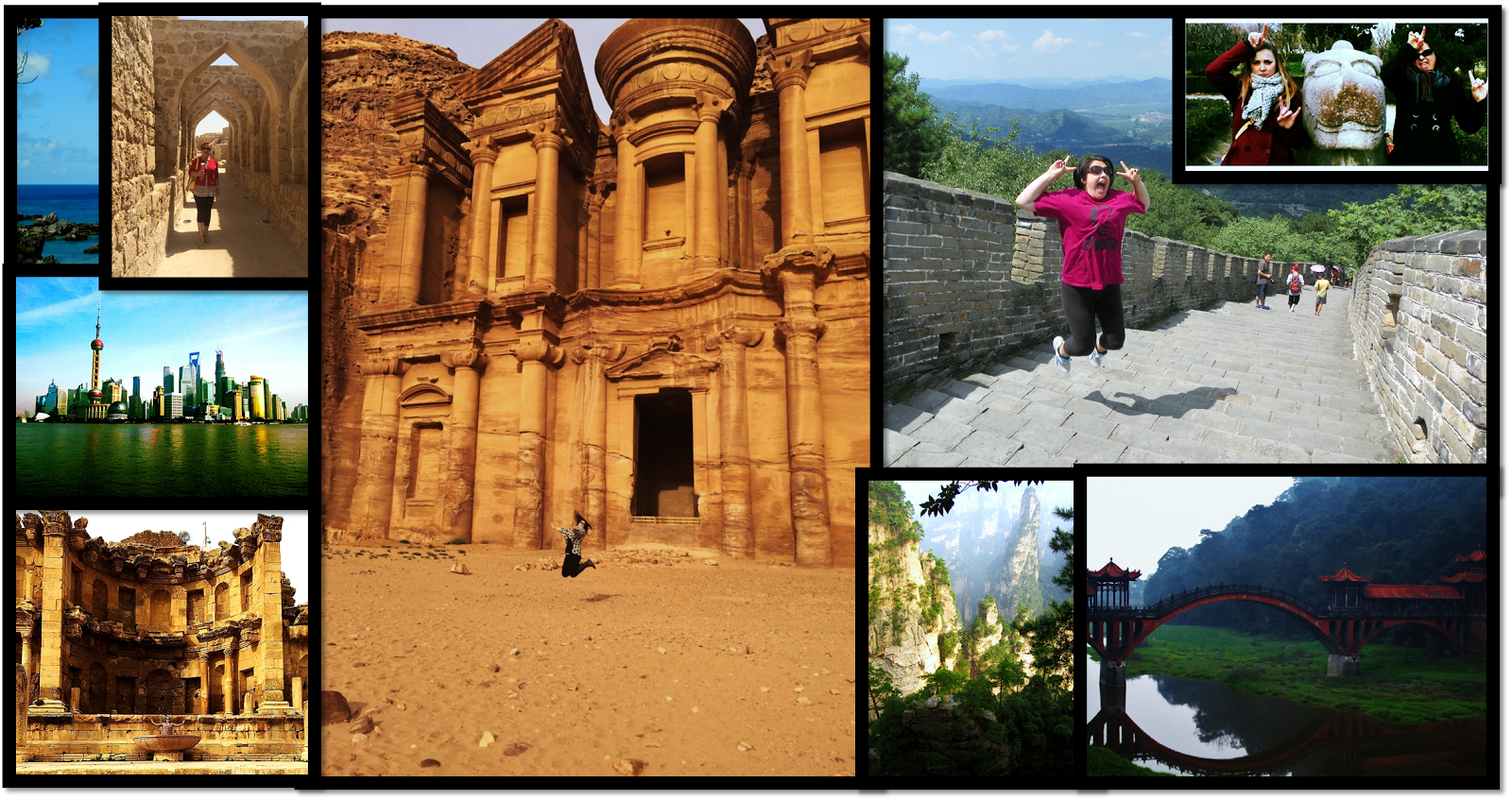
Saturday, February 1, 2014

The Abyss

In my last post I talked about the beautiful mountains in Zhangjiajie National Forest Park...and the horrifying stairs that has left me emotionally scarred for life.  But before Liv and I ever even reached those majestic, stair ridden, peaks, we did a little exploring of the mountains just on the outskirts of Zhangjiajie City.

The city itself features an easily accessible mountain of its own--Tianmenshan.  We also wanted to see this mountain as part of our summer epic.  It is actually the first thing we saw upon entering the city, as it is much closer to the city than the National Forest Park--this is a bus trip that takes a couple of hours whereas Tianmenshan is a taxi ride and cable car away from our hostel.  

Left is the beginning of our cable car adventure...little did we know, center and right are some shots while on the cable car. 
The cable car is very cool because it is so long.  It starts in the middle of the city and goes into the mountains!  We were on that cable car for close to 30 minutes--and we decided to go in the morning...when it was nice and misty.  Basically, once we reached a certain altitude, you couldn't see anything--just the cables disappearing into the mist and the occasional empty cable car coming back down in the opposite direction.   If Zhangjiajie National Forest Park was characterized by stairs, then I would have to say this trip was typified by the swirling mist, or the abyss as we frequently refer to complete foggy cover we encountered on this mountain. We captured our reaction to the encroaching clouds while on the cable car on film in the videos below.  I apologize in advance for the increasingly higher pitched panic evidenced in our voices.


'

Tianmenshan was different from our experience in Zhanjiajie as it was much more misty than the mountains in the park.   It was also filled with considerably less stairs (not counting the last part of our day, which I will get to later).  So we walked along pathways and looked out over a landscape that was continually changing as the clouds drifted in and out, alternately hiding and revealing mountains.   I really liked this mountain; it was quiet, the whole atmosphere relatively hushed, and since we were in the mountains and the sun was hidden by all that mist, the considerable cooler temperatures were very much welcome; this region of China is pretty hot in the summer.

Some really pretty misty mountains!
Misty Mountains Majesty? 
To the left is me being an asshole--the mist was really freaking Liv out, so that was my response. To the center and right are more misty pictures--can't get enough of those!
Another nifty feature of this mountain is the glass walkway.  For ten extra yuan you can walk on a pathway that has quadruple plated Plexiglas, allowing you a view straight down the mountainside.   Once the vertigo wears off, and the terror of walking on glass thousands and thousands of feet up in the air, you realize this is super cool.  Although, I will say that having to put cloth booties over your shoes, to make sure your shoes don't crack the glass, remains terrifying the whole 10 minutes you are on that walkway.


In addition to this glass staircase was this suspension bridge you could go on, which connected two parts of the misty mountains.  It wiggled when you jumped on it, which of course, we did jump on it.  It also disappeared into the mist, so that you could not see the other side.  We caught some of it on tape; unfortunately the wind started to change and the mist started to clear a bit towards the end of the video.


Tianmenshan was really cool because of all this fog or mist or clouds or whatever the heck it is...atmosphere?  It was neat, because the clouds kept shifting, so even if you stayed in the same spot for five or ten minutes, you still had a different view.

Some more lovely misty mountains. 
Before returning back to Zhangjiajie City, there is one more part of this mountain to see, and that is the Ladder of Heaven.  I should have seen this feature of this mountain as a ominous portent of our immediate future, but alas, I ignored the signs.  The Ladder of Heaven is not, strictly speaking, a ladder at all (false advertisement much?!) but rather, as so many things in China seem to be, a giant staircase.  To get to this staircase from the top of the mountain, you take the cable car down to a half way point.  You then take this completely insane road to get the ladder.  I mean, it's the twisty-est most insane road I have ever seen, and the drivers whip around them like they are driving in NASCAR.  To make matters even more reassuring, there are these giant mirrors posted at the turns, so that our drivers can see oncoming racing enthusiasts from the other direction.  Occasionally, on the more tricky turns, our driver would lean on the horn...you know, to warn whoever might be hurdling at us from around the bend they we moments away from imminent death.

I thought I got a better picture of the winding roads, but this the only think I could find (left) (see link above for someone else's picture of that crazy road!), and some shots of our bus (center, right).  We went through tunnels! They were not big enough for two buses, but no big deal. 
Once you arrive at the Ladder of Heaven, you only really have two options: climb that staircase or get back on that bus and go back to the cable car.  We thought, well heck, lets climb it, we're here, aren't we?  Trust me, given what I was about to live through tomorrow, I kind wish we'd just turned around and got back on the roller coaster bus.  However, the view at the top was pretty cool; more swirly misty mountains, which in all honesty, are kind of hard to get tired of.

Left: That there hole is the  mountain would be the ladder of heaven, the center is a nice view of those stairs, and then over to right is a pretty good facial representation about our feelings about those stairs. 
But you once you reach the top of that darn ladder, you feel such a sense of accomplishment (center), and complete dominion over nature (right).

Last but not least I want to leave you with a video of swirly misty mountains, just in case you want to see more of the abyss...erm, totally lovely, and not at all creepy misty mountains.