Friday, February 8, 2013

"You Have Lips Like Jack Bauer"


     "You have lips like...Jack," stated Crystal, my graduate student. "Jack...who?", I asked, puzzled.  "Jack, from the American television show 24", she clarified. I blanked for a moment, not being a regular watcher of 24, and certainly not since arriving in China.  And then Keifer Sutherland's face flashed behind my eyes and I could only agree with her statement; my lips are thin and narrow.  And most people--and by people, I largely mean girls--might have found this unasked for comparison insulting, but I could tell by how she delivered it that this was supposed to be a mere observation, and somewhat of a compliment.  This was all part of a larger conversation about Crystal's interest in the similarities and differences between Olivia's and my appearance and various American celebrities.  Apparently I am a dead ringer for Kirsten Stewart--and yes, that was supposed to be a compliment too (Twilight is very big in China).
     Each culture has different ideas for what is considered pretty, and in China the ideal is light hair, light skin, and big light eyes.  And if you have all three you are like, the epitome of pretty in China.  Now, this certainly has its advantages.  First of all, it feels really good to go about your life each day and have Chinese friends, acquaintances  and complete strangers stop you and tell you that your are beautiful.  Even on a Sunday, hungover, in my sweatpants, stuffing noodles in my face and in general looking like a hot mess.
Me, stuffing my face full of squid and noodles.  I know, who wouldn't want to take my picture? 
    We would be walking around the West Lake, or other areas around China when we were traveling, and it would happen rather frequently, although this happened more frequently to Liv (who, in addition to being awesome, has the triple threat of features).  We would be asked, in either Chinese or English or both, if they could take our picture or take a picture with us.  We would be asked by children, married couples, people with babies (usually we were asked to hold the baby), groups of friends (usually accompanied by lots of giggles).  Or, we would be non-so sneakily photographed.  Seriously though, sometimes they would be right in front of us or sitting at the table next to us, phone out, leaning towards us, taking the picture.  (We would usually pose, which they would only notice after they checked to see how the picture came out--they would usually react by looking up at us, startled, and laughing sheepishly).  This made us feel roughly like celebrities, and was an enormous ego boost.
    However, unless you have come to China to work as a model (and many people do, with varying degrees of success), this hyper-attention to how you look can sometimes be a problem.  And I am not just talking about it being annoying to be stopped regularly at tourist locations to have your photo taken, when you yourself are trying to also take in, experience, and photograph whatever man-made or natural wonder you'd traveled to see.  Or when you are trying to eat lunch.  Or just walking down the street.
Some strangers asking Liv for a photo in Fenghuang!
     I am talking about the frustration that comes from being judged on your ability to do your job based on how you look.  So, the majority of Chinese people that we have met assume that we are students because we look too young to be teachers (all of us are solidly in our mid-twenties).  Our youth combined with what they consider beauty, means that we often times get feedback on our job performance that has little to do with our job.  For example, when students, or sometimes even other educators, give us feedback, they do not talk about our teaching strategies.  They rarely mention how we can improve our teaching, or what they think is working about our methods for teaching English as a Foreign Language.  Instead, our students would say that they like us because we are beautiful.   Or they like our big eyes and our foreign features.  At best, our students will tell us that our teaching style is entertaining (we are, on average, more enthusiastic and prone to ridiculous facial expressions and body language to help communicate our point and convey our meaning--as we cannot fall back on our Chinese language skills.)
   After spending our weekends planning and worrying over lessons for the following week, designing creative ways in which we can test their knowledge, and in general slaving to be good teachers for the semester (and then spend our breaks thinking about how we can do it better next semester), the very last thing we want to here is "we like our teacher because she is pretty!" (although, if it is grammatically correct, and pronounced correctly, well, at least we know our students are learning).  Sometimes it would feel like our students were appreciating us for the wrong reasons.  It was frustrating; we felt like we could be working our butts off to create these lessons...or we could stand in front of the class and smile and achieve the same level of appreciation.

   Which, of course, was not true.  We were, for most students, more than satisfied with our students learning and they showed a marked improvement in reading, speaking, listening, and writing (especially in classes taught by teachers who were really committed to student learning, and not just teaching as a way to be in China).  But it was nonetheless frustrating, especially during our first semester, to be valued, as a teacher, for our physical features, rather than what we could bring to the table as educators.

Alex, me, and Fancy after our last American History class!


Thursday, January 31, 2013

A Average Day in the Life: Hangzhou Teacher

As a teacher at a university in Hangzhou, my mornings begin at about 5:30, which is when I wake up, if I need to shower (if I have showered the night before, I am likely to hit the snooze button about 3 times and roll out of bed and about 6:00).  Then after flinging on clothes, doing something with my hair, and smearing on some makeup, I grab my school stuff (laptop and various instructional materials) and take about a 10 minute walk to our front gate.

The first part of my morning commute.  Note the wall in the distance. 

Now, most of the universities and communities in China are gated, for security purposes, with 10 foot walls, often lined with barbed wire or glass, and there are only one or two exits.  The shuttle that takes me from the campus I live in to the campus I teach in picks us up at exactly 6:55 every morning.  So, on mornings across from our campus, there are a collection of foreign and Chinese teachers waiting in a large crowd next to a stop sign.  We then jockey for a seat on the bus (there is really no line-culture in China; you can push your way to the front, ahead of people who were there first).  The foreigners usually congregate in the back of the bus and we would be the loudest (not a difficult thing to be, as the majority of the Chinese teachers--wisely--use this time to sleep) as we shoot the shit. 

Getting My Teach On


An hour later of talking or sleeping, we arrive at campus, on the outskirts of the city, in the education district called Xiasha.  It is a district of only universities, dorms, and stores that cater to college students.  Usually, unless there is bad traffic, we arrive at about 7:55, just in time for the 8:00 bell.  That's right: bell.  Most universities have a bell that indicates when classes begin and end.  This threw me at first, because it feels a lot  like middle school.  To further this feeling, the university takes attendance very seriously; if students miss class, they need to provide documentation from the school in order for it to be a 'legal' absence.  Most students have 3-4 classes every day from Monday through Friday, with minimal homework.  

So, as a teacher, you are typically teaching anywhere between one and four classes each day, for a total of somewhere between 12-18 teaching hours, depending on your contract and it will vary each semester.  Typically foreign teachers teach Oral Speaking, so you would teach all the same classes each week, which means you only have one prep each week.  Since I taught for the honors college and had some experience in teaching (and two degrees in Education) I was given some other courses, for a total of 4 preps per week.  There are pros and cons to each kind of teaching; one is a bit boring and a little redundant, but somewhat more relaxed and the other is manically stressful but the variation is nice.


Classes are taught (individual schedules may vary) from 8:20 am to 12:05 pm and then you have an hour and half for lunch and a nap, and then you have classes again from 1:30 to 4:30 and then most of us usually catch the 4:40 shuttle back to the campus we live at, but an unfortunate few get to teach night classes from 6:00 to 8:30.  And since scheduling definitely does not take into consideration teachers wants, you might end up teaching one class at 8:30 in the morning and then not again until 1:30...or if your schedule really sucks, maybe a night class.  And since shuttles only run a few times a day and the public bus is a 2 hour commute, going back home and then coming back is not an option (unless you have a car, and lets face it, not too many foreign teachers are going to be in China, or are willing to face the Chinese traffic, long enough to think about getting a car).  And that is your average day as a university teacher in Hangzhou, if everything goes according to plan. 

Friday, January 25, 2013

Two Tuesdays: To China and Back Again: A Jet-Lagged Tale

So, probably the worst part about working in China is the trip back and forth from America.  Now, this is not because the service on the flight is terrible or anything, but simply because the flight is so, so, unbearably long.  A straight flight from the east coast to of the United States to the east coast of China is about 14 hours.  But of course, I am young, my savings account (what savings account?) is pitiful, I have student loan debt and currently get paid in Chinese currency, so I am not taking a straight flight; I have layovers.  On average, I  usually have two or three stops before I make it to my destination.  So, this flight is more like 20 hours.

Immediately post 20 + hours flight. 


However, it is pretty cool when you are traveling back from China, because of the time difference.  I left China on Tuesday, January 22nd at 5:00 pm and arrived in New York at 11:30 pm...on January 22nd!  Which makes me feel like a time traveler, and is also nice, because it feels like I got all that travel time back and it wasn't all wasted being squished between two elderly Chinese women who would keep up a constant stream of flatulence while they slept.  However, it also makes January 22nd approximately the longest day ever, and that is why I am calling this post Two Tuesdays, because for me, it was Tuesday for some 30 some-odd hours.

The other reason the flight is the worst part about working in China is the jet-lag  which is why I am now awake at 4 in the morning, typing a blog entry (which is probably not something I should be doing in my jet-lag  exhausted state, but oh well).  I have tried to make myself so tired that I would sleep a whole night through (which has resulted in some very nonsensical Facebook chat conversations--sorry Becky!--and some interesting dinner conversation) but alas, my body is still on China time, and my eyes popped open at 3:30 and would not close again.  Tomorrow, my goal is 5:30.

And it is not just coming back from China that is rough on the sleep cycle, but also when you fly to China.  The last time I went to China, I made a few traveling mistakes.  First, the night before my flight, I did not sleep at all. I knew I probably wasn't going to be home for close to a year, so I stayed up the whole night talking with my sister, and when she went to sleep, I played some video games, and just in general enjoyed being in America for another few hours.  And then I got on my cheap flight (only 650.00 to China!) and stopped in Chicago, then LAX, and finally Shanghai.

When I arrived in Shanghai (exhausted because I don't sleep on airplanes and didn't sleep the entire night before, and of course, jet-lagged) I was too late to take a long distance bus or catch a train.  So while I was walking around the airport trying to find a way home, one of the security people informed me that I needed a hotel, but, he told me, the airport hotel was too expensive (tai gui le!) but that he knew a cheaper one and to follow him.  So, I did, and my jet-lagged brain (which is considerably lest paranoid and danger oriented than my regular brain) got into a van with a bunch of strangers whom did not speak English. Luckily, they did just take me to a hotel; I checked in, showered, slept for 8 hours, and then the next morning, around 7 am, they took me back to the airport and I caught a bus back to Hangzhou, where I spend the day with my neighbor at Starbucks, drinking coffee and talking about America.

At this point, I was feeling pretty good.  I was feeling like maybe I'd finally kicked jet-lags butt (after making the trip twice already)--3rd times a charm!  So that night, I went to bed around 9:00, feeling pretty tired, and pretty excited because Olivia was returning to China the next evening as well.  The next thing I knew, someone was knocking on my door, so I popped out of bed and was immediately disoriented because it was dark, so I thought (even though my body was telling me I had been asleep for some time) that it most very early in the morning, so I ran to my door, since early morning knocking usually indicates some kind of emergency.  I open my door and standing outside is my neighbor...and Olivia.  I just kind of blinked at them for a moment and they were staring at me in that concerned-look you usually reserve for psych wards or hospital rooms.

"I thought you weren't getting here until tomorrow night", I said to Olivia. "Rachel", she replied, "it is Saturday night..."  Yep, I who can't sleep on planes, trains, or automobiles; who usually wakes up early and has trouble sleeping for more than 7 or 8 hours, slept for an entire 24 hours.  I went to bed at 9:30 on Friday night and woke up at 9:30 on Saturday night.  Dave, my neighbor, proceeded to tell me about how he'd knocked on my door for lunch and had texted a few times throughout the day, but I did not respond, and about how they'd knocked a couple of times this time before I'd answered, because he was worried.

The flight, and the resulting jet-lag/exhaustion are the reasons why I rarely make the trek back home; as much as I love and miss my friends and family, the flight and recovery time (not to mention the cost!) are simply not worth it to only be home for two or three weeks.  However, this time, I will be home for close to seven months, so I am willing to pay the price of living through two Tuesdays.  Now I am going to go play computer games until the rest of America wakes up.

Jet-Lag!

Friday, January 18, 2013

High School v.s College

So, in China, high school is really hard.  And I mean really, really hard.  And I am not talking hard in "I took 5 AP classes my senior year of high school" hard. Its more like "I have been taking AP classes since 2nd grade."

Many Chinese students, beginning in early elementary school, start a very difficult curriculum.  They head in to school very early in the morning, get out in the afternoon, and then spend their afternoons studying,.  Families with money will send their child to after school programs, and many will hire private tutors on weekends.

The goal of all this curricular and extracurricular work is to prepare the student for the gaokao, which is like the SAT's on steroids.  Now, I am not 100 percent familiar with the content of the gaokao, but like the SAT's, it is crucial in determining what college you get into.  But unlike America, where you can squeeze your way around a 950 SAT score by being a really good person, doing a lot of extracurricular activities, being an athlete, writing a really good entrance speech, or having golden recommendations  the gaokao is the only thing that determines the school you are allowed to go to.

The score you get on the gaokou determines what schools you can get into.  So, lets pretend this operates on the same score the SAT's does.  If you get a 2400 on the gaokou, you can go to any school in China.  And so you would choose the best school in China.  If you get a 2300 you can go to the 3rd best school, and any school below it; so you would likely choose the 3rd best school to go to.  If you get a 500 on the gaokao, you would likely go to the most prestigious school that accepts that score.  And the prestige of the school you go to, is going to determine your success and career options after graduating from college.  Because if you and the other job candidate both went to school for the same thing, but he went to #1 school in China and you went to the the #763rd school in China, he is going to get the job.   So the gaokao is a big deal, and students, and their parents (and usually the grandparents), spend a lot of time and money to make sure they do well in high school, attend the best high schools, so they can get a good grade on that test and get into a good university.

Conversely, once you get into college, it is supposed to be easy (well, easier).  It's like, "Phew, I just did all this hard work, and now I can relax."  Unless, of course, they have the misfortune of having a foreign teacher.  Because we, of course, thought high school was a breeze; at least, compared to college. We grew up with teachers and parents telling us, "Wait til you get to college, then no one will be there to hold your hand.  You will be responsible for yourself.  The work is going to be so much harder." And so on.  So foreign teachers are frequently frustrated by Chinese students because they often times do not think college students in China care about their courses.  Students will turn in homework late, be unprepared for projects, expect to be given the chance to make up poor grades on tests, etc.  And the foreign teacher's gut reaction is: "No! What do you think this is?  High school?!"  All without knowing that high school was a hell they just escaped from and college was supposed to be a more relaxed time.

When we (we being foreign teachers) get feedback from our students, it is typically flattering when it comes to our personality or appearance or teaching style, but not so flattering when it comes to homework.  We are often told that we assign too much homework (homework does not seem to exist in their courses taught by Chinese professors), assign too much reading, and create tests that are too difficult.  And it was not until I had been teaching in Hangzhou for probably about 6 months that I realized that the foreign teachers classes were a bit different from the Chinese teachers courses, and not just because we were not told about the curriculum (see earlier blog entry).

We would walk around during free periods to look at other classrooms, and the teachers would be standing in the front of the room, talking into a microphone, to a classroom of students half asleep (some full-out asleep) on the desks, or reading from the textbook, or playing with their phones.  Meanwhile, the foreign teachers are bouncing around the classrooms, making students talk to each other and participate, and I almost broke some kids Iphone when he took it out while I was teaching (do not get me started on the kid who thought he could take a nap in my class).

I suppose this realization that we were making their college lives more difficult did not really change our curriculum too much; after all, we had something we needed to teach them, and went about doing it the only way we knew how (I refused to lecture during an oral speaking class--what would be the point?).  But it did change how reacted to student involvement and how we structured our expectations for our students.  We made sure they understood that our course would be challenging and made sure what specific things they needed to do in order to get the grade they wanted.  We made sure they understood late assignments would not be accepted and that participation was worth 50% of their grade; so if they didn't talk and participate, they would not get a good grade in our class.  And we stopped getting so frustrated with them now that we understood the source of their attitude towards our classes.  I suppose I would be ticked too if I walked into a 100 level lecture class and learned it was being taught by some professor who really wanted to teach the graduate students, and so that was how he was going to treat this intro course.

Tuesday, January 15, 2013

Attention: I DO Like Teaching Here!

I just thought I would give a little notice right now, before I get really going on this blog.  I will be sharing stories that are both frustrating and rewarding.  And I do like teaching here, and I do (most days) like the school I work for, but I know sometimes, some of the blog posts are going to seem a little negative (that is the frustration speaking).  If you are reading this blog, and are feeling discouraged about teaching abroad, that is by no means my intention.  I highly recommend teaching abroad by whatever means possible, it has been a valuable and rewarding educational experience.  I simply mean to share with you my experience, the highs and lows, to give you a picture of what it has been like, for me, teaching in China.

A Difference in Organization


Having only worked for one University in China, I cannot speak for each school, but from what I have experienced here, it is a vastly different system from schools in America.  And some of the initial (and sometimes continuing frustration) that I have felt concerning teaching here comes from the differences in how the University is organized, compared to schools back home.

I have already mentioned the lack of curriculum.  I have since learned that they do, in fact, have curriculum, but they are all written in Chinese, and so what this usually means for the Foreign teacher, is that you are given a copy of the text book and updated by a member of the department who everyone agrees has the best English skills on an “as-we-remember” basis. For instance, last year, I would have this one woman (she was really, very helpful) rush into my classroom periodically during a break; tell me that something (midterm grades, oral speaking final exam assignments, etc) was due—usually tomorrow or something ridiculous—and then dash out again.  She once popped in and asked if I had given my students the topics for the Oral Speaking part of the final.  My response was: “what topics and what oral speaking final?” She then told me that all the students took the exam next week at the same time and that I would be judging another teachers classroom. My students were expected to memorize information on one of 26 possible topics.  And thanks to my total lack of knowledge about this (I had received no email/phone call), my students were not prepared. And this I suppose brings me to my first point of frustration: A lack of information on due dates and expectations.

I cannot count the number of times I would get a call or email from someone at the school telling me that some vital piece of paperwork was due, and it was due tomorrow.  So then we would rush to complete this intended assignment, only to discover that:

1. half the Chinese teachers hadn’t finished it either and it was no big deal or
2. the policy had changed (literally overnight) and they no longer needed it.

The University calendar was another point of contention among foreign teachers at this school.  I know that in American Universities, school calendars are set years in advance.  You can go to your alma matter and look at when the vacations and holidays are going to be for the next 3 years.  Well, there are national holidays, and everyone gets those off, but the school also has the option of assigning extra days to the official holidays to make a vacation.  It’s like getting Wednesday and Friday off for Thanksgiving, instead of only Thursday.  The government says you need to have Thursday off, but the school says you can have Wed. and Fri. too.  However, in this school, you have to make up the holidays that are not actual national holidays.  So, we would not need to make up those classes missed on Thursday, but we would have to make up classes missed on Wednesday or Friday.  And the school schedules those makeup days…usually on Saturday and Sunday.  Sometimes it is the weekend before the holiday, and sometimes it is the weekend of the holiday.  So instead of having a nice, uninterrupted 5 day weekend, your whole schedule is thrown to shit and you are working on a Saturday.  And they don’t tell us this until about the week before.  So if you had any vacation plans, screw it, they just got ruined.  We got smarter about this as time progressed (especially for our 2nd year) and would pester the school to tell us the vacation days as soon as possible, but it is still unreliable.

Teachers in America, you will know your schedule and what classes are going to be taught throughout the year at the end of the previous academic year (or at least over the summer).  Not so for this school.  I received a call 2 days before I was supposed to teach an Introduction to the Cultures of English Speaking Countries course informing me that not enough students signed up, and so the class was cancelled, but can I please teach Critical Thinking and Speaking (not a course I had taught before). When is the first class? In two days.   So I said goodbye to an entire summers worth of planning for that course and said hello to frantically throwing together some kind of syllabus for a course that I would not know even an iota about the curriculum until after the first day of class.

If this sounds chaotic and frustrating and hectic to you, well, it is.  But don’t fear.  Like I said, this is true for my experience at this particular university.  But I have learned that other schools in China are much better organized. Also, as a foreign teacher, you are given a little bit of leeway in due dates (and a lot of leeway in curriculum).  Once you remember that, it does not seem as chaotic.

Also, schools are huge here.  This is located in an whole education district (no fitting in with the city or anything) and there is just a sea of dorms, academic buildings, and administrative buildings (this is the library) that are spread out creating a very large campus. 


American Students and Chinese Students


So, it did not take me a long time of teaching to notice some pretty big differences between Chinese students and American students.  And also some huge differences between Chinese Universities and American Universities, but for now I will focus on the students. 

Some of my students being really cute on a field trip.  
Let me use a more recent example to illustrate.  This semester would be my third semester teaching in China, and the feeling walking into my first class this semester was dramatically different from how I felt walking into the class I described in my previous post.  Not necessarily because the school I was working for had become more forth coming with information, but because I no longer expected said information.

Early this semester, when I was first meeting my new freshmen, I was chilling in between classes.  I taught both sections of Integrated English (and no, I am still not 100% sure exactly what that means) back to back with 10 minute break in between the classes.  The science students had just left, and I was waiting for the Arts students to file in.  Which they did.  And in America, if you still had 7-10 minutes before class started, you would be most likely to fiddle with your phone, talk to your neighbor, etc.  Well, these students filed in and sat down and stared (and I am fully aware some of this reaction was because I was foreign and they were freshmen).  They did not speak, they just sat down and watched me. (I actually left and took a 5 minute walk before the class finally began, because it was creeping me out a little and I did not know any of them yet, to start up a conversation).

In almost every class I have taught, the reaction of Chinese students to instruction is to listen passively.  I have had to come up with creative ways to get them to speak in class, from bribery to threats to coercion.  They will not volunteer information.  Mostly because they fear being wrong.  And in most Chinese classes there is always a right or wrong answer.  Also, in most Chinese classrooms, the teacher will simply give them the answer, with a token 5 second pause, after asking a question. Many of their courses are straight regurgitation and it is what they excel at.  I have had students who have had no familiarity with material memorize huge chunks of data in a very short amount of time.  Which is undoubtedly impressive.

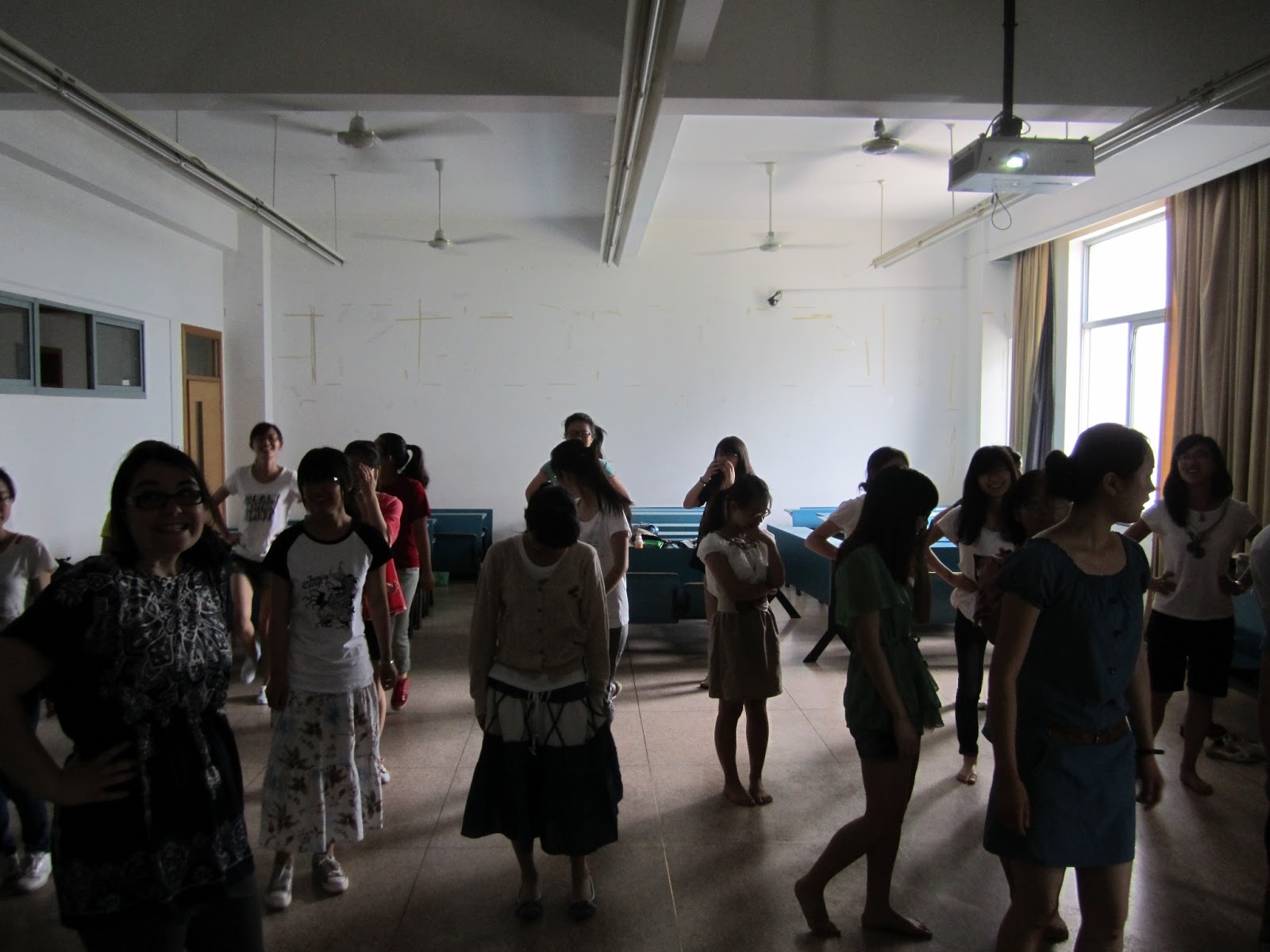
Sometimes when they refused to speak, we did a little kinesthetic warm-up: Dance.  We eventually decided answering my questions was a better idea.

However, when I ask students to synthesize that data, to create something that is not directly retrievable from some text or other source, they struggle.  And they fear to volunteer opinions or speculation as these things are not guaranteed the ‘right’ answer.  In fact, when I taught a reading course and informed my students that there might not be only one right answer, some of them looked downright scared. And so, it has been somewhat frustrating, especially in Oral English courses, were students are expected to speak, or in some of the critical thinking courses, where students are expected to create, rather than simply expel memorized data.

Conversely, with American students, it is difficult to get them to stop talking once they start.  And they do not even have to be particularly well versed in the knowledge in order to feel comfortable sharing their opinion.  Many American students relish the opportunity to create something, rather than simply answer multiple choice questions or write an essay about it.  And in America, we value this talent, and try (when you can dodge state testing, that is remarkably similar to testing in China…) to cultivate in our students.  American teachers and schools generally—and least ideologically—understand that this is the best way some students can demonstrate their knowledge and understanding of curriculum.

This is not true in China. 

Every test they take is based on rote memorization.  Even, to an extent, the Oral Exams. And this is no small skill, the amount of data students are expected to memorize, but it creates students that are vastly different from what teachers in America have been equipped to teach, and so many new teachers here spend their first months increasingly frustrated, and I am no exception.

It does get better J