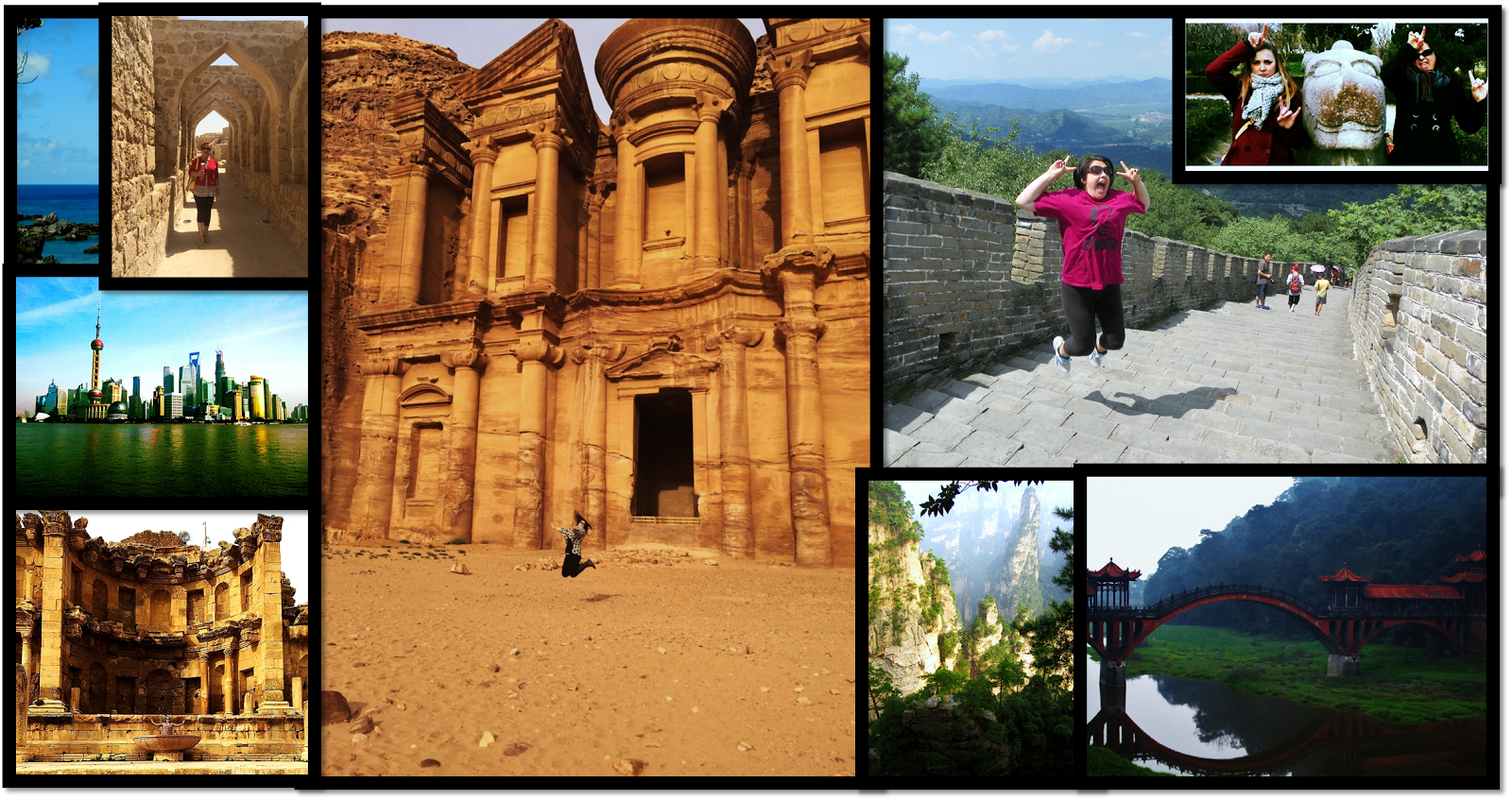
I am nearly forty and have been living and learning around the world for the last 15 years. I have been a teacher in East Asia, SWANA, the Caribbean, and South East Asia
The part of Beijing I was most excited to see, was the Great Wall. We all (my visitors) wanted to see the Great Wall. I mean, come on, it's the Great Wall!! It's one of the world's most recognized national monuments. In 2007, it was voted as one of the new seven wonders of the world. You can see it from space! (Well, I think this might have been disproved, but it sure sounds cool!).
I have made hints before about how my American education made my knowledge of China somewhat limited. Well, I am sorry if this offends you, but it's true--unless you take fairly specific courses in college, most Americans do not learn too much about China. We do, however, learn about the Great Wall of China. I remember learning about how this emperor demanded it be built in order to protect his boarders against nomadic warmongering tribes, commandeered a bunch of peasants, and when they dropped dead from exhaustion, had their bodies thrown into the construction site that would eventually be the Wall. The Great Wall (along with Pandas) also seems to be the images that we associate with China--Google search China and see how many times the Great Wall pops up. Needless to say, everyone who came to China (myself included) wanted to see the Wall.
Pic of some characters on the mountains declaring loyalty to Chairman Mao (I believe), and Mom on the Great Wall!
The Wall did not disappoint. It's huge, it stretches for hundreds of miles, it's ancient, and huge sections of it are totally accessible to tourists. There are a couple of different ways to see the Wall. I recommend booking a trip with your hotel or hostel, as this is usually safe and at a fairly reasonable price. They will also have different trip packages, to different sections of the wall, which offer a different experience. Many of them will take you to a section called Ba Da Ling; it is the most famous stretch of the wall, but it is also the part that has had the most renovation--it does not look ancient at all. The next most common section is Mutianyu--this is a pretty awesome part of the wall because it has been renovated just enough to make it safe, but there are still lots of large, crumbling sections, and the view of older parts of the wall and mountains in the distance makes this place totally worth it. However, there are further sections of the wall that are remote and not renovated at all. If you are looking for a completely authentic Great Wall experience, I would recommend trying to go for one of those. They will take you out for a day trip, and some places also offer a two day hike, where you actually camp along sections of the wall. It all depends on the experience that you want to have. Again, I would look to a hotel or hostel, or find a reputable tourist group before coming to China, to navigate the more remote areas of the Wall.
Shenanigans on the Great Wall, July 2012
My first time visiting the Wall (and Beijing) was in March of 2012, with my mother. This is right in the beginning of spring, so it was not cold, but the landscape around the wall is not lush and green, but still brown and hibernating from winter. This does not afford a lot of contrast between the wall and the surrounding environment, but on the plus side, it does mean that the view of the wall is not blocked by the jungle that is normally growing there; you have an unrestricted view, until it curves around the mountains. We booked our tour through our hostel (365 Inn was our hostel, and I highly recommend it!) to see the Mutianyu section of the wall. If I hadn't have liked any of their tours, however, I could have gone to one of the dozen or so hostels nearby and checked out what they offered--you don't have to stay at a hostel to use their tour bookings! The hostel took care of contacting the tour group, told us to be ready to go at (uhgg) 7:30 am the next day.
Great Wall in March
The tour group picked us up at our hostel, we made a couple of stops at other hostels for more tourists, and then we began our trek out of the city of Beijing. Now, the wall is not right in town; it is in the mountains, and depending on traffic, this is about a two hour trip. Which is just fine, because you get to hear some interesting stories about the section of the wall you are about to visit. You get the wall around 9:30 and you have until 1:30 to explore at your leisure before meeting back up with your tour group for a quick lunch and a ride home. This is plenty of time to see a fairly decent chunk of this section of the wall. You take a cable car ride up to the wall (for about 80 RMB, but it is worth it because it shaves off the 40 minutes it takes to walk up to the wall). If you are at all weary of heights, this cable car is going to cause you a bit of anxiety, but it is totally safe.
Echo, our tour guide giving us a few last minute pieces of advice before turning us free, our cable cars, and my particular reaction to heights...
I visited this particular section of the wall again a few months later, in the summer, and was very glad I did. This time everything was in full bloom, and while the view was restricted by all the foliage, seeing the sections of the wall peek out from the greenery, seeing that contrast, was worth the second trip. I also got to see one of my good friends attempt to climb the Great Wall. You may be wondering what I mean when I say climb...well, what seems to escape the notice of most foreigners (myself included) from all those lovely pictures of the Great Wall, is that it is actually a giant staircase. There are very few sections where it is simply a rolling pathway; most of it is steps. And not even steps--some steps are barely a few inches high, and some steps are about 1 1/2 feet high. Some steps are on a nice sloping incline, and some steps take you almost vertically (seriously, we were on our hands and knees at one point) up the side of the mountain. And going down is not any better--now you get to look at this vertical drop and hope you don't trip, cause you know you'd feel that mistake for weeks. Needless to say, any trip to the Great Wall is going to require a bit more endurance and stamina than most tourists expect.
Scary stairs...manageable stairs....and scary stairs again! It was back and forth the whole way.
Coming back down from this section of the wall is also a treat. You can take the cable car back if you wish, or you can choose to take the Toboggan. Becky, the friend who came to visit me on the summer trip, wanted to Toboggan. And I am glad she talked me into this; it is basically a sled, with a pull break, that you cruise back down the mountain side in. If we hadn't been stuck between a tiny elderly lady who rode the break the whole way down in front of us and a few crazy Germans who didn't bother with he break at all behind us, it would have been totally fun--though it was still totally worth the ride. Below is the video of said ride.
My third and last visit to the Great Wall took place on my fourth and final trip to Beijing this past December. I do not recommend going to the Great Wall in the winter if you have a choice; it's in the mountains and it's hella cold. However, Amanda, who was visiting, had it on her bucket list to see the Great Wall of China. So I was going to make that happen, darn it. To avoid certain death, I decided to take her to the Ba Da Ling section. I figured the renovated nature of this section would prevent us from injuring ourselves (the other sections are uneven, crumbling, and not well maintained--adding a layer of snow and ice would surely result in an injury). Despite visiting the wall on the coldest day of the year, I was really glad that we did. One, Amanda's reaction to seeing the Wall was fantastic. Two, the Wall (and surrounding mountains) covered in snow was really freaking pretty. Lastly, we managed to convince a third friend, and current native of Beijing, to come with us, resulting in a fun few hours of hiking, sightseeing, and funny photo ops. Additionally, he showed us how to take the public bus system right to the wall--no tour group or nothing! Plus, this particular section has what basically amounts to a sedate roller coaster which takes you up and down to the wall.
Pretty Winterscape on the Great Wall, Life List further completed, and monkeying around on the Wall. All in a day's adventure.
If I learned anything from these multiple trips to the Wall, it's that the Wall is completely worth a visit if you are going to be anywhere near Beijing. Do not let the season stop you; it really is majestic in any season, whether you are sweating under layers of winter clothes or sweating in a tank top (cause you will sweat on those stairs!) the Wall is something to see. So bring your climbing shoes, a bottle a water, and some energy, and tackle the Great Wall if you are in Beijing.
Great Wall in Spring, Summer, and Winter...it's all pretty awesome.
I love Chinese food. I mean, I love Chinese food. I liked American Chinese food before coming to China, and once in China, I definitely fell in love with Chinese cuisine. However, once you come back to America, and go back to your local Chinese Takeout...well, it just isn't the same. If you live near a big city, of course you can probably find a few authentic Chinese restaurants that sell some of what you ate while you were in China, but I have not had a lot of luck locating said restaurants in my hometown.
Therefore, I have had this idea sort of cooking around in my brain for the past few months...emphasis on cooking. I figure, I know what it is supposed to taste like, right? Can't I just play around with some of the simple dishes until I get the flavor right?
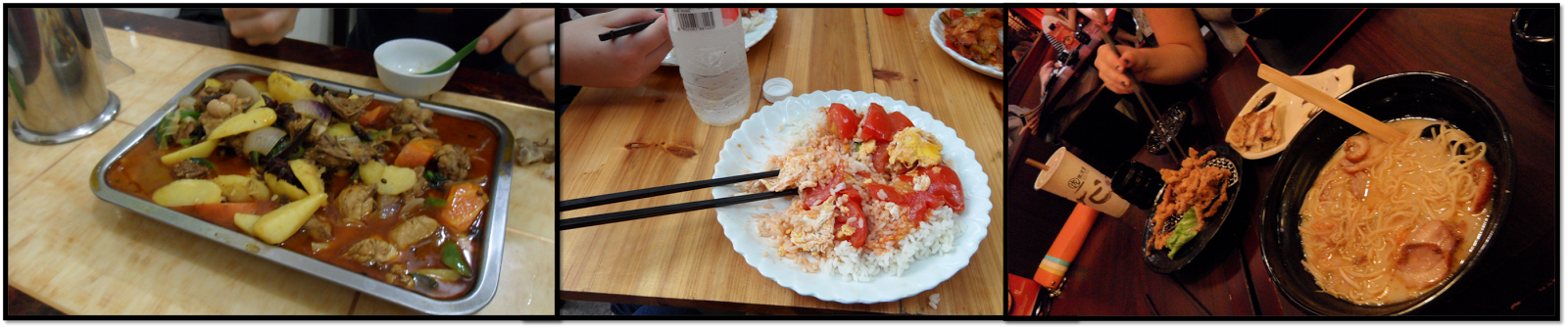
Big Plate Chicken, Egg and Tomatoes, and Duck Noodles
Now, I am by no means a cook. In fact, it hasn't been until the last year or so that I dared anything more creative than boiling water. But I have been watching. I have been watching Chinese people cook, I have been watching my fellow foreign teachers cook (I cook with them, but my skills are limited to mashed potatoes and corn), and over the past six months of being home, I have been watching (and sometimes helping) my mom cook. And I have been learning. I stayed for a week in my grandmothers house and managed to tolerably cook a chicken breast, rice, and a veggie. Armed with such success, I turned again to the notion of trying to recreate some of my favorite Chinese dishes.
However, I still did not take that culinary leap until today. Just the other day, I was talking on the phone with a former foreign teacher friend of mine, and I was bemoaning my lack of Chinese cuisine in my daily life. He took it upon himself to assign me a homework assignment (teachers, sheeeesh!). He told me that I had a month to recreate my favorite dish: Yuxiang Qieze...or fish-scented eggplant--which is a lot yummier than it sounds! I made a lot of excuses about not being able to find the right seasonings, that I couldn't cook, blah blah blah. Then I got kind of annoyed with myself: I was essentially bitching about the lack of something I wanted, but not taking any practical steps to fix it. So, I accepted this food challenge.
I did not want to start with Yuxiang Qieze...it seems complicated. Instead, I decided to start with my second favorite dish: Eggs and Tomatoes. The very next night, I took myself to the store and bought a ton of eggs and tomatoes, and chopped green onions. I armed myself with looking up variations of the tomato and egg recipe, along with watching a YouTube video explaining how to make it. I figured if I messed this one up, I would abandon my quest towards fish-scented eggplant...but if I succeeded....well, maybe I would have one less reason to miss China.
Needing proof, I had my father help me turn it into a video, which is posted at the bottom of the blog. It was touch and go for a little while there (see about 5:40) and I was pretty anxious the whole time that it would taste terrible. And while it did not taste 100% like the dish I ate on an almost daily basis in Hangzhou, it tasted pretty darn good. I think the variation in taste can be attributed to the use of different oils and seasonings. This just means that I will have to play around with it a little bit more, now that I know that I can make it.
If you want to see me struggle for ten minutes, watch the above video. If you want to see how this is actually made, I recommend this lady's video here: http://www.youtube.com/watch?v=FRfLNGE2YUo. She does a great job showing you how to make it and I combined her recipe with some others I found online. You can also run a Google search on Chinese egg and tomato dish, and you should come up with several variations on the same recipe. Wish me luck on my next culinary excursion!
Beijing, the bustling metropolis that is China's capital. Before I went to China, I really had no idea what my salary would be like or my schedule would be like; so I had really no idea how much traveling I would be able to accomplish. However, I knew that I wanted to see Beijing; I mean, come on--the Great Wall, the Forbidden City, Tiananmen Square?! Beijing, and the things located in it, was pretty much all America had taught me about China, so I was going to see that city, darn it!
A panorama of Tiananmen Square
Little did I know, in the early days of fall 2011, that I would see this city no less than four times. Four damn times. Now, some of you might be thinking, "seriously?! Is she seriously complaining about seeing the capital of China too many times?!" And trust me, if I were reading this, I would be thinking the same thing about me too. But let's face it, it's like with (almost) anything; the more you do it, the less magical and more routine it becomes. Let's compare it to Disneyland, for example. Kids who have gone there once in their whole lives talk about how it is the most magical place on Earth. Kids whose indulgent parents take them every year...well, for them, it's just another place, with its ups and its downs. That is how I feel about Beijing; it's got its pros and its for sure got cons. Trust me, there is only so many times you can walk through the Forbidden City.
Sometimes we decided to take the cheapest way possible to Beijing...sometimes we took the nice trains. did I ever take pictures of the nice trains? Nope.
Other than Hangzhou and Shanghai, Beijing is the city I spent most of my time in, and this is due to the fact that so many of my wonderful friends and family did follow through on their promise to visit me in China. Let's face, we all talk a big game when it comes to visiting and keeping in touch with people when you move on to the next phase of your life. But realistically we know that most of the 'keeping in touch' will happen via Facebook, phone calls, email, and the occasional Skype call. And when one of your friends decides to up and relocate herself to China, well expecting visits from friends is understandably...unexpected. I did have three visits from home, however, in the form of my Mom, Becky Burch, and Amanda Woomer, each of whom came at different points during my stay in China. And each of whom really wanted to see...The Great Wall. Which happens to be located (well, the most convenient location) in Beijing.
Yet another less-than-comfortable train ride from Hangzhou to Beijing.
On the plus side, I became an expert on the sights of Beijing. I knew how to get to all the touristy spots, I understood the subway system, I knew which hostels were good and which ones to avoid, I knew where to get the best Peking Duck at the most reasonable prices, I knew which tourist traps to avoid, and where to go if I wanted to barter for souvenirs. I also got to relive the wonder of seeing these places the first time by watching my friends and family experience it for the first time, which was awesome. They also conveniently timed their arrivals in different seasons, so I did actually wind up seeing the city and many of it's attractions in the spring, summer, fall, and winter, which was kind of cool.
Oh look, I found some pictures of the nice, high speed trains. These bad boys will get you from Hangzhou to Beijing (about at 800 miles) in six hours. The slow trains featured above will make the same trip in anywhere between 13 and 22 hours, depending on the quality of the ticket your purchased.
Since I have been to Beijing no less than four times, I decided to do a four part series on my adventures in Beijing, highlighting the various places and activities that can be seen and done in the capital. So, if you are at all interested in this city, stay posted.
When I began this course, I knew that I really wanted to explore my student's writing. I had them for Oral English the year before, and in the very limited writing that that course allowed for, I knew that I had some very expressive and creative minds; I wanted to give some of my more quiet students a chance to explore their English writing, and I wanted to get to know my students better through their writing. I have previously discussed my use of journals in this course in a previous blog, but I wanted to provide an opportunity in the class for creative writing.
What originally interested me in their creative writing was actually in their performance during the Oral English class the previous semester. We'd asked them to re-write one act of Romeo and Juliet in a different genre (either action, horror, or science fiction). They did such a wonderful and creative job with these scripts, I wanted to see what would happen if they were given the opportunity to write creatively in a course designed around writing.
The first two short stories that I had my students read were Lamb to the Slaughter by Roald Dahl and Hills Like White Elephants by Ernest Hemingway. If you you have not read either of these stories, a simple Google search will provide you with websites where you can read the full text. My students really enjoyed the surprise ending of the first story, and the struggle to figure out the topic of discussion between the two main characters in the second story. After amply discussing both of these short stories in class and exploring some of their themes through journal and group work, I decided to make their first independent writing assignment based on these books. Below is a copy of the assignment I gave them; we discussed the requirements in detail before ending our class that day. I gave them two weeks to complete the assignment, and we did not really discuss this assignment or the two texts after the assignment was distributed; I asked each class if they had questions, but they never really had any questions...
This lack of questions really started to ratchet up my anxiety over this assignment. Was it because they really were completely fine with the assignment-- 100% understood what I was asking of them? Was it because they were too shy or nervous to ask about it? And why were they nervous, we had been working with the building trust for over a year now?! Or was it so confusing that they just had no idea where to even begin asking for clarification? Or did they completely misunderstand the assignment and were currently writing who-knows-what?!?! Being a beginning teacher is fraught with such second guessing and self doubt as the aforementioned thoughts that plagued me for the next two weeks.
As it turns out, I had very little to worry about. I received emails from a few of them about a week before the deadline, asking me to read through their papers, and the ones who emailed me seemed to understand the assignment completely. They came into class, each of them with these neatly stapled packets of paper, which they promptly took out of their folders and books and laid on their desks. Instead of discussing their journals this week, I had them discuss their stories, and pass their stories around. We spent an hour reading and appreciating each other's work. I joined in with several groups, bringing my own creation with me (never ask your students to do something you haven't done--so I wrote a story too) and we read and gave feedback (written and verbal) on each other's work. Before we dismissed class that week, I asked them if any of them had any trouble or if they had any overall comments. Many of them talked about how much they enjoyed the project, and many of them commented on how much longer their stories wound up being that what they had anticipated.
An excerpt of student writing of Option 2, adapted from Lamb to the Slaughter.
After hearing snippets of their stories and only reading a few completely through during class and via email, I was itching to get them home to read them; I don't think I have ever been more excited to grade something in my life. Again, I was not disappointed. The majority of the students chose to write about Option 2 (myself included) and either chose Patrick from Lamb to the Slaughter or the man from Hills Like White Elephants. A few of them chose to give Jig (the female character from Hills) an inner monologue and therefore give more depth to her character. The second most popular option was Option 3, and it was split between continuing the story in Hills and talking about what happened to Mary after the end of Lamb. Only one student chose to interview one of the characters.
An excerpt from a student' writing, adapted from Hills Like White Elephants, also Option 2.
There were only a handful of students, perhaps 4 out of the 25 students in the class, who needed to make some additions and corrections to their stories. Most needed to add more detail. For example, the girl who chose to give the inner thoughts of one of the characters was only giving 1-2 word thoughts at a time, so I asked her to elaborate. Another girl was simply not focused enough; she had too many directions to take her story in, resulting in a somewhat chaotic narrative. I was extremely pleased with the level of creativity of my students and with the quality of their writing. I did some grammar/syntax corrections on the papers, gave them feedback on additions they needed (if they needed them), and gave them lots of positive feedback on their stories as a whole.
This assignment was spectacularly effective. It allowed them a certain creative freedom, which they seldom get in their classes. It allowed them to practice a more authentic writing style, as it could not depend on those canned phrases they were taught to use for academic writing. It allowed them to explore the issue of identity and the creation of identity by giving more depth and identity to these characters, and then discussing how and why they chose such identities. What caused them to write Patrick off as a man who simply fell-out of love with his wife? Why did they decide to make Mary insane? Why did they decide the man at the train station was actually married to Jig? Why did they write what they wrote? Additionally, the assignment was wonderfully entertaining, not only for my students (because I really did believe they enjoyed writing it), but also for me; I got to know the creative, dramatic, and occasionally humorous side to their writing and to their personalities.
So nearly a year ago--holy crap, how does that happen?!--Liv and I decided to see some other parts of China. We also decided to do this as cheaply as possible (due both to our salary, and, on my part, my loans from graduate school). This meant the cheapest (and longest!) trains and hostels...but unlimited adventure!
It's an adventure!!!
One of the places we went (our final destination, actually) on what we began to call Budget Tour was the city of Xi'an. Xi'an is located northwest of Hangzhou and is famous, among many things, for being the home of the Terra-Cotta Warriors. This is probably the most internationally recognized part of Xi'an and it is the reason we decided to add Xi'an to our list of things to see.
The Terra-Cotta Warriors are part of an extensive tomb system of Emperor Qin Shi Huang. They are a form of art specific to tombs; in addition to being decorative, they serve as a way to protect the emperor in the afterlife. The tombs are quite extensive, but only three (public) pits have been dug to excavate these national treasures. The reason behind this is that the warriors are actually painted, but exposure to air rapidly deteriorates the paint on the surface, flaking off and leaving behind the iconic brown statues.
There are three pits that are open to the public, as well as a museum that explains the history and purpose of the warriors. There are also several pits that have been excavated, their findings in the museum. Additionally, there are several other pits that have not yet been excavated, in order to protect the quality of the art, and to prevent any vandalism or theft. The first two public pits are mostly empty, with fragments of statues of horses, warriors, and chariots.
Pit's One and Two
I am not going to lie, the first two pits were not particularly impressive, which was initially upsetting; as a history teacher, educated in America (which means we don't learn all that much about China) the warriors were one of the few things I had heard about before coming to China. Therefore, it was one of the things I had really wanted to see.
Since the second pit had slightly more in it than the first pit, I was hoping they were saving the best for last. I was not disappointed. When we reached the third pit, we could tell that it was going to be something big; it was the largest concentration of tourists in the whole park. You walk into the building and there is a balcony overlooking what is a football field full of terracotta warriors, horses, and chariots, all marching towards you. You then are shuffled around the perimeter of this structure, getting a look at the various warriors in different positions. Along with the several hundred warriors, there are also techs working on excavating and cleaning new material (we were somewhat skeptical about this--were they really working in this pit, or were they sort of just there as part of the tour?)
Pit 3!!
I would say the trip to the Terra-Cotta Warriors was completely worth the trip to Xi'an, however, it did not turn out to be my favorite part of our final stop on Budget Tour. My favorite part, among the many things we did in this beautiful city, was ride the old wall of Xi'an. The wall encloses the center part of the city, and you can rent bicycles to traverse the entire wall (which by bike, and taking pictures all along the way only takes an hour or two). We rented bicycles and spent a wonderful summer morning (the weather was gorgeous!) taking in the city-scape of Xi'an and testing the our bicycling skills: the wall is pretty, but is part of a (reconstructed) ancient city wall--this means bumpy and uneven.
While the ride on the wall was definitely my favorite part of the trip, we also explored some other of Xi'an's landmarks. We visited the Mosque in Xi'an's Muslim Quarter, a lovely series of buildings, and lovely blend of Chinese and Middle Eastern Architecture. We also did some pretty hardcore shopping in this district--purses and shoes and shadow puppets! We ate several times in this district as well, as the food was different from what we normally ate in China, and it was delicious.
From left to right: the shopping district, Liv holding some lamb sandwiches, and me standing between one of the gates to the Mosque.
Our trip to Xi'an was made complete by an accidental and unexpected sighting of one my favorite places: Dunkin Donuts...and even better, it was one attached to a Baskin Robbins!
Ahhh, Dunkin...an unexpected little taste of home...even if the pork and spicy beef floss donuts are not on the typical menu in New York.
On our travels, when we were asked where we lived and worked in China by Chinese citizens, their response to 'Hangzhou' was: "Hangzhou?! Hangzhou is the most beautiful city in all of China." This response was so frequent and so predictable!
Now, I totally took Hangzhou for granted. Being from a relatively small town (and trust me, everything in America is small compared to China, even our big cities are modest in comparison) I was used to wide open spaces, trees, and blue skies (and this is suburbs perspective, I can only imagine what people from the countryside must think of cities in China). So when I first arrived, and people kept telling me Hangzhou was the prettiest city in China, I was skeptical. That was until I got to travel about China a bit and I realized, that yes, Hangzhou is a very pretty city, compared to the very industrial feel of many of the other cities I visited in China.
The view from my parent's house...................................................and the view from the roof of my apartment in Hangzhou.
The main reason that Hangzhou is considered to be the most beautiful city in all of China is the West Lake (Xi Hu), which is this enormously landscaped lake area located in the heart of the tourist part of the city. Around the West Lake are a variety of parks, temples, and gardens, gardens, and more gardens. It is a very pretty place to spend your day when the weather of is nice. Although, I have been assured by my students that the West Lake is beautiful in every season, regardless of the weather--indeed, West Lake in the rain is considered very romantic. Having been caught there in the rain--without and umbrella-- I do not find it particularly romantic.
West Lake in the fall, spring, summer and winter, respectively. I'll let you be the judge.
The inspiration for this post came from visiting a park in America recently, and while the park we went to was very nice, I could not help but to compare it to West Lake. West Lake is in a constant state of bloom and greenery. They have landscaped the area so that something is always going on--willows in the summer, lotus flowers in June, tulips in April, water shows in the summer, chrysanthemums in the fall, fireworks pretty much always...and a slew of other things. And of course there are almost constantly open air concerts, people just dancing and singing for the heck of it, and a zillion different manicured lawns that are perfect for strolling, picnics, or chill'in in the sun. You can also take boat rides along the lake and see some of the islands in the middle of the lake, as well as the iconic Three Pools Mirroring the Moon in the middle of the lake (you can find images of these on the 1.00 RMB bill). You can rent bicycles or tandem bicycles and enjoy a nice calm ride around West Lake.
West Lake Activities.
While you are walking around the West Lake, there are also a variety of places for you to eat. Food such as purple corn, squares of rice stuffed with meat, stinky tofu, chicken wings, hot dogs on sticks, and sugar-dipped fruit kabobs can be found at vendors located fairly regularly around the lake. You can also purchase bottled water, coke, Gatorade tea, and juice at these vendors. Around the lake, tucked into visually pleasing and historical looking buildings are Starbucks and Costa Coffee, along with dozens of restaurants and tea houses. The streets surrounding West Lake are also filled with shops and restaurants, ranging from Western to Chinese and everything else. West Lake is also very close to one of the clubbing districts in Hangzhou, so if you spend the afternoon/evening taking in the West Lake, you can then take that party indoors to one of the many nightclubs in the area.
Some scenic views of West Lake
When you are done taking in the lake itself and all of its pockets of flowers, quaint pathways, and shoreline views, you can also take in some temples and pagodas, most famously, the Leifeng Pagoda and Yue Fei Temple. Leifeng is the one of the legendary characters in the history of West Lake and Yue Fei is a general and hero from the Song Dynasty (when Hangzhou was the capital) and is responsible for saving the kingdom and enduring some harsh treatment from the emperor. While these two are among the most famous, there are dozens of other places to visit including Lingyin Temple and the tea fields; indeed, getting lost in the tea fields will provide you with a nice workout, some scenic views of Hangzhou, and a chance to wander through some bamboo forests.
But really, the best reason to visit Leifeng Pagoda (featured in the center photo) is to get some really stunning pictures of West Lake and Hangzhou, if you happen to have a really clear day.
Justin above the tea fields and Liv lov'in some bamboo.
Another reason Hangzhou is considered so beautiful is because it is so "green." I am not talking about it being environmentally friendly (quite the contrary), but it is literally green. Not only is the infamous West Lake landscaped, but so is the entire city. The medians and edges of all the roads are lined with trees and shrubs and flowers. Large intersections include grassy edges, frequently with elaborate topiary and perfectly cut grass. Long sections of the highways have window boxes over the guardrails that are filled with green plants that drape over the edges. The canals that run through various parts of the city are teeming with plants, creating quaint little escapes in the middle of (from an American perspective) a very large city.
Various cityscapes of Hangzhou
West Lake is, indeed, lovely, and has been the location of many fine days of strolling or biking. If you visit Hangzhou, you must see the West Lake, not only because it is pretty and there are many cultural and historical things to see (temples, pagodas, museums, etc) nearby, but because if you don't, and someone asks you where in China you lived/visited, and you say Hangzhou and you did not go to the West Lake, weeping will ensue. Seriously.
Due to some teachers leaving and some scheduling issues our three-teacher Oral English class was reduced to a one-teacher operation at the end of the spring semester, and that one teacher looked like it was going to be just me in the coming fall. Thankfully, Olivia, adding to her already very full teaching schedule, agreed to co-teach this course with me, keeping us at two-teacher operation. Liv and I were pretty excited about this course because 1. We were allowed complete freedom to design our own course, and 2. While we worked at the same school, this would be the first time we were teaching together, and since we got along pretty well in every other adventure, we were excited to co-teach this course.
And I was particularly excited because not only had I made a bunch of mistakes (see earlier blog) and learned a whole lot teaching this course twice before (and Liv had also taught several sections of Oral English over the last year as well), but Liv and I had plenty of time to discuss what we wanted to do for this course over the summer, so we were, compared to previous semesters, uber prepared.
This time we had a plan! We had experience!! We had goals! We had a final assessment that the rest of the course worked to provide students with the skills to fulfill that assessment! We had a syllabus (thanks largely to Liv) that kicked all other syllabuses butts!
We learned that we would be teaching two sections of this course, just like last year. One section of Liberal Arts students (these are the English and Chinese majors) and the Math and Physics majors. Again, the same as last year. Now, by this time, we both knew that the Liberal Arts students would, as a whole, have a higher proficiency in English, and would be more motivated to improve as English is more relevant to their major. We also knew that getting the math and science majors to speak up in class would be more difficult, as they are more concerned about their lack of proficiency in English and so are shy. We could also expect a little bit less motivation as English was less critical to their majors. But this time, we were prepared.
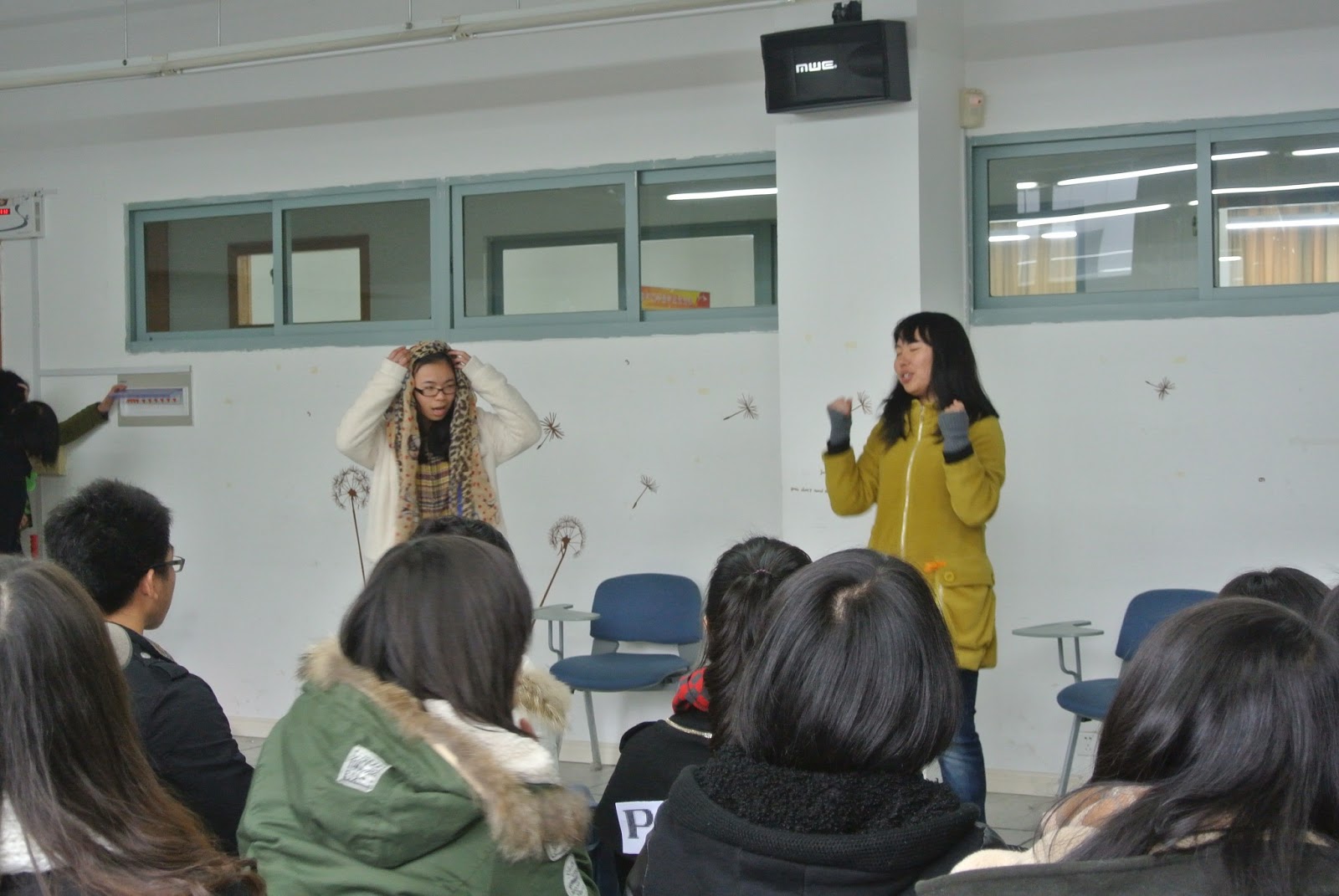
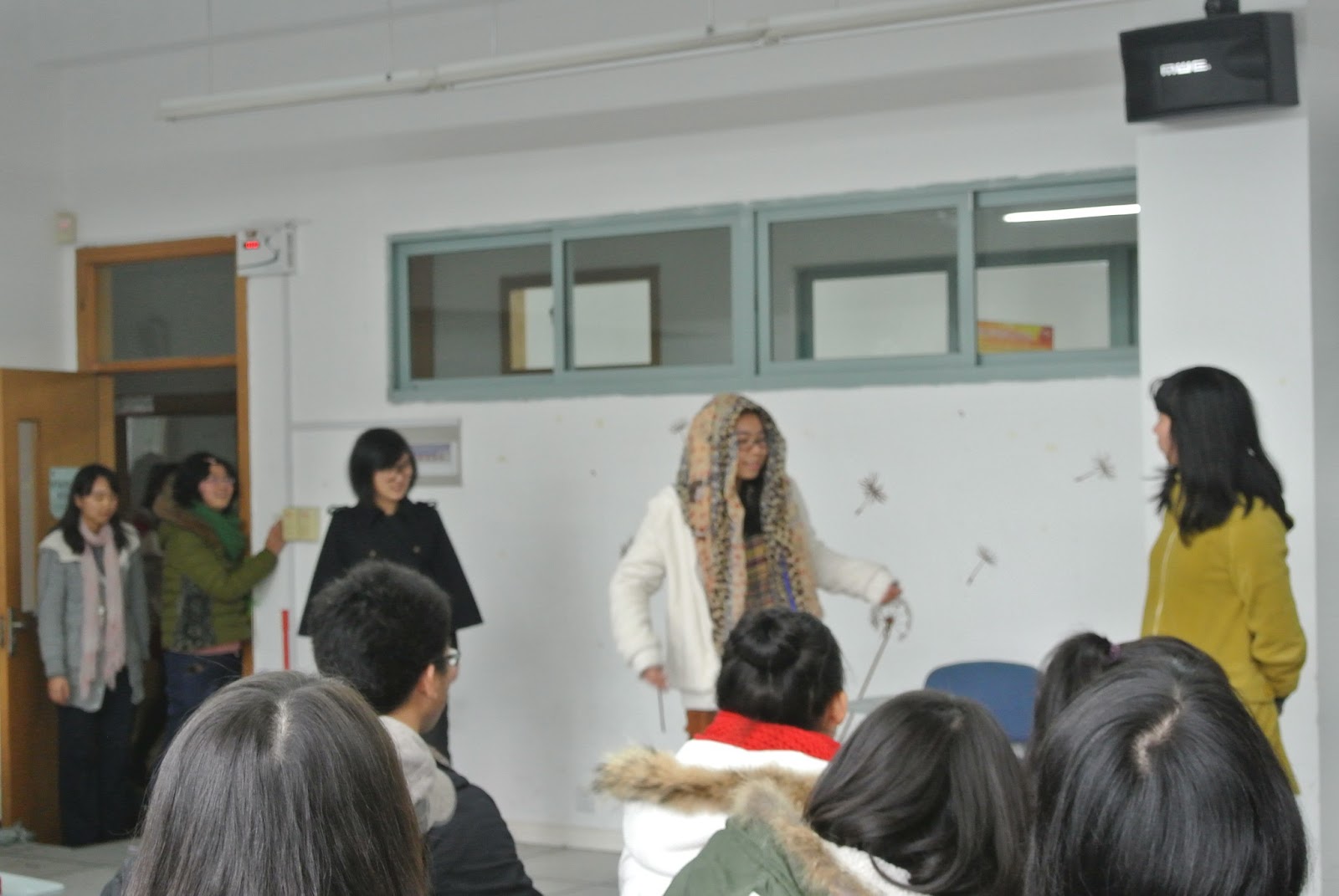
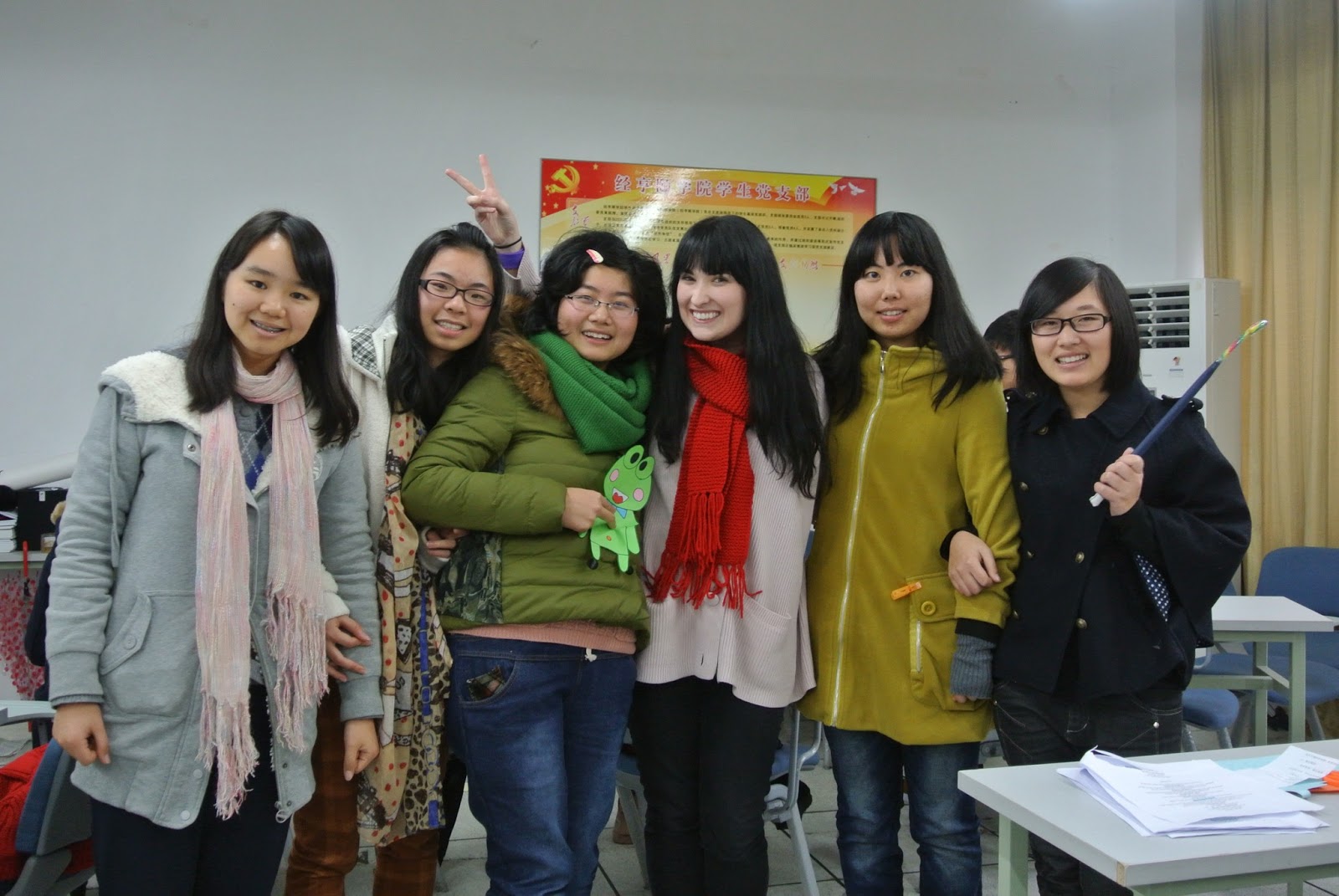
We met on the first day of class and we we outlined our expectations to our students. We explained that we would be learning Oral English using skits. We modeled a skit using intonation, body language, and expression (and also made our students laugh as we pretended to be a girl asking her mom for money so she could go shopping with her friends later). We explained that the majority of their grade would come from participating in each weeks class. We expected them to be talking (in English, or course; we made our classrooms an English Only Zone) and fully engaged and prepared each week. The rest of their grade came from the final exam. We did not have a midterm.
In addition to their kickass syllabus was a detailed example of how to write a script, which would be turned into the teacher on the day of their performance every two weeks. We modeled writing said script (we really nailed that whole modeling thing). We set up a course email that students could contact us through and we occasionally assigned homework assignments that required them to answer us via email.
We explained to them that each person would be required to participate each week in the creation of the script and in the acting, and that each person needed to participate equally. What we meant was that you could not rely on the two most outgoing members of the five-person group to carry the majority of the skit; each person needed a part, and each part needed to have an equitable amount of stage time. Most students understood this and complied. We also (after the issues we had with acting out what they had written about in the previous semester) really hammered home the point that if they wrote, they would act it out; so make sure each person was comfortable with the script. And lo and behold, we had no issues with this this semester.
We did a two week rotation, where I would have half the class for two weeks and Liv the other half and then we would switch. This is nice because it allows us to have our own creative space in the classroom while still working together. It also allows the students to receive two different teaching styles and methods. And as a teacher, it is nice to have to only plan for two weeks to take up four weeks of classes. It also lets you realize what works and what doesn't work and what you need to change and gives you a chance to change it when you teach the next group.
We spent the semester working on four big parts of Oral English: intonation, expression, inflection/stress, and body language. I worked on body language and expression, particularly facial expression, while Liv worked on intonation and inflection/stress. You might be wondering where pronunciation fits in this, and of course we tackled pronunciation issues when we encountered them in class, but the problem with teaching pronunciation is, that other than the s/th sound and the l/r sounds, there is really little point in really stressing pronunciation for a couple of different reasons. One, there really is not a great deal of standard pronunciation in English--I mean, think of all the dialects just in America! It is more important that they get the syllable and sentence stress right, and the intonation. So we did a couple of combined lessons (the two of us in the same classroom with all of ours students) to address that s/th and r/l sound as messing those up does impact comprehension.
By the end of the semester, both groups showed marked improvement in all of our target areas (and I will provide specifics with how I taught my sections of this course in later entries). We were impressed with both groups, and even though I said earlier that the English proficiency was higher among the English and Chinese majors (as this makes sense--English is going to be necessary in their future careers) , the Math and Science students really excel in using facial expression and body language, and we were frequently pleasantly surprised with their performances.
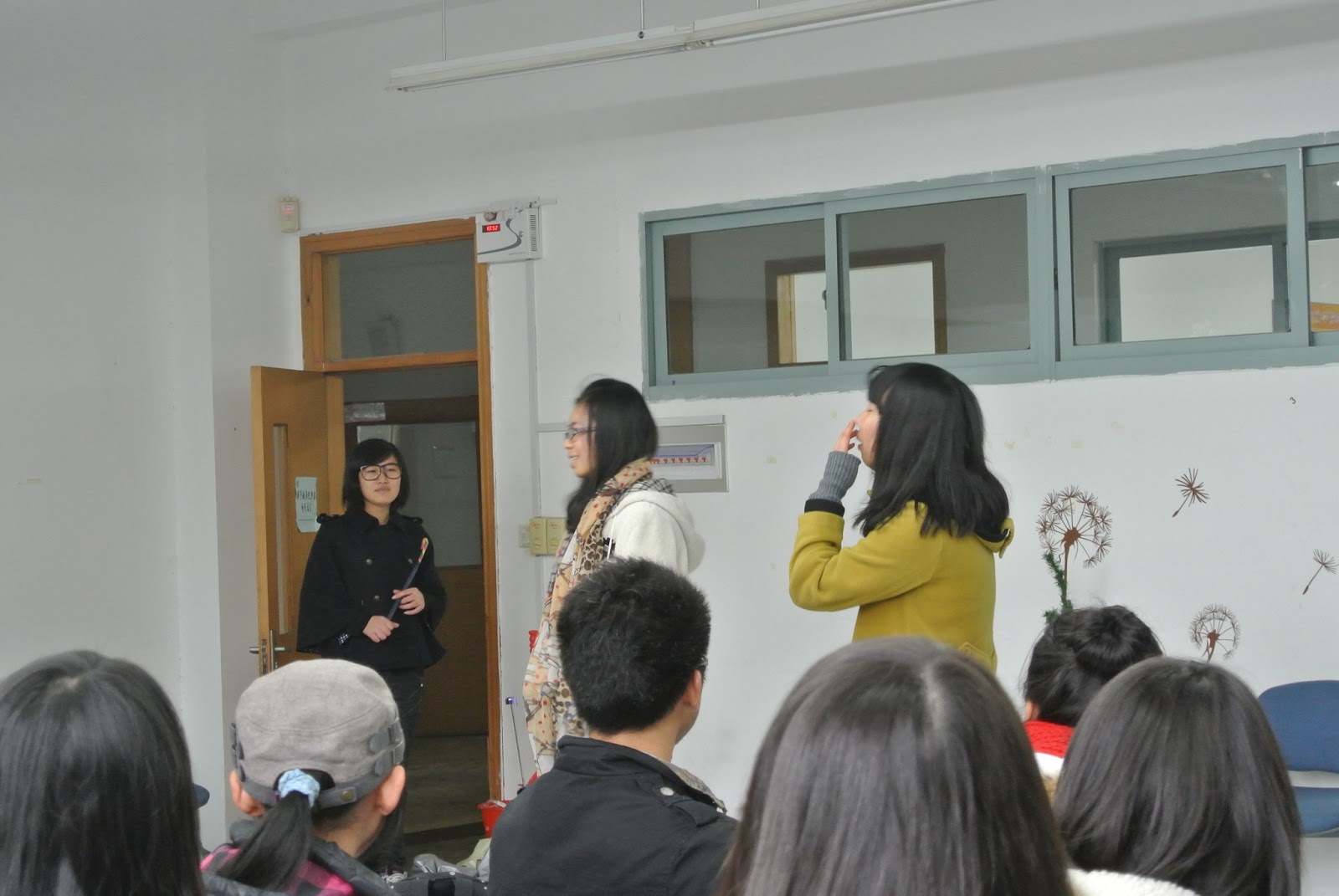
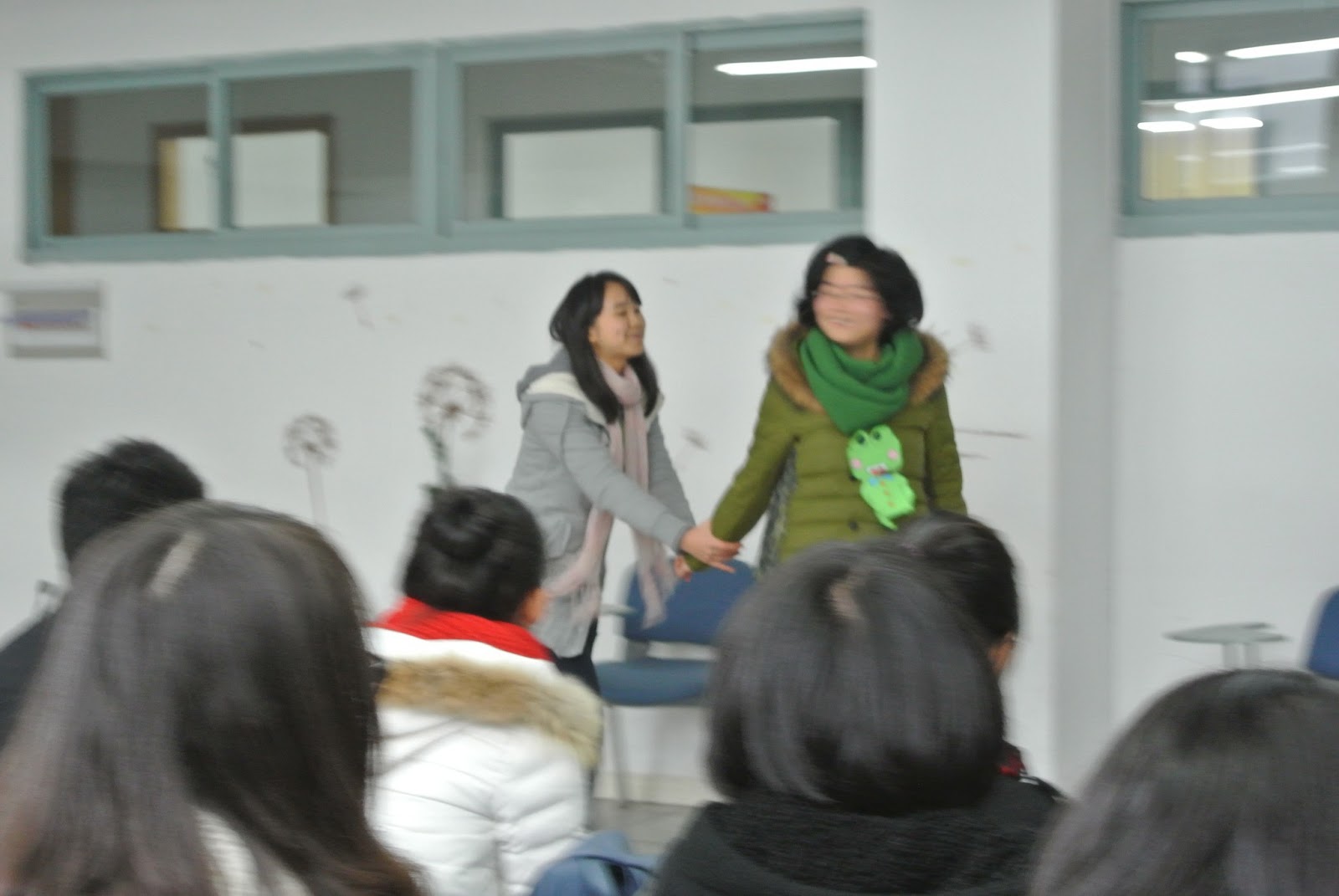
The final exam asked students to take a fairy tales (we did some searching on the internet to find the basics of about 12 different fairy tales) and modernize them. We explained what modernize meant and gave them an example. Most of the groups understood and with a few exceptions did fine on the first draft of their scripts (we allowed them a week to write and send it to us for feedback before their performance, and we addressed any issues with most of them during this process). They they had to take their modernized fairy tales and perform a 5-7 minute skit. And we were quite pleased with the growth they had shown in each of the areas, as well as the humor and creativity with which they rewrote and performed their skits. There were very few students who, for various reasons, did not perform up to our expectations and we were very proud of the work they had done.
I feel like, while my previous sections of Oral English were certainly rewarding, and a great learning experience, it was a stressful learning experience. I felt that I took everything I had learned or not done quite as well as I wanted to the previous year and used it to make this section of Oral English as efficient and effective as humanly possible. And we had lots of fun too; Oral English can be a really fun class to teach, weather you are teaching Romeo and Juliet or Fairy Tales.
Specifics on how I taught body language and such to follow. I was going to post a video of the final exam for one of these groups, but for some reason, blogger is not cooperating.