Sunday, September 29, 2013

Beijing Part II: Tiananmen and the Forbidden City


Many of China's landmarks familiar to Americans are located within, or very near, to the city of Beijing.  We, as a whole, have not heard of the beautiful mountains in Zhangjiajie National Forest Park or the rivers and "Dr. Seuss Mountains" of Guilin.  We have heard of the Great Wall, the Forbidden City, and of course, we have heard of Tiananmen Square.

The names of the Forbidden City and Tiananmen generate simultaneous images of opulent royalty and the brutality of a nation in the grip of change.  The reality of this bustling center of Beijing is quite different from both of those images.  Personally, I love being in the center of Tiananmen Square.  In addition to being surrounded by a number of things to see and do, it is also one of the few wide-open, spaces in the middle of the city.
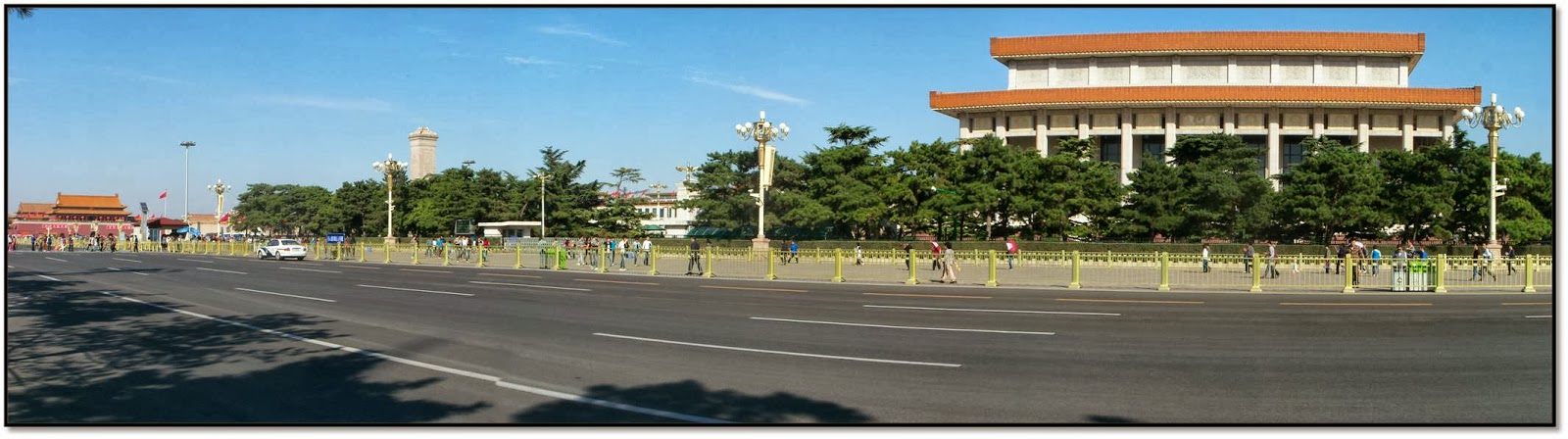
Panorama of Tiananmen in October, 2012
Tiananmen square is a giant rectangle in the middle of the city with a mausoleum on one end, entombing Chairman Mao, next to an ancient city gate, a statue to the People in the center, and the Forbidden City looming in the distance at the far end of the square.  Along the length of the square are government buildings and museums.  Chinese flags abound from all the buildings in the square, and in along a low wall 2/3rds of the way down the square is a giant LCD screen that highlights China's historic landmarks.  In the center of the square walk tourists, both foreign and domestic, taking pictures of the center of the capital city.

There is quite a bit to see and do in Tiananmen Square, even before you get to the Forbidden City.  The first being to tomb of Chairman Mao.  This is no ordinary tomb; Chairman Mao is not buried, but rather displayed in a hermetically sealed, glass-topped coffin, on display to the public throughout the year.  I tried to go see Chairman Mao on my first three visits to Beijing, but I was thwarted, twice by him being closed to the public, and once by mistakenly trying to see him on National Holiday (never go to Beijing on National Holiday, its packed).  Needless to say, by my final visit in December I was itching to get in and see him. Mostly because I had been thwarted previous times, but also for the novelty; there are not too many places where you can seen the bodies of long dead political leaders.

Shots of Tiananmen, and all the way to the right, a shot of the gate at the far end (opposite of the Forbidden City) of the square. 
Seeing Chairman Mao is quite the process; you must have sleeves and shoes that cover your feet (no tank-tops and flip flops) as this is disrespectful.  You are not allowed to bring any of your personal belongings into the tomb with you, but there is a building off of the square where you can rent lockers in which to place your belongings.  You cannot bring a cell phone or camera into the tomb with you, and as you approach the tomb, you go through security; they scan you, pat you down, and ask you repeatedly in several languages whether or not you have a phone or camera.   You show them your passport or ID and are then allowed to go through, you are asked to be quiet and to make no loud or disrespectful sounds.  You enter into the building into a wide hall where you can deposit flowers, you then walk around the flowers and into a narrower chamber.  Across a barrier is the glass topped coffin with Chairman Mao.  For someone who has been dead for quite some time, he is looking pretty good.  I do not have any pictures of him, of course, because it was not allowed, but I did buy a necklace with his profile on it.  And yes, I wear it.
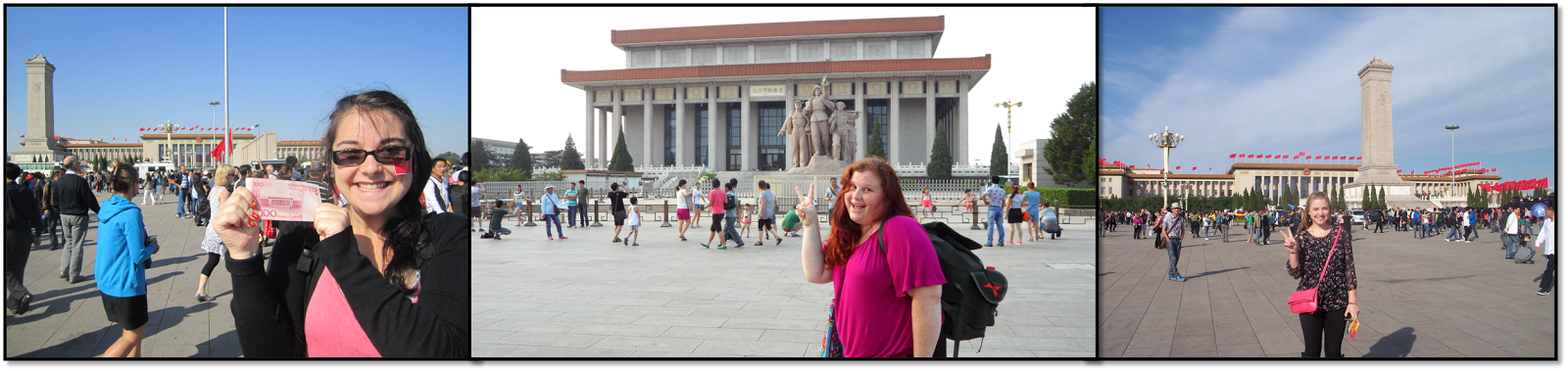
Left: The building in the background is also on the 100Y.  Middle: Becky outside of Chairman Mao's tomb.  Right: Liv in the center of the square, with the Statue to the People in the background
After seeing Chairman Mao, you can stroll through the square and take in the government buildings and the statue in the center, making your way towards the Forbidden City.  These not really a leisurely stroll, as there are typically a zillion people taking in the sites with you, unless you go during the middle of off season--January, which is cold and miserable.  Also, there are tour guides who approach you, fluent in several languages, trying to get you to book them for various tours.  I do not recommend a tour guide for anything in the city of Beijing; their are automated self-guides in dozens of languages at all of these locations, and all the signs are in English as well as Chinese.  So your best bet, is to firmly say "no, thank you" and keep up a brisk pace.
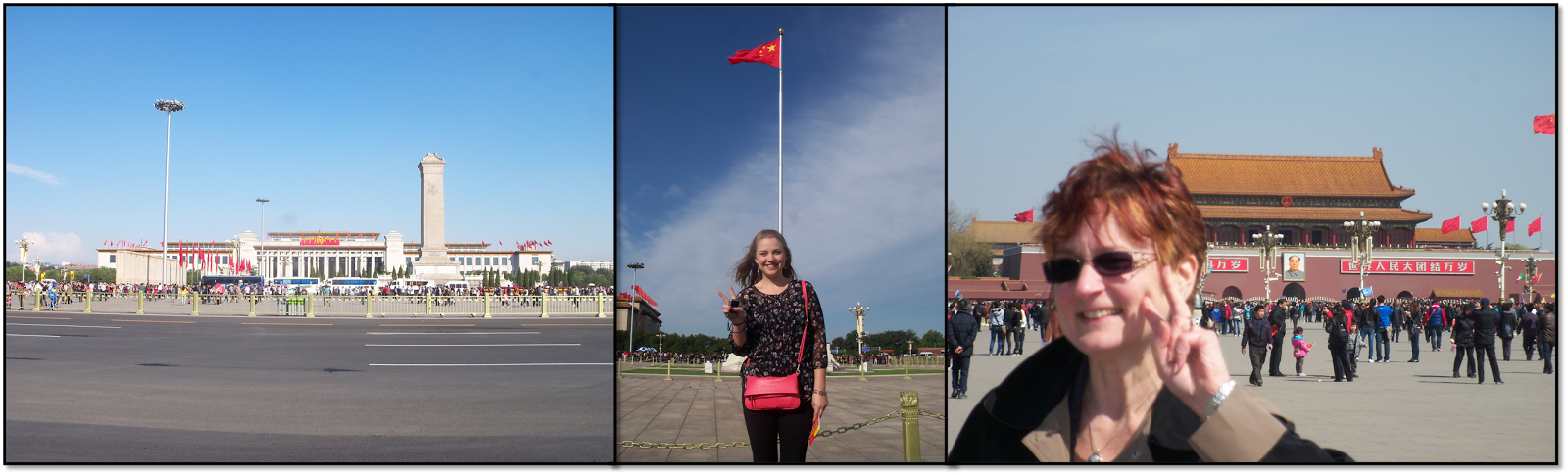
Left: Center of Tiananmen Square from across the street.  Middle: Liv and the Chinese Flag, National  Holiday, 2012.  Right: Mom at the far end of the Square with the Forbidden City in the background in March, 2012. 
You can see a giant photo of Chairman Mao on the outside of the Forbidden City (also called the People's Museum), which from the square just looks like a massive expanse of red wall, topped in gold tile.  Now, there is a very good reason it is called a City, and not a town, village, or hamlet.  It's huge.  If you want to fully explore this site, do not plan on doing more than seeing the Forbidden City that day.  Now, each Garden of Tranquility and Square of Illuminating Inquiry all start to look the same after about four hours, so it is possible, even recommended, to simply wander around until you have seen enough and then leave.  If you do this, you can get in and out of the Forbidden City in a couple of hours.  However, if you want the full experience of the Forbidden City, it can take you from the time it opens at 9:00 am until it closes at 4:00 pm.  It is literally a maze of halls, squares, and gardens, not to mention the inside museum sections, which feature relics from various eras.  And believe or not, the whole thing is not even open to the public!

Exterior of Forbidden City; you have to walk through about three gates until you are actually inside. 
My favorite part of the Forbidden City is the architecture; I am not a huge fan of the red walls and gold roofs, but I love the stone staircases, bridges, and archways.  The stone is all carved, with detail work on the railings and newel posts.  In between the staircases are also elaborately carved murals of dragons and clouds. Occasionally the tiles on the floors are also intricately carved. I also love the detail work near the ceilings; the arches and windows are all painted, along with many of the ceiling tiles.  Perhaps my favorite part of the City is the Empress Cixi's garden; there are these enormous rocks, tumbling through the garden, trees, and painted pagodas.
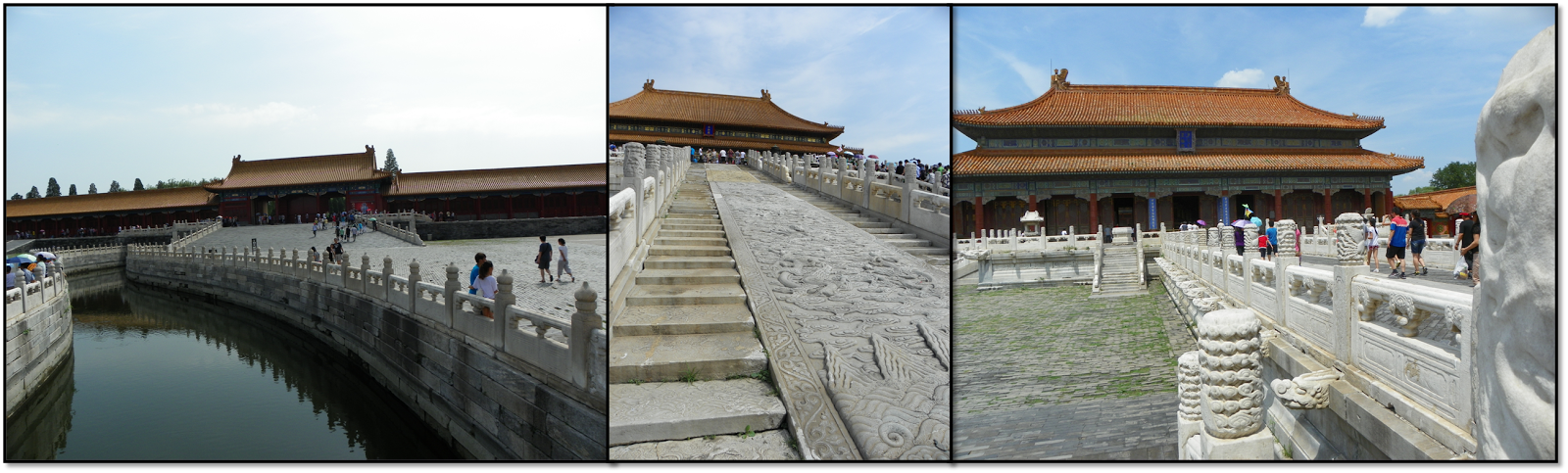
Some of that architecture that I love, the stone work above.  More architecture and the gardens below. 


The Forbidden City is totally worth the visit if you are in Beijing, but there are some things you should watch out for.  The first is the tourist scams that exist in certain parts of the site.  Now, of course everything is going to be over priced, and if you feel like bartering, you can purchase identical merchandise for much less elsewhere in the city.  If this is not a concern for you, than just snatch up your Forbidden City swag in the gift shops.  Now, there is one gift shop that will likely have a woman outside of it, asking you to come inside and look at some student art work.  She will take you inside of a perfectly legitimate souvenir store, and into a room to the side of the counter.  Inside are paintings, and there is a good chance that they will not let you leave this art closet until you purchase one of these highly overpriced paintings.
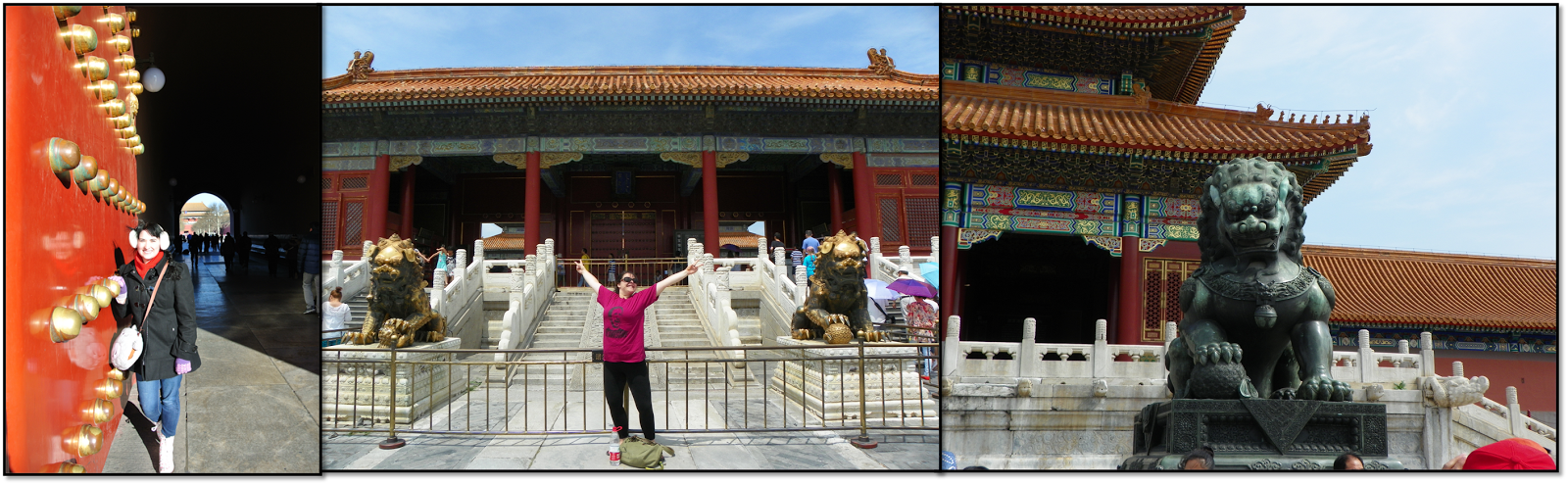

When it's time to leave the Forbidden City, I highly recommend walking back to the beginning and exiting out the east exit, near the entrance.  If you leave out the back entrance, you are several city blocks away from Tiananmen Square, and the subway.  It is a long walk, or a highly overpriced rickshaw ride; if you have to walk all that way, you might as well walk back through the major historical site, snap some more pictures, buy a few more souvenirs, and maybe hit up one more Corridor of Everlasting Effervescence.  Because, hey, when are you going to see the Forbidden City again?


When you finally find your way out of the Forbidden City, you can explore the buildings around the square, which include many museums.  Or you do my favorite thing, which is just to walk around the square, people watch, and marvel at all.

R.
Cross Cultural Reading IV: Book Talk


As I have mentioned in previous blog entries, I really love reading.  When I got the chance to teach a cross cultural reading class, I was pretty excited.  One of the projects that I knew I wanted to include in this course was a book talk.  I wanted this project for two reasons.  The first reason is that it would further expose my students to western literature as well as English.  My second motive was for having the opportunity to speak with them one-to-one about their reading and this course.

I told my students that I did not care what they read so long as it was written in English (meaning they could not go find the Chinese version of this text), it was written by an author from an English-Speaking country, and it was not either Twilight or Harry Potter.  The final reason was simply because the popularity of both those series made reading the books unnecessary; they could just say they read them, and be more than familiar with the plot from either having seen the movies, having read the Chinese version previously.   And I did not want to sit through 25 book talks about Bella and Edward. I also encouraged my students to read contemporary books, as opposed to the classics for two reasons.  One, the classics tend to be boring.  I am not saying they are not worth the read, if you've got the time and stamina, but they do tend to be somewhat dry.  The second reason is that the language in many of the classics is difficult to get through; from syntax, sentence structure, and vocabulary.  Remember, these are second language learners; I did not want them get frustrated or be disappointed with their selection simply because the book's language was too complex.

I included this assignment in the syllabus:

You will have an independent project: Book Talk.  You can choose any book you want, so long as it is written in English, and you will read this book.  You will then meet with me at a separate time to have a conversation about this book and how it relates to our theme of identity.  I want you to think of these questions as you are reading this book.  Which character do you identify with? Why?  Who is this character? How did they get their identity?  What has made them into the person they are? I will ask you further questions about this character in our meeting.  I will have meetings once a month on.  We will sign up for these meetings on our 2nd class.  

I did not go into a great deal of detail on the first day of class about this assignment, as I had a lot to get through, with the syllabus and getting underway with the content of the class.  On the second class, I went into detail on this assignment and asked my students to sign up for a date for the book talk.  The earliest possible book talk wasn't for over a month, so I did not feel too bad about making them sign up so early in the semester.  For one week each month I was available on Mondays, Wednesday, and Fridays to meet with students to discuss their books.  If they could not make any of these dates, they contacted me via email and set up an alternative time.  My students panicked (despite my reassurances) at the idea of reading another whole book in English, and I started nervously counting down the days until our first book talk.  

I was concerned that maybe they would not read the book...I mean, we've all been students, and we have all faced (and sometimes given into) the temptation of just looking the book up on the internet.  And these were all English majors, they had a lot of work to do, and this was only worth 10% of their final grade.  I was afraid I was going to have 25 book talks where they were unable to fully answer all the questions, because they hadn't read the book.  But it turns out that I needn't have worried.  While some of my students did struggle to answer these questions, indicating that they either didn't read it, or perhaps had read it a long time ago and were working from memory, the majority of them demonstrated in our talks that they had read the book.  Not only had they read it, but they seemed, overall to have enjoyed the reading.  

I learned that they were also anxious about the book talk.  They were concerned that, despite going over my expectations for the assignment, I was going to ask them specific plot questions...kind of like a test. While I regret this anxiety, I do believe it is likely the reason they had read the books so thoroughly and were able to discuss what they'd read in detail.  So, it turns out we were both needlessly nervous. 

I met my students one-on-one in my office during my free time during the week, for half hour intervals. I did not want to get right into the "important questions" when they arrived, because they were all visibly nervous. So I asked them first if they'd enjoyed the book and why; many of them told me that they'd liked it, and were able to describe characteristics about the characters or the story line.  The few who were open about not enjoying the book they'd selected were equally as able to point out specific reasons for their dislike. 

I then asked them the following questions: Give me a brief summary of you story (this was largely for my benefit, for the books with which I was unfamiliar). What character did you identify with? Why?  What about that character 'spoke' to you?  What is the character that you least 'identified' with?  Why do you think you did not identify with that character?  If you could change anything about the story, what would you change and why?  What did you learn from this book?  

I was very pleased with the depth of their answers.  They were able to pull apart the characters, compare their own lives and experiences and cultures with that of the characters.  They had some creative ideas about how the story should have been different (or in one student's case, why it was perfect just the way it was), and they were able to articulate why they felt that way.  I asked them further questions about why they wanted those changes specifically, and many of them were able to reference certain personal or cultural influences behind those changes. 

I would certainly do this assignment again; it allowed me to focus on my students in an individual setting, allowing me to get to know my students a little better.  It also allowed me to explore their understanding of our focus on the theme of identity on an individual basis, and allowed them to further explore this theme through a self selected book.  It also further exposed students to English books without taking time away from the books we were exploring in our class each week.  And I got to talk about books; an all around win 

Tuesday, August 13, 2013

Beijing Part I: The Great Wall


The part of Beijing I was most excited to see, was the Great Wall.  We all (my visitors) wanted to see the Great Wall.  I mean, come on, it's the Great Wall!!  It's one of the world's most recognized national monuments.  In 2007, it was voted as one of the new seven wonders of the world.  You can see it from space! (Well, I think this might have been disproved, but it sure sounds cool!).

I have made hints before about how my American education made my knowledge of China somewhat limited.  Well, I am sorry if this offends you, but it's true--unless you take fairly specific courses in college, most Americans do not learn too much about China.  We do, however, learn about the Great Wall of China. I remember learning about how this emperor demanded it be built in order to protect his boarders against nomadic warmongering tribes, commandeered a bunch of peasants, and when they dropped dead from exhaustion, had their bodies thrown into the construction site that would eventually be the Wall.  The Great Wall (along with Pandas) also seems to be the images that we associate with China--Google search China and see how many times the Great Wall pops up.  Needless to say, everyone who came to  China (myself included) wanted to see the Wall.

Pic of some characters on the mountains declaring loyalty to Chairman Mao (I believe), and Mom on the Great Wall!
The Wall did not disappoint.  It's huge, it stretches for hundreds of miles, it's ancient, and huge sections of it are totally accessible to tourists.   There are a couple of different ways to see the Wall.  I recommend booking a trip with your hotel or hostel, as this is usually safe and at a fairly reasonable price.   They will also have different trip packages, to different sections of the wall, which offer a different experience.  Many of them will take you to a section called Ba Da Ling; it is the most famous stretch of the wall, but it is also the part that has had the most renovation--it does not look ancient at all.  The next most common section is Mutianyu--this is a pretty awesome part of the wall because it has been renovated just enough to make it safe, but there are still lots of large, crumbling sections, and the view of older parts of the wall and mountains in the distance makes this place totally worth it.  However, there are further sections of the wall that are remote and not renovated at all.  If you are looking for a completely authentic Great Wall experience, I would recommend trying to go for one of those.  They will take you out for a day trip, and some places also offer a two day hike, where you actually camp along sections of the wall.  It all depends on the experience that you want to have.  Again, I would look to a hotel or hostel, or find a reputable tourist group before coming to China, to navigate the more remote areas of the Wall.
Shenanigans on the Great Wall, July 2012 
My first time visiting the Wall (and Beijing) was in March of 2012, with my mother.  This is right in the beginning of spring, so it was not cold, but the landscape around the wall is not lush and green, but still brown and hibernating from winter.  This does not afford a lot of contrast between the wall and the surrounding environment, but on the plus side, it does mean that the view of the wall is not blocked by the jungle that is normally growing there; you have an unrestricted view, until it curves around the mountains. We booked our tour through our hostel (365 Inn was our hostel, and I highly recommend it!) to see the Mutianyu section of the wall.  If I hadn't have liked any of their tours, however, I could have gone to one of the dozen or so hostels nearby and checked out what they offered--you don't have to stay at a hostel to use their tour bookings! The hostel took care of contacting the tour group, told us to be ready to go at (uhgg) 7:30 am the next day.

Great Wall in March
The tour group picked us up at our hostel, we made a couple of stops at other hostels for more tourists, and then we began our trek out of the city of Beijing.  Now, the wall is not right in town; it is in the mountains, and depending on traffic, this is about a two hour trip.  Which is just fine, because you get to hear some interesting stories about the section of the wall you are about to visit. You get the wall around 9:30 and you have until 1:30 to explore at your leisure before meeting back up with your tour group for a quick lunch and a ride home.   This is plenty of time to see a fairly decent chunk of this section of the wall.  You take a cable car ride up to the wall (for about 80 RMB, but it is worth it because it shaves off the 40 minutes it takes to walk up to the wall).  If you are at all weary of heights, this cable car is going to cause you a bit of anxiety, but it is totally safe.
Echo, our tour guide giving us a few last minute pieces of advice before turning us free, our cable cars, and my particular reaction to heights...
I visited this particular section of the wall again a few months later, in the summer, and was very glad I did.  This time everything was in full bloom, and while the view was restricted by all the foliage, seeing the sections of the wall peek out from the greenery, seeing that contrast, was worth the second trip.  I also got to see one of my good friends attempt to climb the Great Wall.  You may be wondering what I mean when I say climb...well, what seems to escape the notice of most foreigners (myself included) from all those lovely pictures of the Great Wall, is that it is actually a giant staircase.  There are very few sections where it is simply a rolling pathway; most of it is steps.  And not even steps--some steps are barely a few inches high, and some steps are about 1 1/2 feet high.  Some steps are on a nice sloping incline, and some steps take you almost vertically (seriously, we were on our hands and knees at one point) up the side of the mountain. And going down is not any better--now you get to look at this vertical drop and hope you don't trip, cause you know you'd feel that mistake for weeks.  Needless to say, any trip to the Great Wall is going to require a bit more endurance and stamina than most tourists expect.

Scary stairs...manageable stairs....and scary stairs again! It was back and forth the whole way. 

Coming back down from this section of the wall is also a treat.  You can take the cable car back if you wish, or you can choose to take the Toboggan.  Becky, the friend who came to visit me on the summer trip, wanted to Toboggan.  And I am glad she talked me into this; it is basically a sled, with a pull break, that you cruise back down the mountain side in.  If we hadn't been stuck between a tiny elderly lady who rode the break the whole way down in front of us and a few crazy Germans who didn't bother with he break at all behind us, it would have been totally fun--though it was still totally worth the ride.  Below is the video of said ride.


My third and last visit to the Great Wall took place on my fourth and final trip to Beijing this past December. I do not recommend going to the Great Wall in the winter if you have a choice; it's in the mountains and it's hella cold.  However, Amanda, who was visiting, had it on her bucket list to see the Great Wall of China.  So I was going to make that happen, darn it.  To avoid certain death, I decided to take her to the Ba Da Ling section.  I figured the renovated nature of this section would prevent us from injuring ourselves (the other sections are uneven, crumbling, and not well maintained--adding a layer of snow and ice would surely result in an injury).  Despite visiting the wall on the coldest day of the year, I was really glad that we did.  One, Amanda's reaction to seeing the Wall was fantastic.  Two, the Wall (and surrounding mountains) covered in snow was really freaking pretty.  Lastly, we managed to convince a third friend, and current native of Beijing, to come with us, resulting in a fun few hours of hiking, sightseeing, and funny photo ops.  Additionally, he showed us how to take the public bus system right to the wall--no tour group or nothing!  Plus, this particular section has what basically amounts to a sedate roller coaster which takes you up and down to the wall.

Pretty Winterscape on the Great Wall, Life List further completed, and monkeying around on the Wall.  All in a day's adventure. 
If I learned anything from these multiple trips to the Wall, it's that the Wall is completely worth a visit if you are going to be anywhere near Beijing.  Do not let the season stop you; it really is majestic in any season, whether you are sweating under layers of winter clothes or sweating in a tank top (cause you will sweat on those stairs!) the Wall is something to see.  So bring your climbing shoes, a bottle a water, and some energy, and tackle the Great Wall if you are in Beijing.

Great Wall in Spring, Summer, and Winter...it's all pretty awesome.


Saturday, August 10, 2013

Chinese Food: Nostalgia and Desperation

I love Chinese food.  I mean, I love Chinese food. I liked American Chinese food before coming to China, and once in China, I definitely fell in love with Chinese cuisine.  However, once you come back to America, and go back to your local Chinese Takeout...well, it just isn't the same.  If you live near a big city, of course you can probably find a few authentic Chinese restaurants that sell some of what you ate while you were in China, but I have not had a lot of luck locating said restaurants in my hometown.

Therefore, I have had this idea sort of cooking around in my brain for the past few months...emphasis on cooking.  I figure, I know what it is supposed to taste like, right?  Can't I just play around with some of the simple dishes until I get the flavor right?

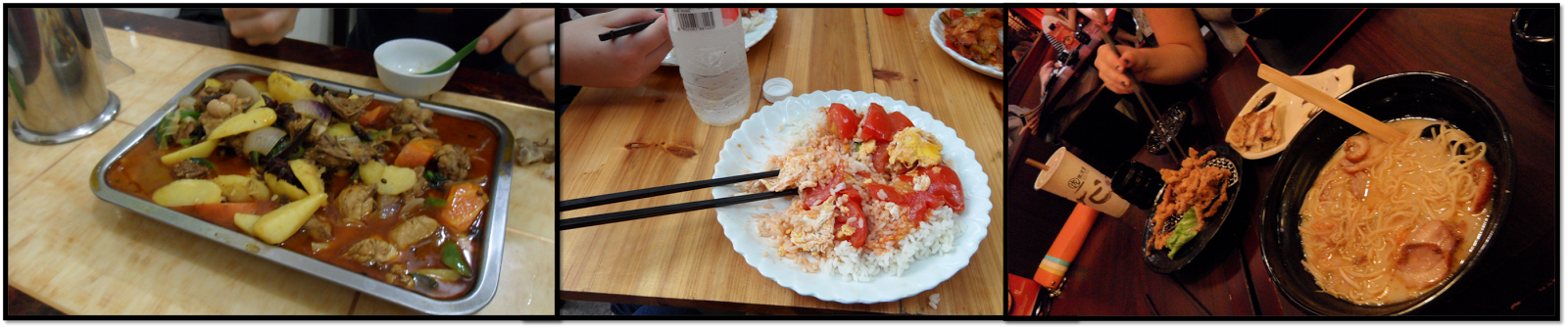
Big Plate Chicken, Egg and Tomatoes, and Duck Noodles
Now, I am by no means a cook.  In fact, it hasn't been until the last year or so that I dared anything more creative than boiling water.  But I have been watching.  I have been watching Chinese people cook, I have been watching my fellow foreign teachers cook (I cook with them, but my skills are limited to mashed potatoes and corn), and over the past six months of being home, I have been watching (and sometimes helping) my mom cook.  And I have been learning.  I stayed for a week in my grandmothers house and managed to tolerably cook a chicken breast, rice, and a veggie.  Armed with such success, I turned again to the notion of trying to recreate some of my favorite Chinese dishes.

However, I still did not take that culinary leap until today.  Just the other day, I was talking on the phone with a former foreign teacher friend of mine, and I was bemoaning my lack of Chinese cuisine in my daily life.  He took it upon himself to assign me a homework assignment (teachers, sheeeesh!).  He told me that I had a month to recreate my favorite dish: Yuxiang Qieze...or fish-scented eggplant--which is a lot yummier than it sounds! I made a lot of excuses about not being able to find the right seasonings, that I couldn't cook, blah blah blah.  Then I got kind of annoyed with myself: I was essentially bitching about the lack of something I wanted, but not taking any practical steps to fix it.  So, I accepted this food challenge.


I did not want to start with Yuxiang Qieze...it seems complicated.  Instead, I decided to start with my second favorite dish: Eggs and Tomatoes.  The very next night, I took myself to the store and bought a ton of eggs and tomatoes, and chopped green onions.  I armed myself with looking up variations of the tomato and egg recipe, along with watching a YouTube video explaining how to make it.  I figured if I messed this one up, I would abandon my quest towards fish-scented eggplant...but if I succeeded....well, maybe I would have one less reason to miss China.

Needing proof, I had my father help me turn it into a video, which is posted at the bottom of the blog. It was touch and go for a little while there (see about 5:40) and I was pretty anxious the whole time that it would taste terrible.  And while it did not taste 100% like the dish I ate on an almost daily basis in Hangzhou, it tasted pretty darn good.  I think the variation in taste can be attributed to the use of different oils and seasonings.  This just means that I will have to play around with it a little bit more, now that I know that I can make it.


If you want to see me struggle for ten minutes, watch the above video.  If you want to see how this is actually made, I recommend this lady's video here: http://www.youtube.com/watch?v=FRfLNGE2YUo. She does a great job showing you how to make it and I combined her recipe with some others I found online. You can also run a Google search on Chinese egg and tomato dish, and you should come up with several variations on the same recipe.  Wish me luck on my next culinary excursion!


Friday, August 9, 2013

Beijing: An Introduction


Beijing, the bustling metropolis that is China's capital.  Before I went to China, I really had no idea what my salary would be like or my schedule would be like; so I had really no idea how much traveling I would be able to accomplish.  However, I knew that I wanted to see Beijing; I mean, come on--the Great Wall, the Forbidden City, Tiananmen Square?! Beijing, and the things located in it, was pretty much all America had taught me about China, so I was going to see that city, darn it!

A panorama of Tiananmen Square
Little did I know, in the early days of fall 2011, that I would see this city no less than four times. Four damn times.  Now, some of you might be thinking, "seriously?! Is she seriously complaining about seeing the capital of China too many times?!" And trust me, if I were reading this, I would be thinking the same thing about me too.  But let's face it, it's like with (almost) anything; the more you do it, the less magical and more routine it becomes.  Let's compare it to Disneyland, for example.  Kids who have gone there once in their whole lives talk about how it is the most magical place on Earth.  Kids whose indulgent parents take them every year...well, for them, it's just another place, with its ups and its downs.  That is how I feel about Beijing; it's got its pros and its for sure got cons.  Trust me, there is only so many times you can walk through the Forbidden City.

Sometimes we decided to take the cheapest way possible to Beijing...sometimes we took the nice trains. did I ever take pictures of the nice trains?  Nope. 
Other than Hangzhou and Shanghai, Beijing is the city I spent most of my time in, and this is due to the fact that so many of my wonderful friends and family did follow through on their promise to visit me in China.  Let's face, we all talk a big game when it comes to visiting and keeping in touch with people when you move on to the next phase of your life.  But realistically we know that most of the 'keeping in touch' will happen via Facebook, phone calls, email, and the occasional Skype call.  And when one of your friends decides to up and relocate herself to China, well expecting visits from friends is understandably...unexpected.  I did have three visits from home, however, in the form of my Mom, Becky Burch, and Amanda Woomer, each of whom came at different points during my stay in China.  And each of whom really wanted to see...The Great Wall.  Which happens to be located (well, the most convenient location) in Beijing.

Yet another less-than-comfortable train ride from Hangzhou to Beijing.


On the plus side, I became an expert on the sights of Beijing.  I knew how to get to all the touristy spots, I understood the subway system, I knew which hostels were good and which ones to avoid, I knew where to get the best Peking Duck at the most reasonable prices, I knew which tourist traps to avoid, and where to go if I wanted to barter for souvenirs.  I also got to relive the wonder of seeing these places the first time by watching my friends and family experience it for the first time, which was awesome.  They also conveniently timed their arrivals in different seasons, so I did actually wind up seeing the city and many of it's attractions in the spring, summer, fall, and winter, which was kind of cool.

Oh look, I found some pictures of the nice, high speed trains.  These bad boys will get you from Hangzhou to Beijing (about at 800 miles) in six hours.  The slow trains featured above will make the same trip in anywhere between 13 and 22  hours, depending on the quality of the ticket your purchased. 
Since I have been to Beijing no less than four times, I decided to do a four part series on my adventures in Beijing, highlighting the various places and activities that can be seen and done in the capital.  So, if you are at all interested in this city, stay posted.


Thursday, August 8, 2013

Cross Cultural Reading Part III: Independent Writing Assignment


When I began this course, I knew that I really wanted to explore my student's writing.  I had them for Oral English the year before, and in the very limited writing that that course allowed for, I knew that I had some very expressive and creative minds; I wanted to give some of my more quiet students a chance to explore their English writing, and I wanted to get to know my students better through their writing.  I have previously discussed my use of journals in this course in a previous blog, but I wanted to provide an opportunity in the class for creative writing. 


What originally interested me in their creative writing was actually in their performance during the Oral English class the previous semester.  We'd asked them to re-write one act of Romeo and Juliet in a different genre (either action, horror, or science fiction).  They did such a wonderful and creative job with these scripts, I wanted to see what would happen if they were given the opportunity to write creatively in a course designed around writing. 

The first two short stories that I had my students read were Lamb to the Slaughter by Roald Dahl and Hills Like White Elephants by Ernest Hemingway.  If you you have not read either of these stories, a simple Google search will provide you with websites where you can read the full text.  My students really enjoyed the surprise ending of the first story, and the struggle to figure out the topic of discussion between the two main characters in the second story.   After amply discussing both of these short stories in class and exploring some of their themes through journal and group work, I decided to make their first independent writing assignment based on these books.  Below is a copy of the assignment I gave them; we discussed the requirements in detail before ending our class that day. I gave them two weeks to complete the assignment, and we did not really discuss this assignment or the two texts after the assignment was distributed; I asked each class if they had questions, but they never really had any questions...


This lack of questions really started to ratchet up my anxiety over this assignment.  Was it because they really were completely fine with the assignment-- 100% understood what I was asking of them?  Was it because they were too shy or nervous to ask about it?  And why were they nervous, we had been working with the building trust for over a year now?! Or was it so confusing that they just had no idea where to even begin asking for clarification?  Or did they completely misunderstand the assignment and were currently writing who-knows-what?!?! Being a beginning teacher is fraught with such second guessing and self doubt as the aforementioned thoughts that plagued me for the next two weeks. 

As it turns out, I had very little to worry about. I received emails from a few of them about a week before the deadline, asking me to read through their papers, and the ones who emailed me seemed to understand the assignment completely.  They came into class, each of them with these neatly stapled packets of paper, which they promptly took out of their folders and books and laid on their desks.  Instead of discussing their journals this week, I had them discuss their stories, and pass their stories around.  We spent an hour reading and appreciating each other's work.  I joined in with several groups, bringing my own creation with me (never ask your students to do something you haven't done--so I wrote a story too) and we read and gave feedback (written and verbal) on each other's work.  Before we dismissed class that week, I asked them if any of them had any trouble or if they had any overall comments.  Many of them talked about how much they enjoyed the project, and many of them commented on how much longer their stories wound up being that what they had anticipated.  
An excerpt of student writing of Option 2, adapted from Lamb to the Slaughter.

After hearing snippets of their stories and only reading a few completely through during class and via email, I was itching to get them home to read them; I don't think I have ever been more excited to grade something in my life.  Again, I was not disappointed.  The majority of the students chose to write about Option 2 (myself included) and either chose Patrick from Lamb to the Slaughter or the man from Hills Like White Elephants.  A few of them chose to give Jig (the female character from Hills) an inner monologue and therefore give more depth to her character.  The second most popular option was Option 3, and it was split between continuing the story in Hills and talking about what happened to Mary after the end of Lamb. Only one student chose to interview one of the characters. 
An excerpt from a student' writing, adapted from Hills Like White Elephants, also Option 2. 

There were only a handful of students, perhaps 4 out of the 25 students in the class, who needed to make some additions and corrections to their stories.  Most needed to add more detail.  For example, the girl who chose to give the inner thoughts of one of the characters was only giving 1-2 word thoughts at a time, so I asked her to elaborate.  Another girl was simply not focused enough; she had too many directions to take her story in, resulting in a somewhat chaotic narrative. I was extremely pleased with the level of creativity of my students and with the quality of their writing. I did some grammar/syntax corrections on the papers, gave them feedback on additions they needed (if they needed them), and gave them lots of positive feedback on their stories as a whole. 

This assignment was spectacularly effective.  It allowed them a certain creative freedom, which they seldom get in their classes.  It allowed them to practice a more authentic writing style, as it could not depend on those canned phrases they were taught to use for academic writing.  It allowed them to explore the issue of identity and the creation of identity by giving more depth and identity to these characters, and then discussing how and why they chose such identities.  What caused them to write Patrick off as a man who simply fell-out of love with his wife?  Why did they decide to make Mary insane?  Why did they decide the man at the train station was actually married to Jig?  Why did they write what they wrote?  Additionally, the assignment was wonderfully entertaining, not only for my students (because I really did believe they enjoyed writing it), but also for me; I got to know the creative, dramatic, and occasionally humorous side to their writing and to their personalities. 

Tuesday, August 6, 2013

Xi'an

So nearly a year ago--holy crap, how does that happen?!--Liv and I decided to see some other parts of China.  We also decided to do this as cheaply as possible (due both to our salary, and, on my part, my loans from graduate school).  This meant the cheapest (and longest!) trains and hostels...but unlimited adventure!

It's an adventure!!!
One of the places we went (our final destination, actually) on what we began to call Budget Tour was the city of Xi'an.  Xi'an is located northwest of Hangzhou and is famous, among many things, for being the home of the Terra-Cotta Warriors.  This is probably the most internationally recognized part of Xi'an and it is the reason we decided to add Xi'an to our list of things to see.


The Terra-Cotta Warriors are part of an extensive tomb system of Emperor Qin Shi Huang.  They are a form of art specific to tombs; in addition to being decorative, they serve as a way to protect the emperor in the afterlife.  The tombs are quite extensive, but only three (public) pits have been dug to excavate these national treasures.  The reason behind this is that the warriors are actually painted, but exposure to air rapidly deteriorates the paint on the surface, flaking off and leaving behind the iconic brown statues.

There are three pits that are open to the public, as well as a museum that explains the history and purpose of the warriors.  There are also several pits that have been excavated, their findings in the museum.  Additionally, there are several other pits that have not yet been excavated, in order to protect the quality of the art, and to prevent any vandalism or theft. The first two public pits are mostly empty, with fragments of statues of horses, warriors, and chariots.
Pit's One and Two

I am not going to lie, the first two pits were not particularly impressive, which was initially upsetting; as a history teacher, educated in America (which means we don't learn all that much about China) the warriors were one of the few things I had heard about before coming to China.  Therefore, it was one of the things I had really wanted to see.

Since the second pit had slightly more in it than the first pit, I was hoping they were saving the best for last.  I was not disappointed.  When we reached the third pit, we could tell that it was going to be something big; it was the largest concentration of tourists in the whole park.  You walk into the building and there is a balcony overlooking what is a football field full of terracotta warriors, horses, and chariots, all marching towards you. You then are shuffled around the perimeter of this structure, getting a look at the various warriors in different positions.  Along with the several hundred warriors, there are also techs working on excavating and cleaning new material (we were somewhat skeptical about this--were they really working in this pit, or were they sort of just there as part of the tour?)
Pit 3!!
I would say the trip to the Terra-Cotta Warriors was completely worth the trip to Xi'an, however, it did not turn out to be my favorite part of our final stop on Budget Tour.  My favorite part, among the many things we did in this beautiful city, was ride the old wall of Xi'an.  The wall encloses the center part of the city, and you can rent bicycles to traverse the entire wall (which by bike, and taking pictures all along the way only takes an hour or two).  We rented bicycles and spent a wonderful summer morning (the weather was gorgeous!) taking in the city-scape of Xi'an and testing the our bicycling skills: the wall is pretty, but is part of a (reconstructed) ancient city wall--this means bumpy and uneven.


While the ride on the wall was definitely my favorite part of the trip, we also explored some other of Xi'an's landmarks.  We visited the Mosque in Xi'an's Muslim Quarter, a lovely series of buildings, and lovely blend of Chinese and Middle Eastern Architecture.  We also did some pretty hardcore shopping in this district--purses and shoes and shadow puppets!  We ate several times in this district as well, as the food was different from what we normally ate in China, and it was delicious.

From left to right: the shopping district, Liv holding some lamb sandwiches, and me standing between one of the gates to the Mosque. 
Our trip to Xi'an was made complete by an accidental and unexpected sighting of one my favorite places: Dunkin Donuts...and even better, it was one attached to a Baskin Robbins!

Ahhh, Dunkin...an unexpected little taste of home...even if the pork and spicy beef floss donuts are not on the typical menu in New York.