Thursday, April 17, 2014

Hot Pot: Fon-Don't


So, China is enormous and consists of some 56 ethnic groups.  This means that the diversity of food is astronomic. Even if many of the ingredients stay the same, the flavor of different regional dishes changes dramatically.  For example, an eggplant dish in Hangzhou that was one of our staple dishes--when we went to Hunan province we ordered the "same" dish, but the taste was totally different (it was even more amazing!).

The same is true for a style of food called hot pot.  Many regions in China eat and enjoy hot pot, and many different regions have their own distinct style of hot pot.  However, hot pot seems to be largely associated with the western parts of China.

So what exactly is hot pot ? Well, it's sort of like fondue.  Except instead of tossing items into melted cheese or hot oil, you are using boiling water.  The first thing you do when you sit down at your hot pot table (usually round with a big hole in the center) is choose the kind of water you'd like to boil all your food in.  This consists of selecting the kinds of spices or flavors you want your food to absorb.  Now, you are not necessarily limited to only one, as they are able to place a divider in the middle of the giant bowl.  We usually opted for one side being super super (Sichuan) spicy.  The other half was much milder.  As soon as you choose the flavors for your pot, the waiters bring out this giant metal bowl and place it in the recessed pocket in the middle of your table.  They then reach down under the table and turn on a gas heater than begins to heat up all that water.

Hot Pot!  Look at all that food. 
The next item on the to-do list is to then choose what exactly you want to add to that boiling pot of water. Depending on the quality and type of hot pot you are at, the possibilities are endless.  You can choose from an array of veggies: several kinds of mushrooms, cabbage, bak choy, spinach, sliced lotus pods, bamboo, potatoes (to name only a few).  You can choose from a variety of meat (either thinly sliced or ground up in little balls): fish, pork, beef, turtle, bull frog.  Or lots of kinds of sea food: squid, shrimp, oysters, clams, mussels, scallops, etc.  Or other stuff like duck blood, tofu, quail eggs, or calf brains.  There's even more types of food that you can order that I am not mentioning, but I am just listing the ingredients I have personally had while eating at hot pot.

I love the meat mountain on the top. 
Once they begin to bring out the foods that you have ordered, you start chucking items into the boiling water.  We usually placed the items that took the longest to cook in first.  You toss stuff in until the water starts to get too high and then you wait about five to seven minutes.  During this wait, you meander up to a bar that has a gazillion different kinds of sauces arrayed along it.  You throw a few different kinds of sauces into the same container (like peanut sauce with garlic sauce and toss in a few chopped green onions--yum yum) and mix it all up.

To the far left is that sauce I was talking about, meat mountain in the middle, and me slow torturing a shrimp before I ruthlessly eat him. 
You take this sauce back to your table--where most of your food should be finished percolating.  You then dip your chopsticks into the pot, fish out some food, and chow down.  As you consume food, you gradually add more of the uncooked food to the water until you have exhausted your supply of food.  At this point you can either wrap up your meal, or call your waitress back over and order more.

Hot pot in Beijing to the left and center.  The right is Olivia (also torturing shrimps) at an individual hot pot.  Instead of having a huge pot in the center, we each have little Sterno heated pots with whatever flavor we want, and then we share the ingredients. 
Personally, I am not a fan of hot pot.  It is far to much hassle, especially when you are very hungry.  I have also made myself sick on it before, as (depending on the quality of the location) the quality of the food is not always that great (and one time I just ate waaaaaay too many quail eggs). Additionally, if you don't wait for some of the meats to cook all the way through, you can make yourself sick.  However, it is one of Dave's favorite foods in China, so we went several times during our stay in China, and we took everyone who visited us to hot pot--it is an interesting culinary experience for foreigners and one we did not let our loved ones avoid when they visited.

That being said, it's one of the few types of food I don't miss.

Monday, April 14, 2014

American Food: The Quest for Cheese


While I was in China, large amounts of time, energy, and thoughts were dedicated to the pursuit of American cuisine.  Often times this centered around a desire for cheese.  It's not that you couldn't find cheese in China, it's just that Chinese dishes didn't use it--ever.  So eventually you just started craving it, and other American foods. I would day dream about steak and potatoes the same way teenage boys daydream about playboy models.  Our fervor for some of the dishes from our homeland was damn near religious.

Of course, now that I have been back home for the past year, I would give an ovary just to have authentic Chinese food; while I was in China, I would have given anything for a casserole. A piece of beef that wasn't cut to chopstick sized bits.  Something made up of at least 95% cheese.  To meet these food needs, we would occasionally go to some pretty extreme lengths.  It is those lengths that I am going to divulge in this post.  Try not to judge.

Now, it's not that American food was particularly hard to find--if you were in the mood for American fast food, anyway.  McDonald's, Subways, Papa Johns, Starbucks, Burger Kings, Pizza Huts, and KFC's abound in the bigger cities in China (well, KFC is everywhere in China).  And despite having a more diverse menu--I had escargot at Pizza Hut once--they all pretty much taste the same as back home, and they offer all the classics to which you are accustomed.  One of our earliest American food quests was to the nearest McDonald's.  I'd been in China for about two months, and I had been adjusting to (and falling in love with) the cuisine just fine.  But I love French Fries (and all potatoes), and for a long time McDonald's were my favorite.   When one of the returning foreign teacher's discovered my long lost love, he volunteered to take Liv and I to the nearest location--about 10 minutes by bicycle!  It was a very happy reunion.


Continuing in the vein of fast food fixes, there is a Burger King at the train station in Hangzhou.  On more than one occasion we would volunteer to "assist" one of the other foreign teacher's who was heading out on travel to the train station.  You know, to help them carry their bags, defray the cost of the cab, keep them company...and tear into a whopper after we waved them goodbye.  I'd like to to think we would have helped our fellow teachers without the Burger King, but I don't think we would have been quite so happy about it.

Hangzhou had several fast food places that could somewhat satisfy our needs for American food.  However, we found ourselves missing other aspects of terrible-for-you American cuisine: junk food.  Sure, Chinese grocery stores have a LOT of different flavors of potato chips.  I mean, a lot--but they are not flavors most Americans are waiting in line to try (Hot and Sour Fish Soup Flavored, to name just one).  So, occasionally, we would tire of the limited selection in the imported food section at our local grocery store and we would make the 40 minute high-speed train trek into Shanghai.  For the sole purpose of buying junk food.  Shanghai also boasted a Krispy Kreme (Liv's favorite), a Dunkin Donuts (my favorite), and a Hershey's store (the world's favorite); we would make trips into Shanghai for no other reason than to gorge on fresh glazed doughnuts and ice coffee and load our backpacks up with chocolate, chips, and other snacks we could not find in Hangzhou.  This would include ingredients to make cookies, as the brown sugar found in our local grocery store did weird things to our cookies--we needed to get some imported brown sugar.


Our first New Year's in China found four of us in the city of Nanjing for about 36 hours.  Dave had asked  us to join him in presenting a lesson to a group of students at a vocational school as part of his work for the state department.  For dinner that night, we'd decided to check out what our hotel (that's right, hotel, not hostel--thank you state department) had to offer.  On the 28th floor of the building was an Irish Pub and Restaurant, and we thought: why not?  Some of us got pizza, some of us got quesadillas, and a few of us (the lucky) ordered the burger. Well, it turns out Danny's has the best freaking cheese burger any of us had ever eaten.  After returning to Hangzhou, the four of us could talk about nothing except for the phenomenal nature of this burger.  I am not sure what, exactly, about this burger made it so great--maybe it was the flavor in the meat, the onion-tomato ration,  or the fact that it had a fried egg on it--but it was (and still is) the single greatest cheese burger I have ever eaten.

Well, a full year later found Liv and I looking at various cities as our last trip together in China before I returned to America on a semi-permanent basis.  Liv suggested Nanjing.  Not because we loved the city (which we did) or to see any of the historic stuff we missed on our first whirlwind tour (which we eventually did get to) but mostly just to go back to that pub and eat that burger again.  That's right guys, we traveled four hours by high speed train, paid about 70.00 USD for the tickets, and an overnight in a hostel...to eat a burger.  And just in case you were wondering?  It was just as great the second (and third--we went there twice on that trip!) time as it was the first.

Oh, you know, never mind all that historical stuff...
Cuz we had some burgers to eat. 
Challenge...strategy...victory. 
Back in Hangzhou, we eventually started to figure out what restaurants in town offered the best options for American cuisine at reasonable prices (after considerable trial and error).  We also learned what to avoid (some of them just cannot get the meat right--very different taste or very bland).  We would go every other week or so to a restaurant and get something somewhat American--cheese covered pasta, various grilled sandwiches, pizza.  Or we'd head to the one and only Mexican restaurant in the town.  Or we'd go hit up a hostel when we were feeling like an American style breakfast as they seem to have breakfast nailed at most of these places--eggs, bacon, toast.


We found ourselves craving dishes that our parents made, that try as we might, we were just unable to replicate in China.  However, we did try our hand at cooking a few times, with often times pleasant results.

Our group of foreign teacher's would always be on the lookout for new restaurants selling American style food; we'd report to one another when we stumbled upon a new spot, or an old spot with a new menu.  And we'd all mourn together when some of established restaurants would close or change location.  I guess you always miss what you can't have; that was true of American food while I was in China.  And it is certainly true of Chinese food now that I am back in the States.

Wednesday, April 9, 2014

Chengdu: Leshan Giant Buddha


Our trip to Chengdu was centered around seeing two things, the pandas and the Giant Buddha at Leshan.  We did many other awesome things in this city (visit a monastery and an authentic Tex-Mex restaurant), but those were our two main touristy objectives.

So why this Buddha?  Well, it's the largest (at 233 feet tall!) stone Buddha in the whole wide world.  It is carved into the side of a cliff along the coast of a convergence of not one, not two, but three rivers. It is a UNESCO World Heritage Site, and seemed like a pretty cool thing to go see, if you were going to be in the region.  And hey, don'tcha know we were going to be in the area! If you want more specs on this Buddha, you can read about the history here.

Look at all those rivers!
Our hostel offered a tour to Leshan, but the lady working at the hostel told us it would be cheaper, just being the two of us, to simply take the public long-distance bus to Leshan, get on a city bus once we were in Leshan, and get to the site in that way.  We were a bit hesitant, but she made it sound easy, so that is what we did.

We found our way to the long distance bus depot just fine, and three hours later we found ourselves in the much smaller city of Leshan.  However, this is where our trip takes a turn for the sketch.  We got off that long-distance bus amid a cluster of cab drivers vying for our attention and our business.  We brushed them off with increasingly more desperate utterances of "bu yao" (don't want) and pushed our way to the bus stop.  There we waited a few minutes for the number 13 bus.  Now this bus looked, sounded, and operated like it had spent the last 30 years on rough, rough road.  This would not be the last sketch bus in a slightly sketchy town we would find ourselves on in the course of our travels in China, but it was the first.  I distinctly remember turning to Liv, telling her it was a pleasure getting to know her and expressing sorrow that we would not be able to further our burgeoning friendship.

This was the view from our bus.  In a land of billions, we were a little alarmed at how few people we were seeing. 
Despite pretty strong feelings of foreboding, we did not (obviously) meet with any unpleasantness.  We stayed on our bus for about 10 minutes, winding upwards through Leshan, which is built on a mountain (we were at a solid 45 degree angle pretty much the whole ride).  We saw the signs for the Leshan Giant Buddha (and had the help of some very nice fellow bus riders) got off the bus at the right stop and made our way into the park.
And Stairs. 
We were in luck!  Being off season (January in the mountains!), we were one of about seven people in the entire complex. The bus dropped us off in a deserted parking area and we walked over to the lady selling tickets into the park.  We bought our ticket and she directed us up a flight of stairs (it's always stairs).  The noise of the city faded away rapidly as we climbed these stairs. Along the staircase were small niches carved into the rock walls depicting either text or smaller stone figures.   When we reached the top, you walked a short distance over to the cliff-side and found yourself eye level (as in, the statues eyes) with the Giant Buddha.

Niches!
See, we are at Buddha's eye level.   Liv could probably fit in his ear. 
Along the side of this cliff is yet another staircase.  We climbed down said (slightly terrifying) staircase, stopping at intervals to take photos of this Giant Buddha from newly revealed perspectives.   We got to the bottom, so we were now eye level with his giant toes,  had a few more photo ops and then looped around and climbed up a much less steep (and less terrifying) staircase.  Once back at the top--though now we were on the other side of the giant Buddha, we were free to explore the remainder of the park.  It was a tad chilly--although still really green!--so we only wandered around for an hour or two, making our way towards the rear exit of the park.

Super scary stairs of death.  
And now his toes are our eye level.  He's got some big toes. 
We exited this park in the middle of nowhere.  We found ourselves on a mud road, with no one else around.  We could see a paved road in the distance that had a bit of traffic on it, and decided to make our way towards that.  By some miraculous stroke of luck (or urban planning--after all, this was probably the exit used by the droves of tourists that came to visit during peak tourist season) it just so happened a bus stop was right here.  And the bus that came by that stop?  The number 13 bus. So we hopped on, rode it to the end of the line, and got back on the long distance bus to Chengdu feeling like conquering world adventurers.

And that is where we ended our tour of the park.  We walked probably a half mile til we found the road and got back to pseudo-civilization. 
I'll leave you with this, possibly the best sign in the entire world.  It's hung outside the public restrooms in the park. 

Saturday, April 5, 2014

Tae Gui Le!!


Most Americans ( in my experience) are initially uncomfortable with the concept of bartering.  Most people get stressed out at the thought of it and long for a land with fixed (and tagged) prices.  I was no different when I first arrived in China.  Every time I was forced to barter, I was plagued with anxieties: how much should it cost? How much is reasonable? I don't want to overpay, but I also don't want to offend someone by offering too little.  I don't want to rob someone of their livelihood!  I spent a lot of time--and money!--just giving the sellers at barter-friendly markets their initial asking price (or only putting up a token argument).  I mean, I once had a man at one of the vendors roll his eyes at me and shake his hands when I said okay the first time--the vendor was trying to get me to argue with him for a lower price!

So this is our favorite shopping center, it is literally right off the subway stop.  The picture is taken from exiting the subway terminal, facing on of the many entrance to this underground shopping warren. 
This avoidance of bartering lasted a few months.  Until I realized just how much you could talk these sellers down.  And how much money I could be saving--and thus how much more shopping I could be doing.  You see my logic? Thus I began to study the behavior of the sellers as well as the buyers (Dave and Justin were very good bartering mentors).  It also helped that my Chinese language skills were slowly improving--many  vendors spoke English, but I discovered better results (i.e. lower prices) if we conducted most of our exchange in Chinese--"a special price for you, because your Chinese is so good!" Overtime I grew to both love and excel (in my humble opinion) at bartering.

It just keeps going. 
So what are some of these behaviors that result in shopping wins?  Well, the first is to go into a shop with absolutely no emotion (this includes fear).  If you are foreign, you are probably going to be crowded by the sellers shortly after you walk through the door, and they are likely going to follow you around (this happens to everyone, eventually, as it seems to just be how business is conducted in China.  I think it is a way to show the buyer that you are available to help them make purchases. However, if you are foreign you are approached almost immediately when walking into the store). So expect to have someone at your elbow almost as soon as you enter, unless they are busy with another customer.  You can tell them you are just looking, and sometimes they will drift away, sometimes they will "assist" you by pointing you in the direction of certain popular items.   If you walk in to a store and look a bit intimated by the sellers and what's going on, the vendor is going to assume you are not as familiar with shopping and bartering in these markets and is going to try and start at a higher asking price.

Look at this stuff--and it's price is up to you and  your skills!

When you find something you want, you must also remember to not show any kind of emotion. If you get too visibly excited about an item, the power is transferred from the buyer to the seller.  Now he or she knows you really want it, and are thus more likely to pay more for it.  So keep it cool. Maybe pick it up, look at it for a moment, set it down, and then drift away from it for a while.   Examine some other items with the same level of "meh" as you did that item you really want.  Drift back over to the item you really want and begin the hard part of bartering with the question: "Duo shao qian?" (How much?)

Now, if you are foreign, the asking price is just going to be higher.  It just is.  Because let's face it, you can afford it.   So let's imagine I am buying a tea set.  And the seller asks for something outrageous--let's say 400 yuan.  This is like 70.00 USD.  I know that not only is this inflated because the seller wants to get the most from a sale, but it is extra inflated because I am foreign.

Instances of me bartering, both in Beijing.  On the left is me at the Forbidden City arguing over the price of a very badly translating book and to the right is a man I bought a fan, two t-shirts, and a hoodie from...all for about $50. 

So my rebuttal is some kind of outraged sound (maybe a 'ha' or a 'snort' or a 'no').  My next words will be Tae Gui Le!!  This means too expensive.  Now it is the vendors turn. He is going to ask me how much I think it should be.  Since he has given me an outrageous price, I will deliver to him something equally outrageous.  I will say 30 yuan.  Some vendors will laugh, since they know that I am simply doing the opposite of their initial volley--asking for astronomically low in response to the astronomically high price they suggested.  Some will respond to my price with their own outrage, "No, no, no, it's impossible, it's impossible."  To which I would reply that 400 yuan is impossible.  They would then come down, maybe say 350.  I would come back with something more reasonable with 100.  He would say 275, I would say 130, he would say 200.  At this point, someone is getting frustrated, either me, because he is not coming down low enough, or the seller because I am not budging.  Eventually he will yell that this is as low as he can go.  Sometimes you can still push them, especially if I were to counter that 175 is as high as I will go.  Now you are at a standstill and it all depends on who blinks first.  Do. Not. Blink.

Walk away.   Say "bu yao" (don't want) and walk away.  Shrug your shoulders (maybe look a tad disappointed) and walk away.  Nine times out of ten this will result in the vendor calling you back and either saying "okay" to your last suggested price, or at the very least shouting out a lower price.  Maybe that is a price you can deal with.  Fork over the agreed upon yuan and walk away victorious--you have just halved the original asking price of that tea set. (As a side note, you probably should not pay more than 100-150 for a tea set at most of these stores).  Depending on how much energy you have for bartering that day, you can talk them down really low.  I once talked a lady down from a 450 yuan bag down to 90 yuan.  We hated each other by the end, but I got that bag for the price that I wanted.

Now, if the vendor does not call you back, don't sweat it.  You usually can find the same thing at one of the other vendors.  The lady I bought the bag from was the third vendor I'd done battle with that day. If you walk around and you cannot find it, you can always go back and pay him his lowest asking price.  The only time I recommend just getting the item you want is if you know you won't be back.  If you are visiting a place and are only there for a day and you will never go back, get it as low as you can and then just pay them.  You don't want to regret not getting something really awesome because you were haggling over 10 dollars.


Bartering takes practice.  You're probably going to overpay for a lot of items until you get the hang it.  I eventually fell in love with this system.  It was still a bit stressful (and exhausting), but it was also fun.  It's kind of like a game, and once you know the rules, it's a lot of fun to play.  The hardest rule to learn is how  much is reasonable to ask for something.  You learn this by watching others and also by your successes.  If you are able to get a tea set for 175, next time try 150.  If you can get it for 150, try 120.  If you can't seem to get it lower than 120, then you know that you should probably never pay more or less than 120 for a tea set.  Never more than 10-15 yuan for a fan, never more than 25-30 yuan for a t-shirt, 50-60 for a hoodie, etc.  You get to learn the more you barter.  Eventually, you will find yourself walking into stores, demanding a price, and budging very little from that price.  I walked into a fabric store during my last week in China, pointed to the fabric I wanted, said, "120 yuan, right?" (I'd gotten it for this price before from a different vendor).  He looked like he was going to argue, but before he could I looked him dead in the eye and said, "120 yuan." He said okay.

Some more traditional things you can buy.  The guy to the right is selling paper cuts (hanging in the background) and is doing Chinese Finger Painting--he is using ink and different parts of his hands to paint the pictures you see in the foreground.  He is in the middle of a painting in the photo. 

Learning to do this well is an uncomfortable process for many Americans.  We are just not used to the idea that we can argue price.  It's almost as if we've come to understand that the price tag has a reason for being exactly what it is marked.  If it wasn't worth that price, it wouldn't be marked that way--we accept that the price is accurately reflective of the value of the item.  Well if China has taught me anything, its that all that is totally arbitrary, and completely inflated.  So get comfortable with bartering, because once you get the hang of it, you are going to do some killer shopping.  And you are going to deeply resent returning to a land where the prices are fixed and you are pretty sure that item is not worth anywhere near what is on that price tag.

I was once told by a vendor that I "bartered like a old woman."  This might be the greatest compliment anyone has ever given me.


Also, I have to thank Miss Amanda Woomer for the photos for most of this blog--I didn't ever think to take photos of this place while I was in China, so she went and took some for me.  She also has a blog about her time in China, which you can check out here.


Sunday, March 30, 2014

Ursus Idiota


The majestic Giant Panda.  A creature almost symbolic of China itself (seriously, check your Chinese takeout menu, I bet it has a scene of the great wall and a panda on it).  I went to go see these august and noble beasts over two years ago.  Why, you ask, have I waited so long to talk about these awe inspiring beings?

Because: I. Hate. Them.

I had no strong feelings of like or dislike concerning Pandas  prior to my trip to Chengdu, the nearest city to the Giant Panda Preserve.  I thought, as many do, that the Panda was adorable.  I thought (especially after watching the Great Panda Adventure as a young child) that they were an endangered species, and like all endangered species, in need of human intervention in order to thrive.  I can remember reading articles about zoos having difficulty breeding pandas in captivity and the success stories always making the news.  But beyond that, I didn't really ponder the perplexity of pandas.

However, when Liv suggested Chengdu as the site of our first big adventure (it was our very first--but would be far from our last--solo trip in China) I expressed excitement at seeing these bears.  I mean, come on--seeing Pandas in China?  How can you not be excited about that?  Plus, I have always loved zoos and the like, so I was pretty stoked to see these guys.

Having been two years ago, I cannot quite remember where in our Chengdu timeline the Pandas fell, but it was one of the two really big things we went to that city to see (the other being the Leshan Buddha statue), and so I believe we went on our first or second full day in the city.  We went on the tour provided through our hostel (these are great--the price is reasonable, they provide transportation to and from the hostel, and they are safe and reliable).  We left very early in the morning and arrived at the Great Panda Preserve around 8:30am.  We were not the only group there that day, nor were we the only Americans--there seemed to be a group from a University from the states.

We began our tour of the pandas.  It would appear that this preserve has the pandas set up in several group habitats.   But after passing two or three such habitats, we began to notice some fairly startling similarities in panda behavior.  Almost all of them were lolling on the ground in a sort of a blob-like sitting position, pounding back bamboo like it was their job.  I mean, I am not expecting them to play tricks or anything for me, but you'd think one or two of them would be engaged in some other kind of behavior!  But alas, just a lot of continuous bamboo munching.

Eating bamboo...
We did eventually pass a habitat that had several pandas in it, some of them still sleeping (rolled up in tight little balls in the trees--I watched them come down but I still have no idea how a panda manages to go up and down trees), most were engaged in the never-ending consumption of bamboo, and one or two were actually walking about not eating (though I suspect they were just searching for more bamboo).  My favorite was the one who tried to cross a little bridge thing and fell on its head, almost in slow motion.  I may not have been forming any strong positive feelings towards these fat, lazy fluffballs at this point, but I didn't hate them....yet.

Annnnnnd eating more bamboo....
Moving to a location where more bamboo can be consumed.
About halfway through our tour we were guided to a little cafe.  The cafe did not seem to be running, but they had a projector and screen set up inside the cafe.  We filed in and sat down and the docent began playing a movie* about the plight of the panda.  It should be noted that an Enya song played on a loop during this whole video.

Sure, habitat destruction and poaching has negatively impacted the giant panda to a point where there is not too many (if any) in the wild.  But some zillion years ago (because according to this video the pandas are like 850 million years old) pandas stopped eating meat.  Making them dumber.  In captivity, pandas will not willingly procreate.  They have no sex drive--also a possible byproduct of their altered, now exclusively bamboo diet.  So since the panda will not willingly engage in sex, the lab techs (desperate to preserve this creature) artificially stimulate the male, collect his semen, and inseminate the female.

It is one of the great disappointments of my life that I did not video that film.  In lieu of that, here are some pictures of Panda Science!

Now this might seem fairly standard for animals in captivity. I don't think the giant panda is the only creature that fails to reproduce successfully in captivity--I don't know if they are the only ones that refuses to try.   However what does not seem fairly standard is the next phase it what is starting to look like panda suicide.  Once they get that lady panda all nice and fertilized and she carries that baby to term, the moment that baby panda is born, they have to tranq the mom and little lab techs need to run in and rescue that little baby panda.  Why?  Because if they don't, the mama panda tries to beat it to death. I am not kidding you.  They showed us video of a mama panda treating this little pink newborn like a hockey puck.

Now most people in the audience were sympathetic to the preservative efforts of the zoologists working at this institution.  But Liv and I?  No, we were horrified.  Why are these animals still alive?  Why are we bothering to keep these animals alive when they have clearly, as a species, decided its time to go? What animal refuses to procreate and then kills its young and still desires to live?  Also, I am not convinced the panda would have survived on its own, even if you factored out the human reasons for their endangered condition--they sit around all day eating bamboo.  They are not fast or particularly threatening. They are like big targets for any kind of predator.  If there was a fire, and a panda was sitting there eating bamboo, I am pretty sure it would not run away--it would go up in flames in a blissful bamboo-food coma.


So, our take away lesson from this experience is that pandas are kinda dumb and have no independent will to live.  And maybe we should just let them go--release them to the wild and let nature take its course.  I will say, however, the baby pandas?  They're adorable and super active--they haven't been addicted to bamboo yet.   Watching them run around, play on plastic rocking horses, and in general be cute was one of the most adorable things I have ever witnessed.


I realize that this video of a baby panda does nothing to convince you of my argument against the pandas, but he's just so damn cute, I can't not share it with you. 

The red pandas are also super cute, although they are given relatively little attention at the preserve.  They were some of my favorites.

See? So Cute!  And much more deserving of preservation.
* There was a lot of information in this video about the pandas.  I share with you only what stuck out in my memory, so this is likely giving you a skewed version of the data found in the video they showed us.  My factual information may also be colored somewhat by my hatred of this mammal. But in a last ditch effort to instill doubt in you about the wisdom of panda preservation, I leave you with this image of the worst and most horrifying taxidermy job I have ever seen. 


Meet Demon Panda.  And let this image stay with you. 

Wednesday, March 12, 2014

Wumart Games

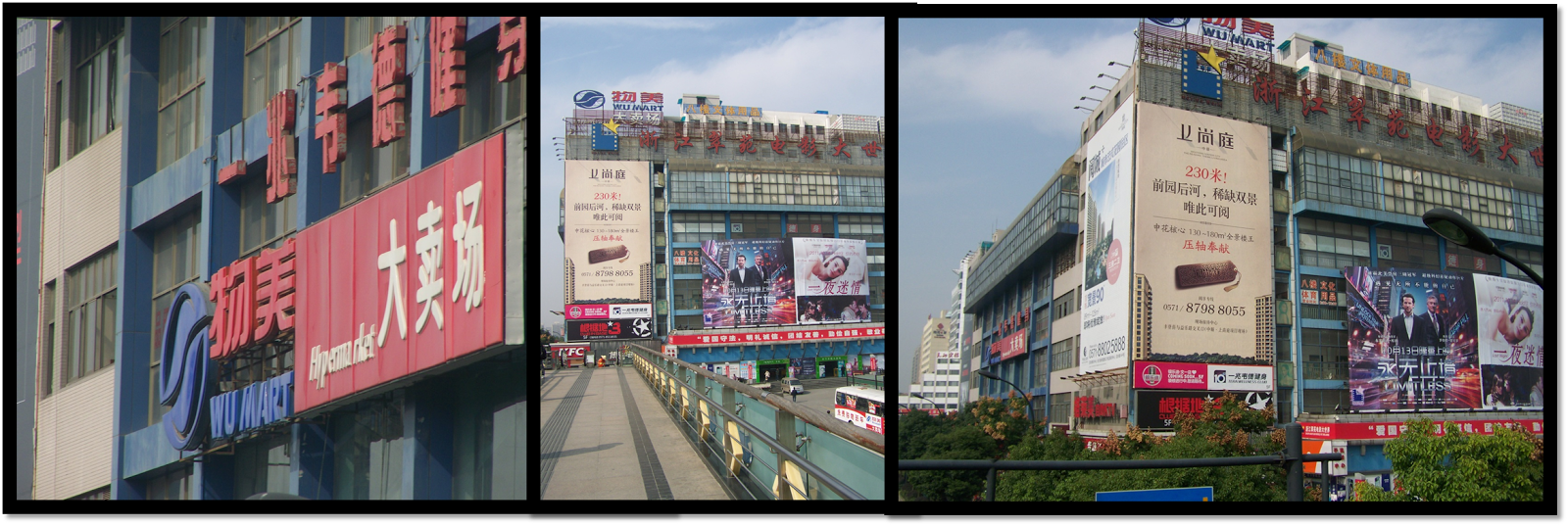
Yes that whole great monolith is Wumart!

I am choosing to talk about one of my favorite adventures while in China for two reasons.  One, because as of March 17th, we are coming up on the two year anniversary of this event.  I can't believe how fast time passes.  The second reason is that it correlates somewhat with my post about being foreign in China.

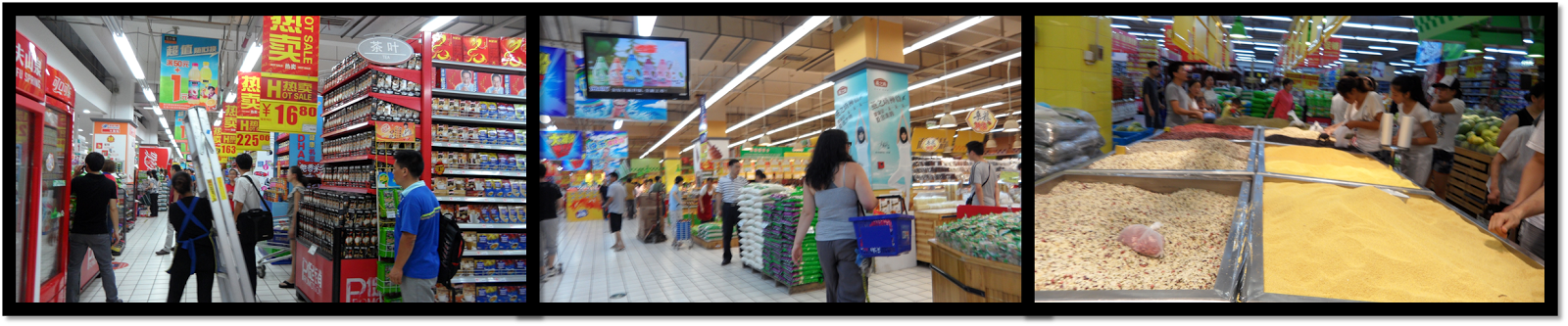
Before getting into exactly Wumart Challenge is, and how it came into being, I first want to talk about Wumart.  Wumart is a hypermarket, and no that is not just a pretentious new word for supermarket.  These places are monstrous--it is literally one-stop shopping.  The building that Wumart is in consists of eight separate floors, the actual Wumart taking up two full floors; we simply referred to the entire complex as Wumart.

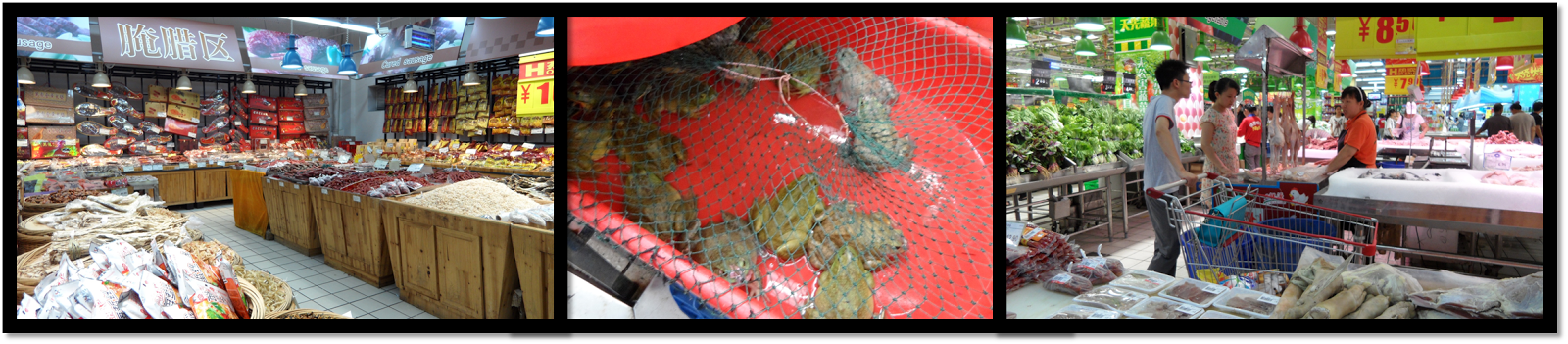
One floor (the second in the building) is entirely groceries--packaged goods, frozen goods, a butcher, fresh produce, bottled drinks, snacks and snacks and more snacks, bulk foods, an imports section, alcohol, etc.  The other floor (the third floor) consists of everything else you would need in your home--electronics, books, clothes, bedding, toys, cookware, appliances, bicycles, musical instruments, cleaning supplies, bathroom products, athletic equipment; the list goes on.  Now, you might not find a wide variety of different kinds of these products (for example, if I didn't like the only two styles of backpacking backpacks, I would have better luck at a store that specializes in out-doorsy stuff) but they will have some kind of product that will fit your needs.
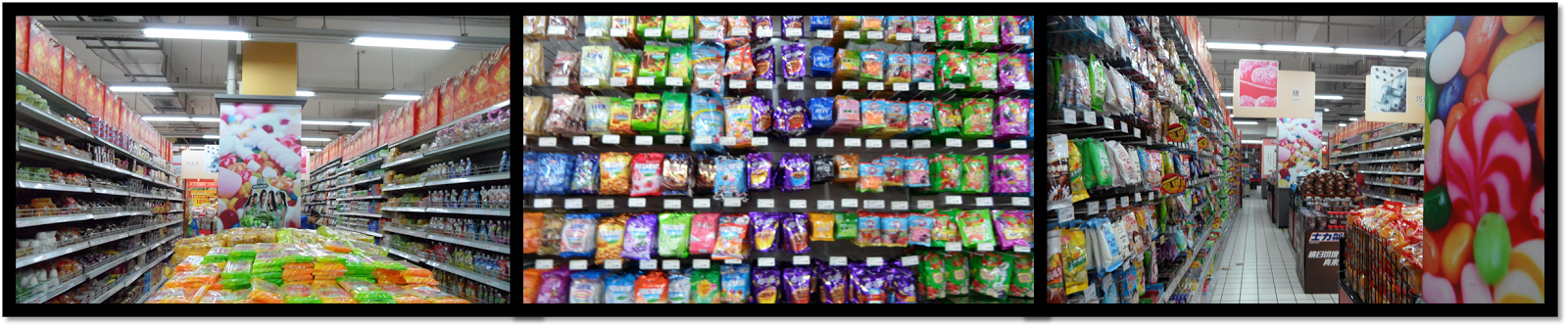
I swear I have never seen so many different kinds of Oreos, candy, or Lay's potato chips in my life. 
So. Much. Produce.
Yes, you could buy frogs.  To eat.  And a whole bunch of other fresh produce. 
As for the remainder of the building, the first floor contained small independent shops...almost like in a mall, along with a few restaurants.  The second and third floor, as I said, contained Wumart proper.  The fourth floor was a parking garage, the fifth floor contained a spa, a full gym, a night club, and a KTV club.  The sixth floor was a movie theater.  The 7th floor consisted of both a pool hall, an arcade, and internet gaming cafe.  The 8th and final floor consisted of what I can only compare to a flea market--they sold small office type supplies or specialty items (like if you wanted something printed or written on a scroll or you wanted to buy supplies for Chinese brush painting).   We worked out in the gym in this building, the KTV was our favorite KTV club, and if we didn't feel like going to one of the clubbing districts, we would go dance it out at this club, because it was so near our home.  As for the shopping--Wumart would pretty much have all the necessities.  We were in and out of this place, for some reason or another, all the time.

So now that you have some idea of what Wumart is (though no amount of description or pictures can really do the place justice), let me explain Wumart Challenge.  One day Olivia, while buying socks in the same building she had dinner and worked out in, had this thought, " wow--there's so much to do here--you could literally spend all day in this place."  Then she vocalized this thought to Dave and myself, saying, "Can you imagine spending, like, an entire 12 hours here? I think it'd be possible."   And thus a crazy vision was born.   Ideas for how to  spend 12 hours in Wumart began to fly:  Some sort of scavenger hunt? Different challenges?  What if we put participants into teams?  How can we use each floor? How much would something like this cost each team? Dates? Rules? Themes? COSTUMES?!?!

I am not sure what exactly caused this to turn from amusing walking-home-from-dinner conversation to an actual plan.  Maybe it was the novelty of the idea?  Maybe it was the organizational juices flowing in some very detail-oriented people?  Maybe it was March and we were bored?  Or maybe it was too good of an idea to pass up in a context that would allow us to do something like this-this goes back to being foreign in China.  I have no idea if, had this occurred to a group of Chinese students or teachers, it would have been tolerated.  But I think we were allowed to do this, and we were even able to conceive of doing this, was in part due to the particular freedoms we enjoyed as foreigners in China.  I am not sure we would have been able to pull something like this off in America without considerably more planning.  I mean, you get in trouble for taking pictures in Target in America, so I can't imagine what would have happened had we tried something similar here (you know, without being part of The Amazing Race or something equally as funded and publicized).

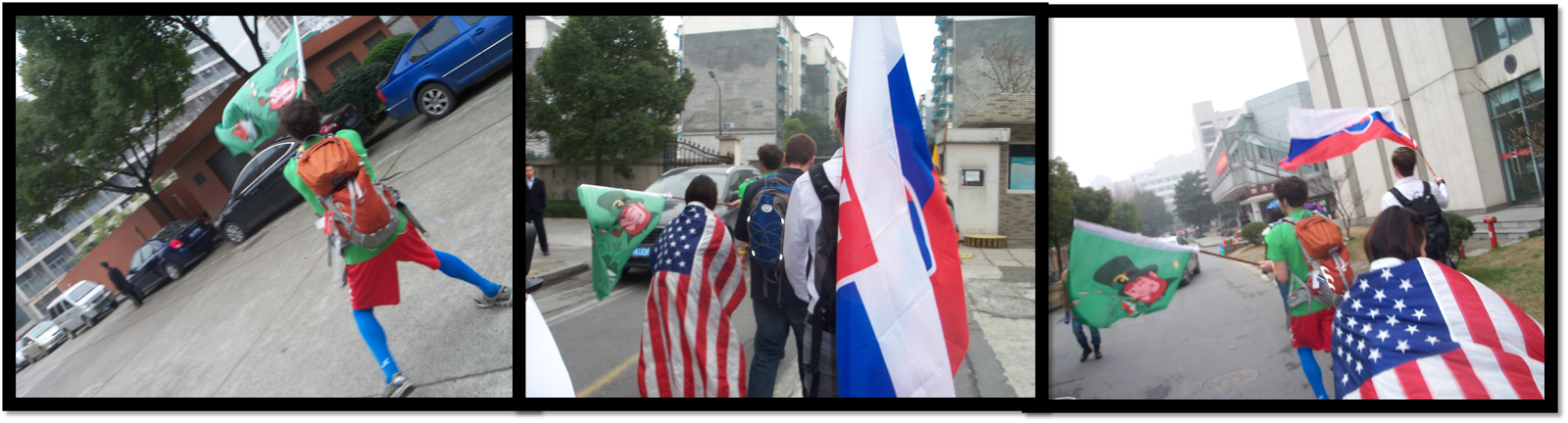
It was decided that Wumart Challenge would begin at 8:00am on Saturday, March 17th (it was coincidental that this fell on St. Patrick's day).  We would begin our day with a full breakfast (as Irish as we were able to make it, given our limited food diversity).  When registering, each team was told that it must have coordinating outfits (this could be as simple as same colored t-shirts to as complicated as costumes) and some kind of flag that represented their team.  Each person on each team would also need to bring with them about 250 yuan for various costs.
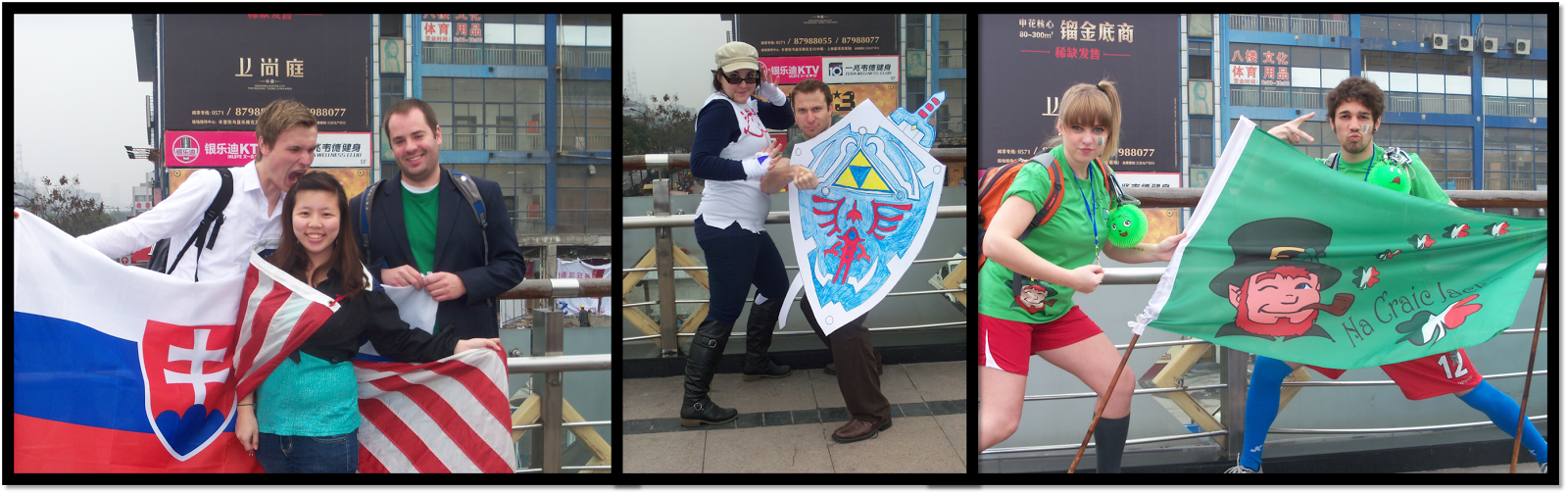
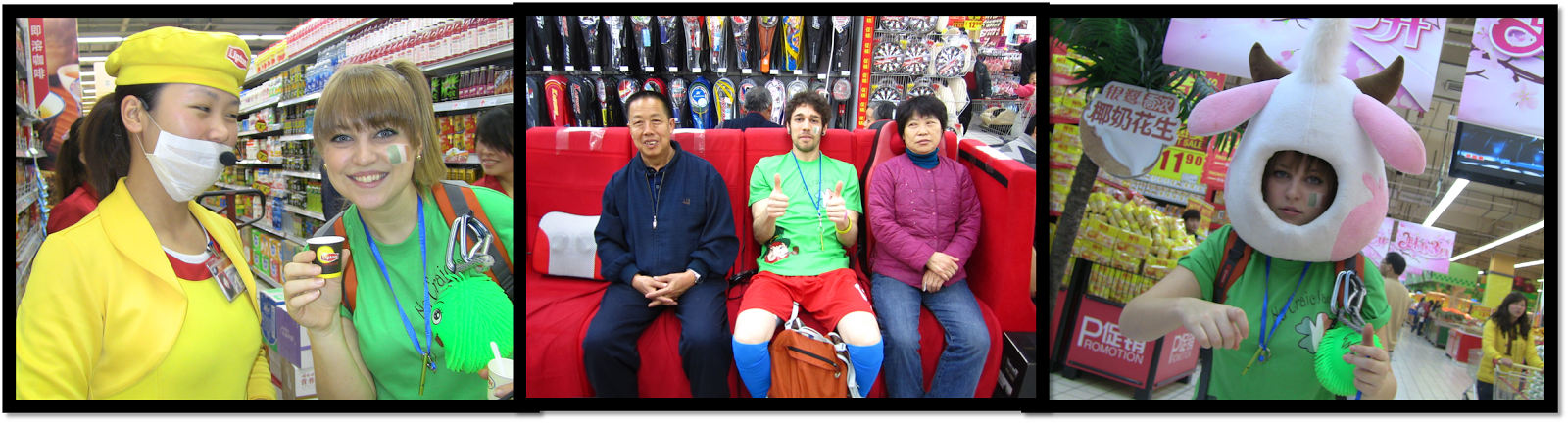
Maybe some of us took our coordinating outfits more seriously than others....

As we wanted as many people to participate as possible, Dave and I took over the planning of this event, so that no one team would have an advantage by knowing  the particulars about each challenge.   We also forfeited our right to compete in most of the challenges. We sent an email to all of the foreign teachers detailing the premise, cost, and requirements for competing in Wumart Challenge (again, without being too particular about what exactly they would be challenged to do).  We received a positive response from eight people, so we grouped them in four teams of two people per team.  We chose team mates randomly and sent an email back to everyone about two weeks before the event with the teams, giving people enough time to work on their coordinating outfits and flags.
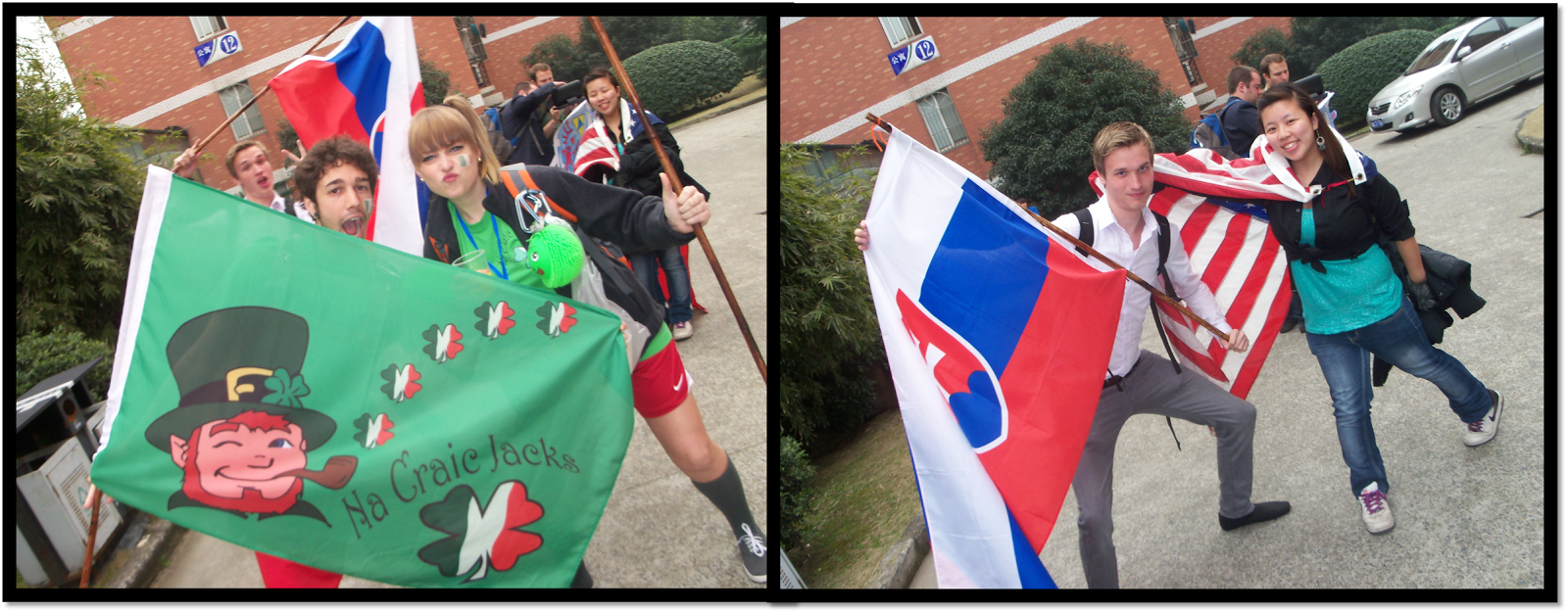

After our Irish Breakfast (which was mostly eggs, bacon, french toast, and a lot of orange juice with booze in it) we made the teams march in a parade (complete with music and flag waving) the 1/2 mile from our apartment complex to Wumart--much to the amusement of the general population.  We stopped for a pre-challenge photo-op on the pedestrian crossing bridge in front of Wumart and then headed in and up to the fifth floor (which has a huge empty space in the center, and was relatively quiet during the day) for Survivor-esq torch ceremony and directives.  Each team was given an envelope.   In the envelope was a schedule for the days events/challenges.  We explained that each task must be photographed/videoed for proof of completion, and that teams must arrive at designated locations at the proper times.
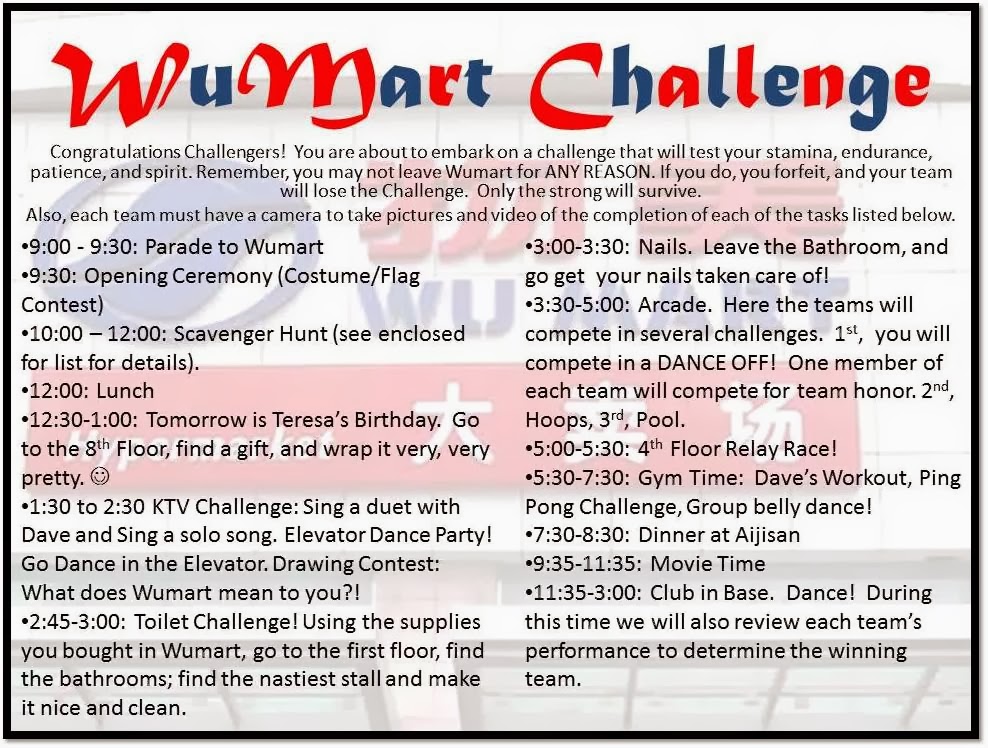
Wumart Challenge Schedule
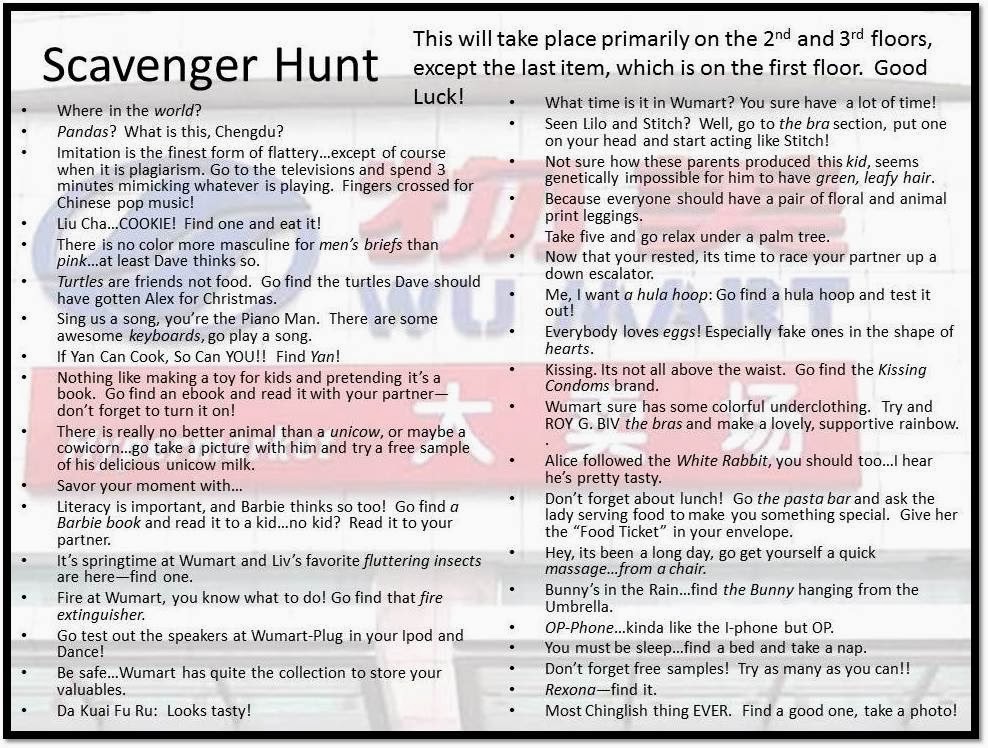
We then blew out our torches and the teams headed to the first task--The Scavenger Hunt.  This task took our players to the second and third floors of Wumart. They had to decipher the clues on the list and then locate (and photograph) these items.  Now, we had noticed that in China, things seem to move around and change a lot, so Dave and I did not actually make this scavenger hunt until the night before the event.  And we asked vendors if certain items would be present on the following day.

Torchlight ceremony (where are the torches you ask?  Well, they're tea lights sitting in tea cups in the daytime, so you can't see them at all) and Dave explaining some instructions and rules.
Scavenger Hunt Clues!
As you can see from the schedule above, we made them run all over the place  The idea was to try and get them to do some sort of activity on each floor.  Dave and I made a KTV room our home base--while teams were completing the scavenger hunt and birthday tasks, we hung out and sang.  The teams then met us here for lunch (which they were to bring back from Wumart's hot food vendors).  They were then asked to compete in solo and group songs, to be judged by myself and Dave.  We made them draw pictures of what Wumart meant to them (the results of this were hilarious).
Scavenger hunt photos from team Liv and Justin (top and bottom)
That is dedication. 
We made them clean squat toilets and get their nails done on the first floor, (Scavenger hunt on the second and third floors), a relay race in the parking garage on the 4th floor.  We made them sing with us in KTV and complete several work out/athletic challenges in the gym all on the fifth floor--we came back to this floor at the end of the night to dance in the night club.  We made them see a move (John Carter--I believe this was the only English movie playing at the time) in the movie theater on the 6th floor and compete in arcade games and a pool tournament on the 7th floor. We made them hunt up a birthday gift for a fellow teacher on the 8th floor, and bring it wrapped back to us--we would judge the best wrapped gift.  Basically we ran them all over the building.  And we stayed in Wumart from the time it opened its doors at 10am until they kicked us out at 3:00am, 17 hours later.
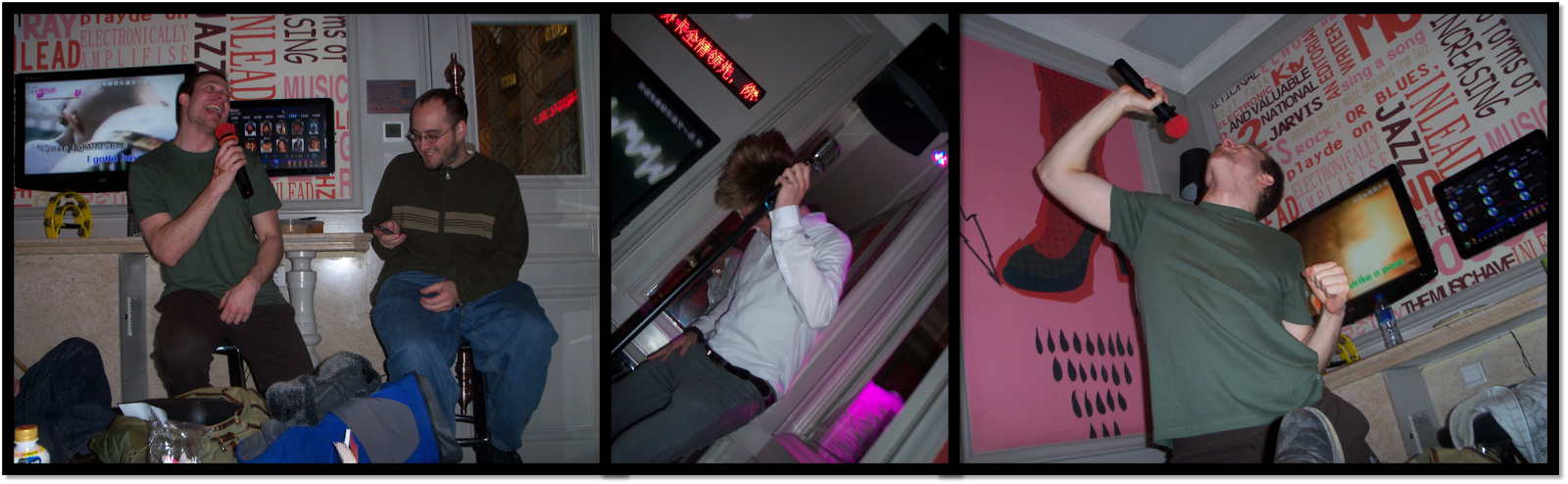
KTV Sing-Along
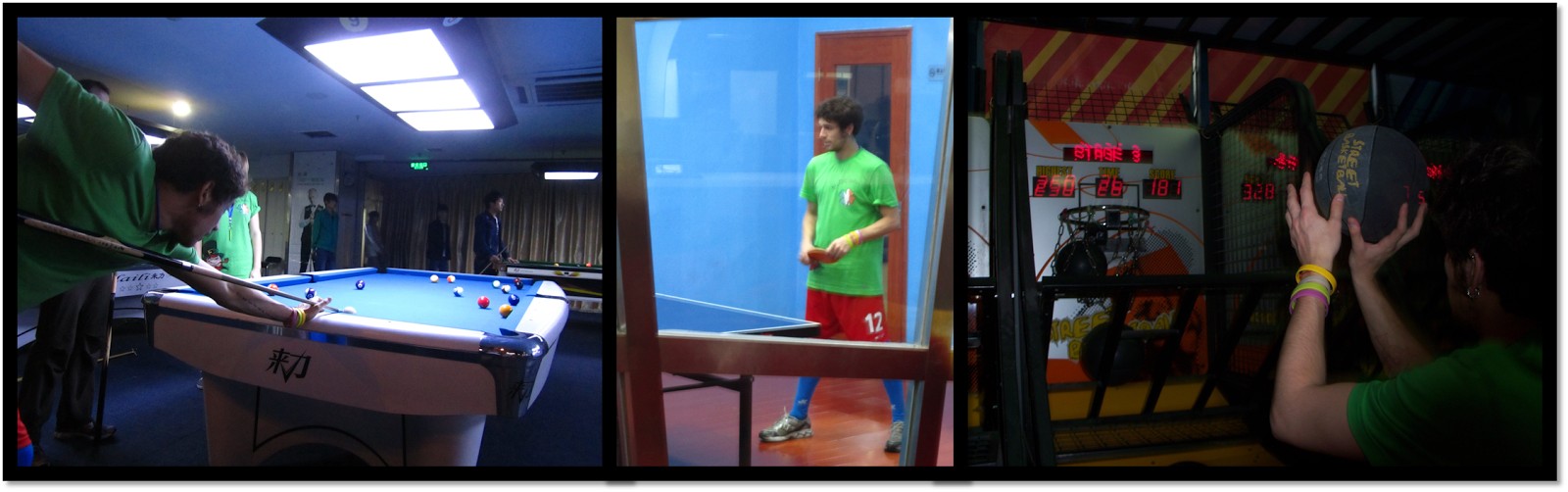
Billiards challenge (left), ping-pong challenge (center), and arcade games (right).
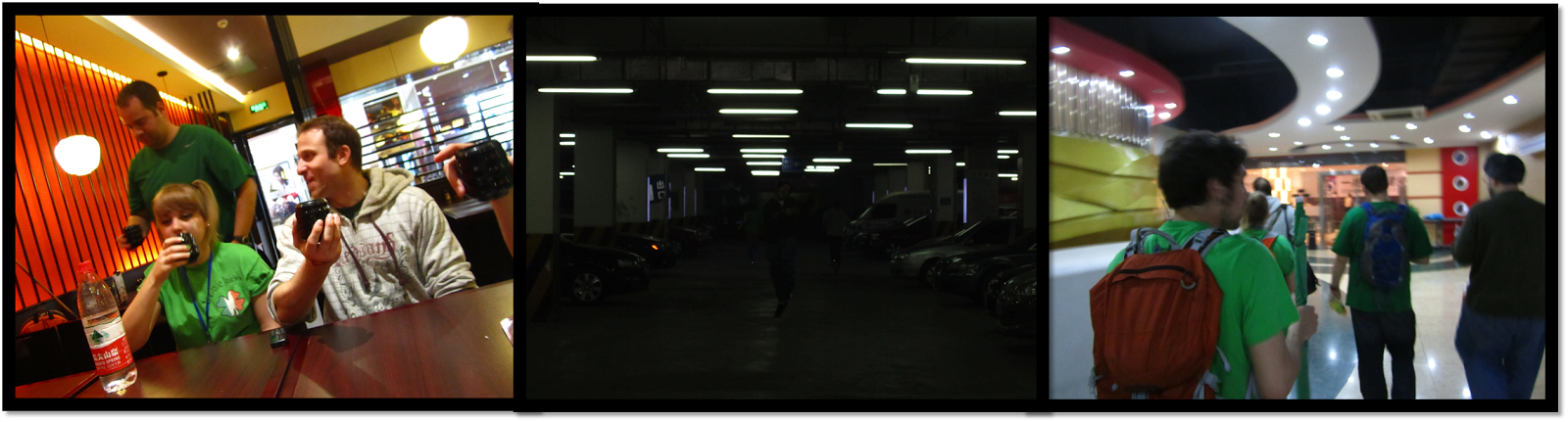
Time for refueling at Ajisan's (left), Parking Garage Relay Race (center), and heading into the gym to workout with Dave (right).  Below is a video of yet more embarrassing things we made them do--test out the speaker selection by dancing it out in the middle of he floor. 

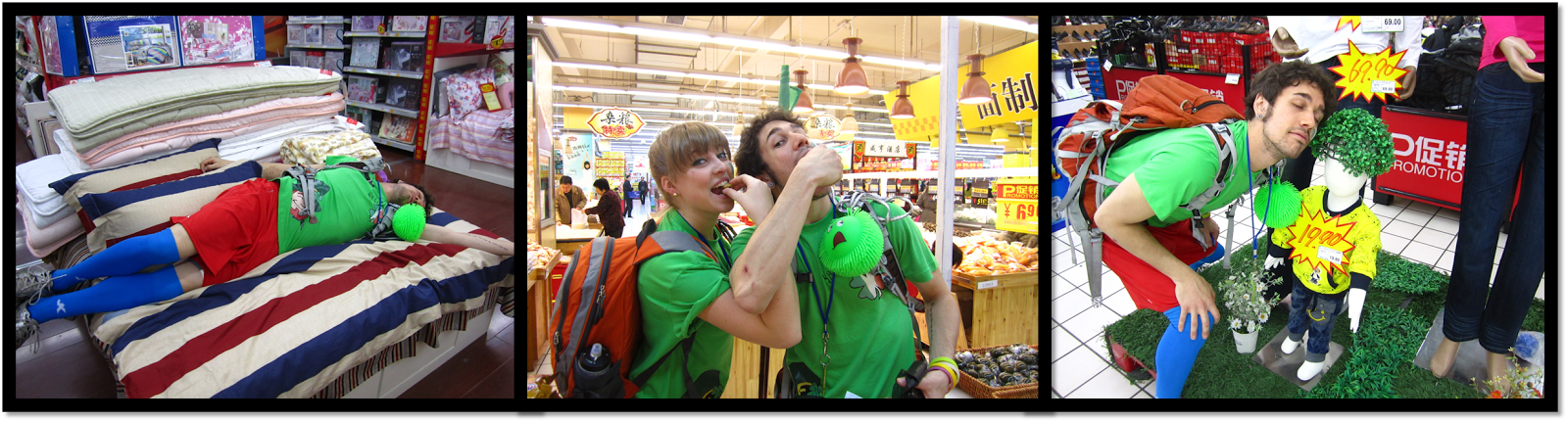
What started off as an off-hand (and brilliant) remark on the comprehensiveness of Wumart turned into a 17 hour adventure in ridiculousness.  The best part is that when were finished, not only did we have this great (if totally random) day filled with competitive absurdities, we all also knew all the nooks and crannies of Wumart.  We actually decided that Wumart Challenge might be a good thing to have brand-new teachers participate in when they arrive in Hangzhou.  But why just stop with Wumart?  Why not have them explore different parts of the city?  We never made this Hangzhou Challenge into a reality, partly due to the fact that we only had two new teachers the second year.
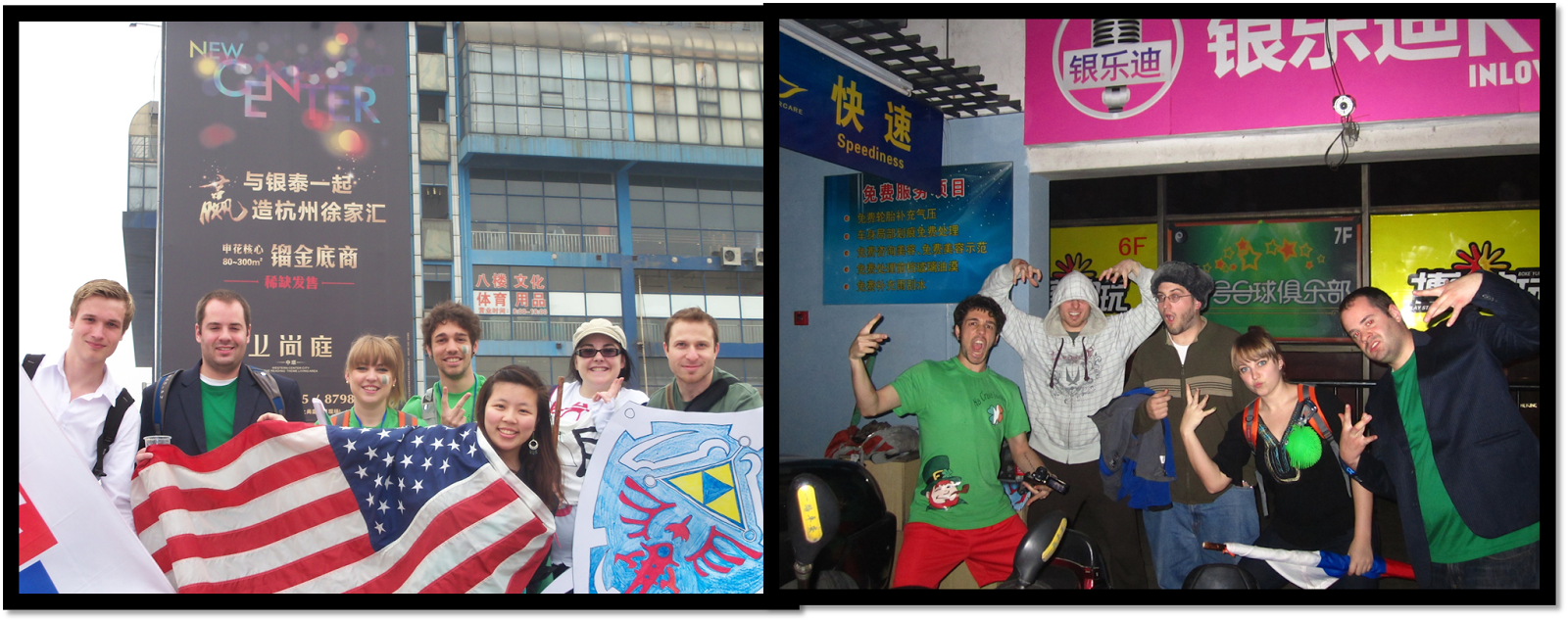
Wumart Challengers at 10 am (left)......and then at 3am, 17 hours later (right).
I think Wumart Challenge is a good example of why being foreign in China is such a unique and overall positive experience.  We would not have been able to do this in America (partly because we don't have a Wumart, and partly because it likely would not have been tolerated).  But when our contestants did meet with resistance in Wumart, they quickly explained what they were doing, and they received assistance and encouragement from Wumart employees.  So happy anniversary to all the participants in Wumart Challenge, the strangest competition in which I have ever been involved.

Also a huge thank you to all the employees in Wumart whose day we probably made just a tad more challenging by having all these over-enthusiastic foreigners running about, but remained so patient and nice about it.  I leave you with the video below; our 3am post-event euphoria/exhaustion.


Critical Thinking and Speaking--Argumentative Speeches


For the second part of this course, we worked on argumentative/persuasive speeches.  Now, we started learning how to write said speeches while we were still working on debates.  After that day's group had their turn debating, we would spend at least 25-30 minutes learning or working on another step in the argumentative speech writing process.

It is very important that you teach formal essay writing of any kind quite explicitly to Chinese students (or really, to any student).  We take for granted that logic and formal writing styles are the same everywhere, but they are not.  Chinese logic tends to be circular, hovering around the central idea without ever really discussing it directly.  It's almost like they want the audience to draw their own conclusions based on the evidence they are giving them.  They put a lot more weight on assumptions, and rely heavily on the audience to make the correct assumptions; it's considerably more abstract. Western logic is much more linear and direct--this happened, for this reason, because evidence evidence evidence! Western logic typically lets the audience know exactly the opinion they are defending and then backs up that opinion with sequential evidence.  Sometimes Chinese students will feel that you are insulting the intelligence of the audience by being quite so explicit in your argument (instead of trusting the audience to make the correct assumptions); thus if you want your students to write in a western fashion, you have to explicitly teach this style of writing.  Because this style of argumentative writing is not universal and needs to be taught--some teachers get frustrated by their students writing because they are subconsciously expecting university students to have some academic writing prowess.  And they do!  They just don't have the same prowess in the same style of writing as many of their foreign teachers.  I have watched this lack of explicit teaching drive foreign teachers into fits of frustration, which they then take out on their students--with less engaging lessons and punishing grades.

So we broke this argumentative writing down part by part.  We started with the introduction, and broke that down even further into hook, expansion, and thesis.   I taught them what a hook was and why it is a compelling way to start an argument.  I had a lot of help with lessons for this as both Liv and Dave had taught several courses of academic writing by the time I taught this class.  We played around with crafting different hooks for our different controversial topics.  I would write a topic on the board, and we would generate possible hooks for an introductory paragraph of an argumentative speech on this topic.  We then talked about expanding on the idea you were going to be writing about.  We would briefly explain the issue (pros and cons) in two to three sentences and then state our thesis.

The thesis is the hardest concept I found for my students to understand.  It seems to be in contrast to the Chinese style of writing.  My students would ask me: "Why are we telling them what we are going to tell them about right now, in the beginning?  Why not wait and explain each point in each paragraph?"  I am not going to lie, I did not really have a compelling answer, other than keeping ourselves clear for an audience, and that clarity enhances the power of an argumentative speech.  I told them the thesis has to contain the major talking points of your argument.  So, for example, if you are going to write an essay on why the One Child Policy is bad, you could say something like this, "The One Child Policy negatively impacts development in China because it places too many burdens on children, increases the chances for female infanticide, and does not significantly decrease the growth of Chinese population."


After several classes on introduction and thesis, we moved on to the body paragraphs.  Here, I explained that each paragraph needs to begin with a topic sentence.  This topic sentence should address only one of your argumentative points.  I made comparisons to their debates; a body paragraph is like a written version of one of your claims in your debate.  You need to state the claim in the first (or topic) sentence.  For example, if we used the example from the thesis above, the topic sentence for the first body paragraph might be "The One Child Policy negatively impacts development in China because it places too many burdens on children."  You then need to follow it up with 'hard' evidence, anecdotal evidence, persuasive language.  You also need to acknowledge the other side of the argument, briefly, but remind the audience why (with facts) your claim is more valid. 

My biggest challenge with the body paragraph was getting students to use the 'hard' evidence; these are facts or statistics taken from other sources.  My students seemed more prone to using personal or anecdotal evidence.  I explained that this evidence was fine, but you need the hard evidence as well.  I think this also has to do with the Chinese style of writing; providing these anecdotal examples and allowing the audience to assume correctly the right side of an argument.  I made them compel the audience in no uncertain terms that the argument they were defending was the 'correct' one by making them use hard facts and evidence. I also had a problem with plagiarism.  We discussed citations in class and how to use them, but I still had several students hand me speeches without citations.   This is in part due to the fact that citations are a pain in the ass, no matter where you are teaching.  Additionally, however, plagiarism does not carry the same level of horror in China as it does in the States.  Thus, it took me a while to impress upon them the gravity of stealing someones intellectual property.  However, we eventually got the hang of citations (and I was less worried about them being in strict accordance with APA/MLA/Chicago, and more just pleased that they noted an author or the name of a  website/periodical--small steps!).

We then briefly discussed the conclusion. I  told them they did not need to restate any hard evidence here, merely restate the problem, their claims (in their thesis) and told them to end on a strong and persuasive note.  Here might be a good place for one last anecdote that will swing the audiences opinion in your favor. 

With the speaking practice coming in from the debates, and the writing taking up the majority of our remaining class time, by the end of the semester, I would say about 20 out of the 24 students in my class wrote and delivered excellent argumentative speeches.   They followed the linear format, used wonderful evidence/examples, and had developed their argumentative skills.  We also improved our critical thinking by examining critical issues (that they self-selected*) from multiple view-points.  I would say for those four who did not excel in this area were the result of not particularly enjoying public speaking, being new to the major (switched to English majors from other majors--they did well, but they started behind their classmates and struggled a bit with this task), or in one case just refused to listen to advice and constructive criticism from both teachers and classmates.

I sincerely wish I had video of their final exams, as they all did a wonderful job on their speeches.  However, the flash drive in which I had their speeches saved to is completely dead.  Even those student who struggled in this course showed improvement in their speeches (both in their Oral English and in their ability to write and deliver a persuasive speech).  One of our first assignments of this course was for them to write an short essay telling me why a certain location (typically their hometown) was a great (or bad) place to visit.  These initial argumentative essays pale in comparison to the paragons of persuasion they were able to write, develop, and deliver by the end of the course.


My Argumentative Orators on our final day of class.  Miss these ladies. 

*Self selection is important, always, but in particular with something like this.  If you are going to ask students to research a topic, choose a side, and ask them to defend that side, you need to make sure these are issues they care about.  So even if you know of several fascinating world issues, if they are not relevant to your students, they are not going to care too much about forming an opinion about them.  Thus, my students selected the topics they wanted to research, and had them approved by me--I only said no to issues that did not really have a compelling counterargument...I think I maybe refused two requests?  Thus, in addition to issues such as global warming and the One Child Policy, students also selected issues such as students dating in college, using reality television to find a spouse, colleges requiring morning exercise.